

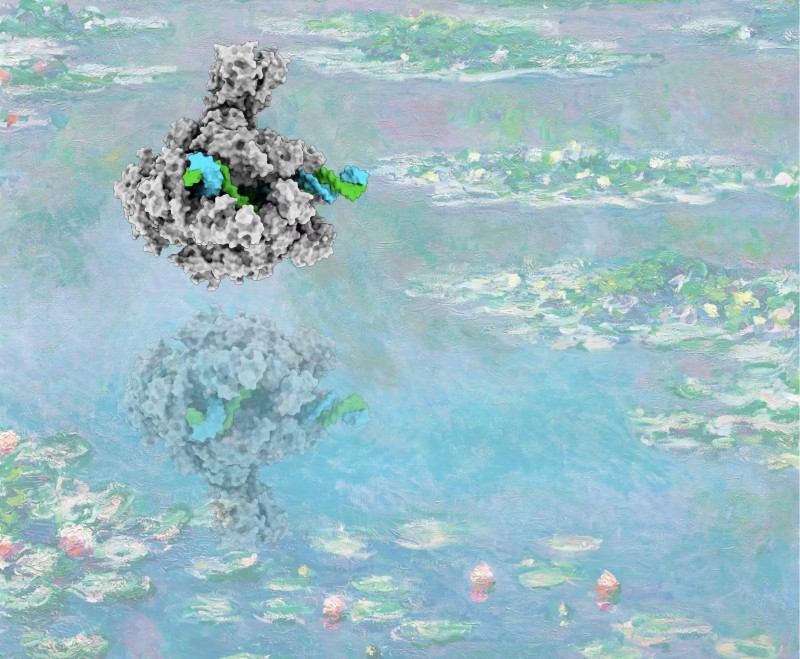
Inside every cell in your body, right now, a molecular machine is threading its way along a strand of DNA and reading it. The enzyme is called RNA polymerase II, and it is perhaps the most consequential piece of biological machinery evolution has ever produced: without it, none of your genes get expressed, no proteins get made, nothing works. Scientists have known this for decades. What they have never quite managed to pin down is exactly how the chemistry happens at the level of individual atoms. Now a team at UC San Diego, working with colleagues at Oxford, has done it, and the answer contains a genuinely unexpected ingredient: water.
Not water as a solvent, passively filling space. Water as an active participant. Water as, in a real sense, part of the machine itself.
The resolution that made this possible is almost difficult to process. The cryo-electron microscopy structures the team produced reached below 2 angstroms, which puts them at finer detail than the width of a single atom. At that scale, you can see individual water molecules frozen in their positions inside the enzyme, and you can see what they are touching. The researchers identified over 1,350 ordered water molecules in their highest-resolution structure, many of them clustered at precisely the sites where the chemistry of RNA synthesis actually occurs. These were not stray solvent molecules rattling around by chance. They were positioned too specifically, with residence times in molecular dynamics simulations running from 100 to 10,000 picoseconds (for comparison, bulk water molecules spend about 3 picoseconds in any given location before moving on). The water molecules at these critical sites were staying put, held in place, doing something.
A Reaction Nobody Fully Understood
The basic chemistry of transcription involves adding nucleotides, one at a time, to a growing RNA strand. Each addition requires a nucleophilic attack on the incoming building block, which in turn requires a proton to be stripped from the RNA primer before the attack can proceed, and a proton to be donated to the byproduct afterward. It is a two-step chemical sequence, and for about 25 years researchers have argued over which parts of the enzyme do which jobs. One candidate for proton donor, a residue called His1085 on the trigger loop, seemed obvious because it sits right next to the relevant bond. But mutations that eliminated His1085 often still allowed transcription to continue, which suggested something else was also capable of stepping in.
Two water molecules, W3 and W4 in the team’s numbering, turn out to provide the answer. They sit in geometrically ideal positions to donate protons during the reaction, effectively providing a parallel and redundant pathway alongside whatever His1085 is doing. A third water molecule, W0, does the opposite job: it coordinates with one of the magnesium ions at the active site and appears to abstract a proton from the RNA primer, lowering the energy barrier for the nucleophilic attack to occur. That proton then gets passed along a chain of three water molecules (W0, W5, W9) and dispersed into the surrounding solvent. A proton relay, running entirely through water, right in the middle of the enzyme’s active site.
This kind of mechanism is not without precedent in chemistry generally. But seeing it operating inside an enzyme like RNA polymerase II, at this resolution, changes the conceptual picture considerably. The protein-centered view of transcription, where the enzyme is understood as a machine made of protein parts that act on nucleic acid substrates, turns out to be incomplete in a fairly fundamental way. The water molecules are not auxiliary. They are integral.
The Trigger Loop Problem
The other revelation concerns a mobile structural element called the trigger loop, which folds into a closed conformation when the correct nucleotide substrate binds to the active site, and unfolds again after each addition. The folded trigger loop was already understood to be essential for positioning the incoming substrate correctly. What the new structures reveal is that the trigger loop does not do this alone. More than 50 water molecules form hydrogen-bonded networks bridging the trigger loop to surrounding structural domains, including regions that previous protein-centered models had essentially written off as irrelevant to the process. When the trigger loop folds, it carries an entire water network with it. When it unfolds after catalysis, that water network dissolves, and a different set of waters moves in.
The team captured snapshots of the enzyme in both states, before and after a nucleotide addition, and compared the water distributions. About 92 percent of the water molecules occupied the same positions in both structures, which speaks to their structural role as architectural scaffolding. The remaining 8 percent, concentrated at the active site, show the dynamic rearrangement that accompanies catalysis. Twenty-eight water molecules disappear between the pre- and post-catalytic states. One new one appears, coordinating with a magnesium ion to fill a position previously occupied by part of the substrate.
There is an additional finding that perhaps carries the broadest implications. When the team compared their water map with equivalent data from E. coli RNA polymerase, a prokaryotic enzyme separated from the yeast enzyme used in this study by roughly two billion years of evolution, they found more than 230 positional matches. The water molecules involved in proton transfer, in particular, are strictly conserved. This is not coincidence. Evolution does not preserve things by accident, and the fact that these same water positions have been maintained across the entire domain of life suggests they were already in place before eukaryotes diverged from bacteria. The waters are not passengers that happen to be present. They are part of the machine’s original architecture.
Beyond Transcription
The researchers propose that some of these water molecules also act as molecular lubricants, specifically at the interface between the enzyme and the nucleic acid scaffold it moves along. Displacing water from a surface requires less energy than breaking a direct protein-DNA contact, which could help explain how RNA polymerase manages to translocate smoothly along DNA without stalling. If that mechanism generalizes, it might say something interesting about a whole class of motor proteins and nucleic acid processing enzymes that face the same basic problem: how to grip tightly enough to work, but loosely enough to move.
For drug development, the implications are worth thinking about carefully. Most small molecules that target transcription do so by binding to protein sites. If water networks at the active site are functionally essential and evolutionarily conserved, they represent a class of target that has been almost entirely overlooked. Whether water-displacing or water-mimicking compounds could interfere with transcription in ways that conventional inhibitors cannot is an open question, but it is now at least a well-posed one. The structures are published, the water positions are mapped, and the machinery, in its actual complexity, is finally visible.
The study was published on April 30, 2026, in Molecular Cell. DOI: 10.1016/j.molcel.2026.04.015
Frequently Asked Questions
Why does it matter that water molecules are “active” in transcription rather than just passive background fluid?
The distinction shapes how scientists think about the entire process. If water is passive, understanding transcription means mapping the protein machinery. If water is an active participant, then models, drug targets, and disease explanations that ignore water positions are missing a structurally critical layer. This study suggests that some longstanding puzzles, including why certain mutations to key residues don’t stop transcription as expected, have water-mediated workarounds that were invisible until now.
Could the water molecules in this enzyme be targeted by drugs?
Possibly, though nobody has done it for RNA polymerase II. The discovery that specific water positions are conserved across billions of years of evolution suggests they are functionally indispensable, which is exactly the property you want in a drug target. Whether small molecules can be designed to displace or mimic those waters without interfering with normal cellular function is an engineering challenge, but the structural maps to attempt it now exist.
How is it possible to image individual water molecules inside a protein?
Cryo-electron microscopy at resolutions below about 2.5 angstroms begins to resolve the electron density of individual atoms. The team achieved 1.96 angstroms in their best structure, and then used residence-time analysis from molecular dynamics simulations to confirm that the water molecules they saw were genuinely stable positions rather than noise. Cross-validation against two independent half-maps provided further confidence. It required both a technical advance in how the samples were prepared and a substantial increase in raw imaging resolution compared with earlier structures of this enzyme.
Is this how all RNA polymerases work, or is it specific to the human version?
The enzyme used in this study was from yeast rather than humans, but yeast RNA polymerase II is closely related to the human version and has long been the standard model for this class of enzyme. More striking is the comparison with E. coli RNA polymerase, which is far more distantly related, yet shares over 230 of the same water positions. The conservation of the proton-transfer water chain between bacteria and eukaryotes suggests the mechanism predates the divergence of these domains of life, meaning it almost certainly operates in the human enzyme as well.