

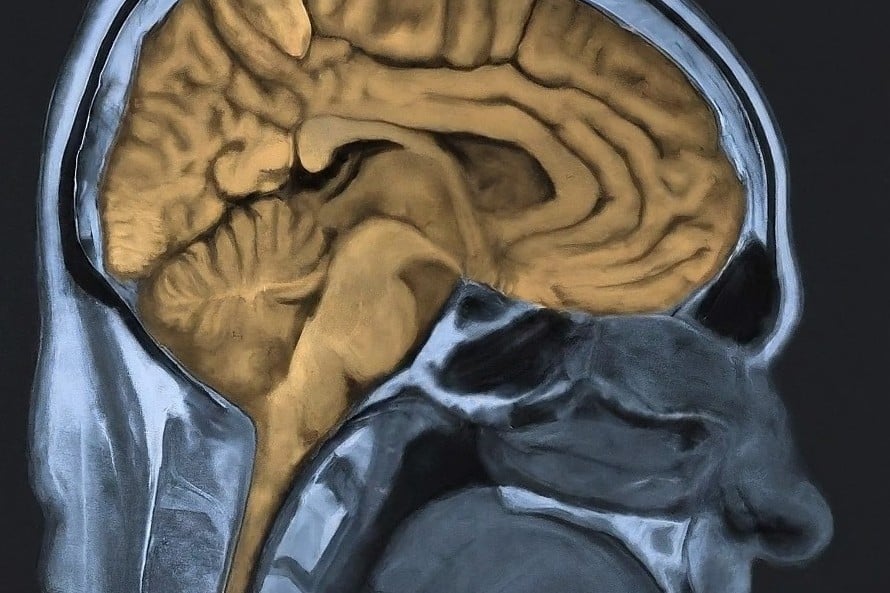
A small shift in theory can sometimes make a machine see more clearly. Researchers at Rice University and Oak Ridge National Laboratory now suggest that by rethinking how water molecules move around MRI contrast agents, sharper scans and safer diagnostics may come within reach. Their new physics based model, published in The Journal of Chemical Physics, offers a microscopic account of magnetic resonance relaxation that earlier approximations could only gesture toward.
The work centers on a deceptively simple promise: if you can understand how a contrast agent perturbs the motion of surrounding water molecules, you can predict, and eventually control, how bright or dark tissue appears in an MRI. The team’s framework, called the NMR eigenmodes approach, solves the full Fokker Planck equation rather than carving away complexity for convenience. That choice, though technical, feels like a philosophical turn, a decision to let the mathematics carry its full weight.
A Theory That Refuses to Look Away
Contrast agents are built around metal ions, often gadolinium encased in an organic shell, and their power comes from how they coax nearby water molecules to relax differently under a magnetic field. Previous models simplified this dance, smoothing over the jagged, jittery motions that govern the final MRI signal. The Rice and Oak Ridge team instead embraced the disorder, treating molecular motion as something to be resolved rather than averaged away.
“By better modeling the physics of nuclear magnetic resonance relaxation in liquids, we gain a tool that does not just predict but also explains the phenomenon,” said Walter Chapman, the William W. Akers Professor of Chemical and Biomolecular Engineering. “That is crucial when lives and technologies depend on accurate scientific understanding.”
The eigenmodes picture identifies the natural modes of motion that water molecules adopt as they respond to a contrast agent. It is a little like discovering the notes that make a chord shimmer. Each mode contributes its own frequency, its own weight, its own signature in the relaxation process. When you line them up, a richer and more granular picture of molecular behavior emerges.
A Musical Metaphor for Molecular Motion
Part of the appeal of the new approach is that it does not discard the intuitive imagery that often helps scientists and physicians think through problems. One member of the team reached for a musician’s vocabulary to capture what the model can now resolve.
“The concept is similar to how a musical chord consists of many notes,” said Thiago Pinheiro, the study’s first author, a Rice doctoral graduate and postdoctoral researcher at Oak Ridge. “Previous models only captured one or two notes, while ours picks up the full harmony.”
You sense the relief in that framing. Instead of pretending the chord is simple, the model listens closely, pulls apart the frequencies, and then rebuilds the sound. The supplemental material, with its dense grids of eigenfunctions and relaxation spectra, shows how the theory tracks experimental measurements across a broad range of MRI frequencies. The match is striking, especially for systems where existing models struggle, such as complex gadolinium based agents.
Other pieces fall into place. The framework can separate the contributions of inner shell and outer shell water molecules, clarifying how each layer participates in the signal. It reproduces the expected power law tails for free diffusion that longstanding theories predict. And it does this while remaining flexible enough to incorporate interaction potentials, confinement, and molecular dynamics simulations without collapsing under its own ambition.
Beyond the MRI Suite
The authors also point to broader terrain. Because nuclear magnetic resonance is not confined to hospitals, the theory could influence studies of battery electrolytes, porous rocks, or cellular interiors. In each case, the challenge is the same, to capture the messy physics of liquids in motion and convert it into something measurable.
Philip Singer, an assistant research professor at Rice, put it plainly in the release. Detailed modeling, he said, can connect the molecular scale to the macroscopic effects engineers and scientists measure. And the team has made the code openly available, inviting others to extend or adapt the approach to their own problems.
You feel the quiet confidence in this work, the sense that a careful recalibration of theory can, in time, sharpen the images patients and clinicians rely on. The promise is neither flashy nor overblown. It’s simply a better way of listening to what water is already telling us.
Journal: The Journal of Chemical Physics