

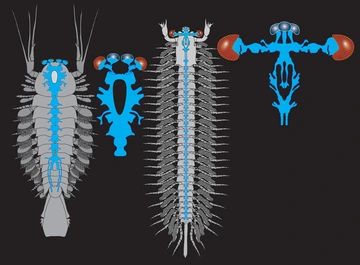
The brain is only two millimeters wide. In a Nature Communications study published August 28, 2025, a team led by Nicholas Strausfeld at the University of Arizona reports that Jianfengia multisegmentalis, a tiny Cambrian fossil from China’s Chengjiang biota, carried a crustacean-like brain that helps resolve a long standing question in arthropod evolution.
The neural traces place Jianfengia with the mandibulates, the branch that includes insects and crustaceans, rather than with the chelicerates once suggested by its claw-like head appendages. A fossil so small turns out to mark a very large divide.
What A Two Millimeter Brain Can Tell Us About Arthropod Evolution
Jianfengia is small enough that its head, carapace and eyestalks can disappear into a fingertip’s shadow. Yet the fossil preserves rare neural traces. The team analyzed several exquisitely preserved specimens from Yunnan, mapping the darkest mineralized residues within the head and aligning features across mirror symmetric envelopes to reconstruct the cerebrum. Under white light and ultraviolet, the eyestalks reveal hexagonally packed ommatidia. In a few facets where surface lenses are missing, the authors even discern substructures they interpret as cone building cells. All of it sits beneath a shell like head shield, with stalked compound eyes lateral to the midline and a trio of simple rostral ocelli toward the front.
The neuroanatomy is the key. Jianfengia shows three nested optic neuropils within each eyestalk, plus nerves from the frontal ocelli feeding a discrete forebrain region. The circum esophageal cords and synganglion align with branchiopod and malacostracan patterns known from living crustaceans. In short, the wiring diagram looks pancrustacean. The surprise is that Jianfengia also has the famous grasping “great appendages” of the megacheirans, which for decades were taken as evidence of a chelicerate link. The brain and the claws tell different stories. The brain wins.
“These and other neuroanatomical traits provide a powerful tool for resolving euarthropod relationships.” Nature Communications
A Fork In The Tree, Seen From Half A Billion Years Away
Arthropods split early into two vast branches, mandibulates and chelicerates. For decades, paleontologists debated which side certain Cambrian forms should occupy. Jianfengia complicates the old picture by wearing chelicerate like “hands” on a crustacean like head. The authors argue that the great appendage condition is not a chelicerate exclusive, but part of an earlier stem state from which both major branches diverged. Their phylogenetic trees, built from 120 mostly neural characters across extant and fossil taxa, repeatedly resolve Jianfengia as sister to total Mandibulata, while short bodied megacheirans such as Leanchoilia and Alalcomenaeus sit as sisters to total Chelicerata. The fork is clearer when you follow neurons rather than exoskeletons.
Microscopes, Granules, And A Careful Reconstruction
The study leans on exacting technique. The team used Nikon and Leica photomicroscopy, mixed UV and white light, and image processing to isolate the darkest granular deposits that trace neuropil outlines. They countered taphonomic tilt by flipping and registering left right features around the esophageal foramen. Two independent pipelines, one manual tracing and one intensity thresholding with Gaussian blur, converged on the same architecture. The eyestalk neuropils align with those of crayfish and other malacostracans. The circum esophageal organization mirrors branchiopod brains such as Triops and Artemia. Skeptics may wonder whether this is over interpretation of blotches in rock. The redundancy of methods, plus the match to living circuitry, makes the case more persuasive.
“As occur in pancrustaceans, three nested optic neuropils are resolved in the eyestalks of Jianfengia, together with rostral ocelli and their associated nerves supplying a discrete forebrain region.” Nature Communications
Why It Matters, Beyond The Fossil Slab
There is a human stake, even here. We build our evolutionary charts to explain how complexity arises and persists, and arthropods are the planet’s great success story. If neural organization carries robust signals of ancestry, then the brain becomes a durable archive when the skeleton misleads. That means future arguments about deep splits in the tree might be settled by circuitry, not claws. The authors even suggest a living echo of the transition, pointing to ostracods whose antennules end in claspers. The great appendage, it seems, was not lost so much as repurposed. A tiny brain points the way, again.
Micro Explainer: What Is A Great Appendage, And Why The Fuss?
Megacheirans are Cambrian arthropods with prominent grasping head appendages, often called great appendages. For years, these pincer like structures were treated as precursors of chelicerate fangs, pulling megacheirans toward the spider horseshoe crab branch. Jianfengia complicates that narrative. Its brain looks pancrustacean, with stalked compound eyes feeding three optic neuropils and frontal ocelli wiring into the forebrain, while its appendages still resemble megacheiran claws. The study’s phylogenetic analysis, using 120 mostly neural traits, places Jianfengia as sister to total Mandibulata. The conclusion is that the great appendage likely represents an early stem state that could be modified into antennules in mandibulates or into chelae and fangs in chelicerates. Same starting part, different evolutionary destination.
Journal: Nature Communications