
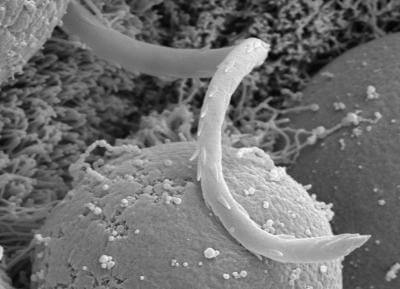
A genomic investigation by University of British Columbia researchers has revealed that a lethal parasite infecting a wide range of insects actually originated from pond scum, but has completely shed its green past on its evolutionary journey.
A team led by UBC Botany Prof. Patrick Keeling sequenced the genome of Helicosporidium – an intracellular parasite that can kill juvenile blackflies, caterpillars, beetles and mosquitoes – and found it evolved from algae like another notorious pathogen: malaria.
Keeling and colleagues had previously reported that malaria shared a common evolutionary lineage with the algae responsible for toxic red tides. Their latest study, published today in the online journal PLOS Genetics, shows that Helicosporidium evolved from green alga but, unlike malaria, preserved virtually all its genes except those required for photosynthesis.
“Both malaria and Helicosporidium started out as alga and ended up as intracellular parasites preying on animals, but they have done it in very different ways,” says Keeling, director of the Centre for Microbial Diversity and Evolution at UBC and a Senior Fellow of Canadian Institute for Advanced Research.
“Malaria drastically reduced its genome and became very dependent on its host for nutrients. Helicosporidium, on the other hand, lost almost nothing except those genes required for photosynthesis, which it no longer needs as a parasite.
“It’s as if photosynthesis has been surgically removed from its genome.”
The discovery, done in collaboration with scientists at the Universities of Rhode Island and Florida, will allow researchers to compare how parasites evolve at the molecular level in these two distantly related lineages. It also provides the first insights into their origins, development as well as methods of infection, which are key to controlling the population of pest-insect hosts.
ScienceBlog.com has no paywalls, no sponsored content, and no agenda beyond getting the science right. Every story here is written to inform, not to impress an advertiser or push a point of view.
Good science journalism takes time — reading the papers, checking the claims, finding researchers who can put findings in context. We do that work because we think it matters.
If you find this site useful, consider supporting it with a donation. Even a few dollars a month helps keep the coverage independent and free for everyone.
What could be a possible cause for this form of evolution? (producer to consumer)