

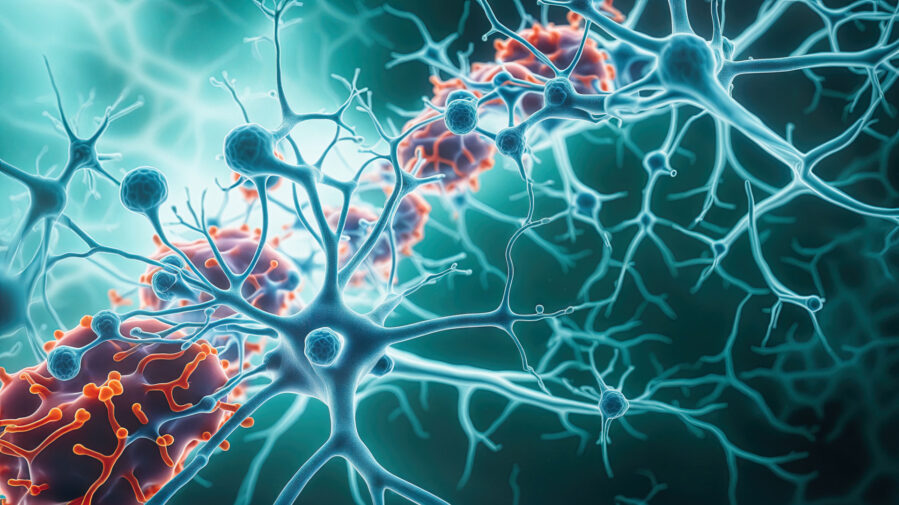
Tau tangles have long been treated as cellular garbage, the unmistakable debris of a brain in decline. Pathologists find them packed inside dying neurons, and for decades the interpretation seemed obvious: these clumps of misfolded protein were killing brain cells. A study published in Nature Neuroscience suggests the truth is stranger. Those tangles may have started as a weapon against infection.
Researchers at Mass General Brigham exposed human neuron cultures to herpes simplex virus 1, a common pathogen that can invade the brain. The neurons responded immediately. Tau protein underwent rapid chemical modification, a process called hyperphosphorylation, then began clumping together. But rather than simply gumming up the cellular machinery, the altered tau bound directly to viral particles and blocked the infection from spreading.
The finding reframes one of neurology’s most familiar villains. Tau isn’t just a structural protein that goes bad in Alzheimer’s disease. It appears to be part of an ancient immune system, a sticky trap evolved to catch viruses before they can replicate.
Cellular Alarm Systems
The experiments revealed something else. Infected neurons didn’t keep their defenses to themselves. They released hyperphosphorylated tau into the surrounding environment, where neighboring cells absorbed it. Those uninfected neurons then showed reduced viral spread, as if they had received an early warning. The whole process resembled a localized alarm network, with sick cells helping to shield healthy ones.
This layered defense makes evolutionary sense. Earlier work from the same research group showed that amyloid beta, another protein that accumulates in Alzheimer’s brains, can trap microbes outside neurons. Tau appears to handle threats that make it inside. Together, they form a coordinated response: amyloid beta as the outer perimeter, phosphorylated tau as the interior guard.
“Our work indicates that many of the features of Alzheimer’s disease that we think of as only pathological from today’s perspective may once have been protective,” Rudolph Tanzi explains.
Tanzi, who directs the McCance Center for Brain Health, has spent years arguing that Alzheimer’s pathology cannot be understood purely as breakdown. The persistence of risk genes through human evolution, he suggests, points toward some hidden benefit that natural selection preserved.
When Protection Turns Chronic
The problem is lifespan. For most of human history, people rarely survived past 40. A fast, aggressive immune response that trapped viruses was worth the cost, even if it left behind protein debris. You simply wouldn’t live long enough for the tangles to accumulate into disease. Modern medicine changed that calculation. Now brains must function for eight or nine decades, and a defense mechanism designed for short emergencies becomes a chronic condition.
Lead author William Eimer notes that the very properties considered pathological in Alzheimer’s, tau phosphorylation, aggregation, cell-to-cell spread, may have originally served protective purposes. When his team blocked tau phosphorylation in their experiments, neurons became more vulnerable to infection. The disease hallmarks were also the defense mechanisms.
None of this proves that viruses cause Alzheimer’s. The study doesn’t claim tau tangles are beneficial overall. What it suggests is more subtle: the brain may be running an ancient antiviral program that no longer knows when to stop. Chronic inflammation, repeated subclinical infections, or simply the accumulated wear of aging could keep the system perpetually activated.
That perspective complicates treatment strategies. Therapies designed to clear tau or amyloid have largely disappointed in clinical trials. If these proteins are part of an immune response rather than mere waste products, removing them might leave the brain undefended against threats it evolved to fight. The challenge now is finding ways to calm the response without dismantling the machinery entirely.