

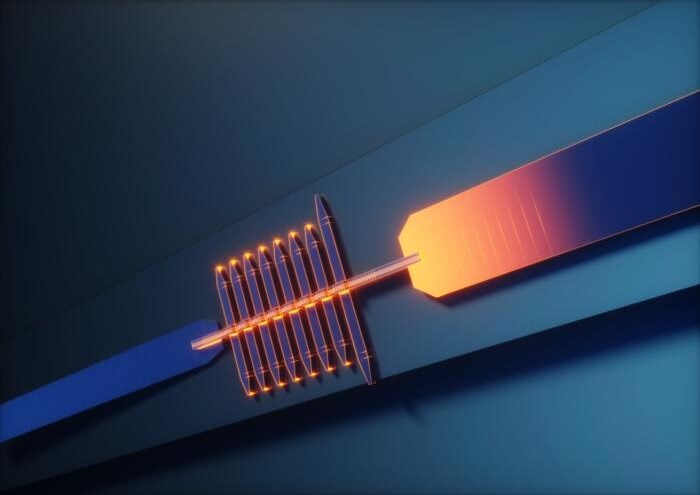
At 20 millikelvin, roughly 270 degrees below zero, a gold-palladium nanowire sits inside a dilution refrigerator at Aalto University in Finland. It is perhaps 150 nanometres wide, barely wider than a strand of DNA, and its temperature can shift by amounts that are, by any normal reckoning, absurd. Researchers have now used this wire to measure pulses of microwave energy smaller than a zeptojoule. One zeptojoule, for what it’s worth, is approximately what it takes to lift a red blood cell by a nanometre against Earth’s gravity. It is, to put it plainly, not very much energy at all. The team’s result, published in Nature Electronics, sets a new record for calorimetric energy measurement and points a way toward detectors sensitive enough to catch individual microwave photons one by one.
The device belongs to a class of sensors called calorimeters, instruments that measure energy by converting it into heat and reading out the resulting temperature change. What makes this one different is that it exploits a peculiar trick of materials physics.
The nanowire is made from an alloy that does not itself become superconducting, but the researchers sandwiched it between superconducting aluminium islands. Quantum mechanics being what it is, superconducting order leaks across the boundary between the two metals, a phenomenon called the proximity effect. The result is a series of Josephson junctions: points where the supercurrent is just barely holding together. Any rise in the wire’s temperature weakens that current, shifts the resonance frequency of a tiny electrical oscillator built into the circuit, and that shift is what the team reads out. “That combination of metals makes superconductivity such a fragile phenomenon that it weakens immediately if the temperature in the ultracold conductor rises even a little bit,” says Mikko Möttönen, the Academy Professor who led the project and is also a co-founder of IQM, one of Europe’s leading quantum computing companies. “This makes it such a sensitive setup.”
Fragile, certainly. But also extraordinarily useful, if you can actually extract a signal from all the noise.
Listening Through the Static
The fundamental problem with measuring zeptojoule pulses is that the signal they produce is almost indistinguishable from the background noise of the electronics reading it out. A single raw trace of the probe signal, with a pulse of around 1.19 zeptojoules arriving at the sensor, looks more or less like static. The team got around this by borrowing a technique from radar engineering called matched filtering, which is essentially a way of asking: given a known expected signal shape, how much of that shape can we find buried in the noise? By averaging 1,000 high-energy pulses to extract a template, then convolving that template against each single-shot trace, they improved their signal-to-noise ratio by roughly 30 percent compared with simpler approaches. It was enough. The sensor resolved pulses corresponding to about 150 microwave photons at 8.4 gigahertz, with a full-width half-maximum energy resolution estimated at 0.83 zeptojoules.
The thermodynamic noise limit for a device of this kind, given the heat capacity of the nanowire and its operating temperature, works out to somewhere around 0.13 zeptojoules. So the current setup is not yet at the fundamental ceiling; the main bottleneck appears to be the amplification chain that reads the sensor output, not the sensor itself. Adding a quantum-limited parametric amplifier directly at the millikelvin stage could potentially halve the noise figure, pushing the device substantially closer to the limit set by physics rather than by electronics.
Whether that matters depends on what you want to use the thing for. And there, it turns out, is rather a long list.
Axions, Qubits, and the Limits of What We Can Hear
The two applications Möttönen’s group has in mind sit at quite different scales of ambition. The nearer-term goal is qubit readout. Superconducting quantum computers operate at millikelvin temperatures, and reading out the state of a qubit currently requires amplifying the signal up through multiple stages to room temperature, each stage adding noise and potentially disturbing the qubit. A calorimeter that works at the same temperature as the qubits themselves, and can register a readout without that amplification chain, would in principle be far less disruptive. “A calorimeter operates in the same millikelvin temperatures that qubits require,” Möttönen explains. “This introduces less disturbance into the system as we don’t have to bring the device to a high temperature or amplify the qubit measurement signal to get a result. In the future, our device could be a component for reading out qubits in quantum computers, for example.”
The more speculative application involves dark matter. Axions are hypothetical particles proposed to explain certain puzzles in particle physics, and they are thought to interact occasionally with electromagnetic fields, producing a microwave photon when they do. Catching that photon requires a detector sensitive enough to notice a single quantum of microwave energy arriving at an unknown time, with no advance warning of when to start looking. “We want to make this setup capable of measuring input that has an arbitrary time of arrival, which is important for things like detecting dark-matter axions in space when you have no idea when they might reach your system,” Möttönen says.
That is a harder problem than resolving a pulse you’ve deliberately fired at your own sensor. The current device has a dynamic range of only a few zeptojoules and a thermal recovery time of around 260 microseconds, during which it cannot register a new pulse. For axion hunting, you would need it to be patient and always-on, which may require rethinking the sensor geometry, the absorber material, or both. Graphene-based absorbers, which have a much smaller heat capacity than gold-palladium alloys, are theoretically capable of energy resolutions approaching 0.05 zeptojoules, nearly an order of magnitude better. The Aalto group lists this as a direction for future work.
Single-photon detection is well established at optical wavelengths; the detectors in your smartphone camera are, in a sense, counting individual photons. Microwave photons carry roughly 100,000 times less energy than visible-light ones, and detecting them individually has proved correspondingly harder. Calorimetric detection would give you energy resolution across a broad frequency range, something narrow-band qubit-based detectors cannot. The team’s current resolution corresponds to about 1.4 terahertz times Planck’s constant; single-photon sensitivity for terahertz radiation is perhaps already within reach. Pushing into the microwave regime below 10 gigahertz is the next frontier.
There is something slightly vertiginous about the scales involved. The device resolving 0.83 zeptojoules is doing so at a temperature so close to absolute zero that thermal fluctuations are almost frozen out, inside a refrigerator that probably cost more than most houses, using a nanowire so thin that a thousand of them laid side by side would span the width of a human hair. And yet the physics the team is bumping up against is not the physics of the cold or the small but the physics of noise, of the irreducible randomness that quantum mechanics insists on at every scale. Getting closer to the limit means quieter amplifiers, cleverer signal processing, perhaps materials not yet tried. The sensor itself may not be the problem. The question is whether everything around it can be made quiet enough to let it listen.
https://doi.org/10.1038/s41928-026-01615-2
Frequently Asked Questions
What exactly is a zeptojoule, and why does it matter as a benchmark?
A zeptojoule is one trillionth of a billionth of a joule, the unit of energy. To put it in physical terms, it is roughly the energy needed to lift a red blood cell one nanometre upward against gravity. It matters as a benchmark because microwave photons, the kind used in quantum computing and potentially emitted by dark matter particles, carry energies in this range. Detecting them requires sensors that can register changes at this scale without being overwhelmed by thermal noise.
How does a calorimeter measure energy at these scales without simply measuring its own thermal fluctuations?
The key is operating at extremely low temperatures, around 20 millikelvin, where thermal fluctuations in the detector are themselves tiny. At that temperature, the absorption of even a zeptojoule-scale pulse produces a detectable shift in the resonance frequency of a superconducting circuit built into the sensor. The team also used a signal-processing technique called matched filtering to pull the pulse signature out of the background noise, improving sensitivity by about 30 percent over simpler methods.
Could this technology actually detect dark matter?
Possibly, though significant further development is needed. One leading dark matter candidate, the axion, is predicted to occasionally convert into a microwave photon in the presence of a strong magnetic field. Catching that photon requires a detector sensitive to single microwave quanta arriving at unpredictable times. The current device is not yet there, but the Aalto team has identified it as a target and the energy resolution is already moving in the right direction.
Why does quantum computing benefit from more sensitive calorimeters?
Reading out the state of a superconducting qubit currently requires routing the tiny microwave signal it produces through several stages of amplification, each adding noise and potentially disturbing the qubit’s delicate quantum state. A calorimeter operating at the same millikelvin temperatures as the qubits could in principle perform the readout without that amplification chain, reducing both noise and back-action on the qubit itself.
What is the fundamental limit on how sensitive these detectors can get?
The theoretical lower bound is set by thermodynamic fluctuations in the detector’s absorbing element. For the gold-palladium nanowire used in this experiment, that limit works out to around 0.13 zeptojoules, still well below what was demonstrated. Switching to absorbers with lower heat capacity, such as graphene, could push that limit to roughly 0.05 zeptojoules. Whether current sensors can reach their own theoretical limits depends mostly on how quiet the surrounding amplification electronics can be made.