

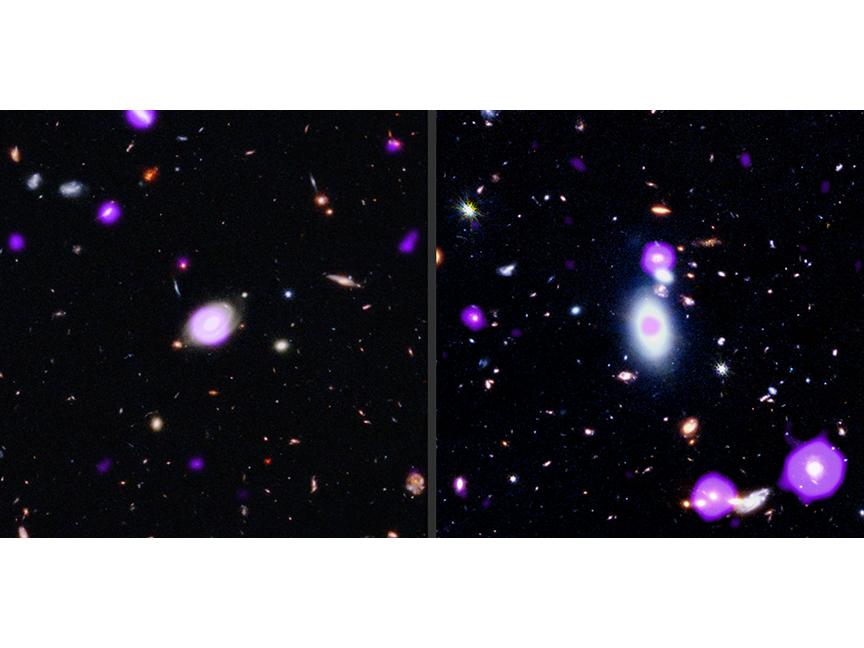
Key Takeaways
- The study reveals that supermassive black holes have slowed their growth due to a depletion of cold gas supplies since cosmic noon, around 10 billion years ago.
- Researchers identified that the typical Eddington ratio for black holes has dropped significantly, indicating reduced accretion rates over time.
- Using a tiered survey from multiple X-ray observatories, the team analyzed 1.3 million galaxies to understand black hole evolution.
- The findings suggest both black hole growth and star formation are linked, as they depend on the same cold gas reservoir, which has diminished.
- Future black hole growth is expected to continue slowing as cosmic gas reserves wane, leading to a quieter existence for these massive objects.
Point a telescope at 1.3 million galaxies spread across the observable universe and you are not really looking at space. You are looking at time. The light reaching Chandra’s mirrors left some of those galaxies when the cosmos was barely a billion years old, while other photons have been travelling only a few hundred million years. Lay those signals out in order and you get something close to a film of cosmic history, with the most ancient frames glowing brightest in X-rays and the recent frames considerably dimmer. That pattern has puzzled astronomers for decades. The universe’s supermassive black holes, it turns out, used to be ravenous. Now they are barely eating.
A study published in the Astrophysical Journal by a Penn State-led team has identified why. The answer is not that black holes have become more placid consumers, or that fewer of them are growing, or that they have somehow shrunk. The answer is simpler and more revealing: the kitchen ran low on supplies. Cold gas, the feedstock that powers black hole growth, has been draining from the universe since the era when these objects were at their most productive, roughly ten billion years ago. What the new data shows, in unusual detail, is that as the gas thinned out, the rate at which black holes devoured it fell in almost perfect lockstep.
“A longstanding mystery has been the cause of this big slowdown,” said Zhibo Yu, a graduate student in astronomy and astrophysics at Penn State and lead author of the paper. Using data from three major X-ray observatories, his team was able to distinguish between three competing explanations for the first time at this scale.
Cosmic noon refers to the period roughly 10 billion years ago when both star formation and supermassive black hole growth were at their highest levels across the universe. At this point, galaxies were rich in cold gas, which both processes rely on as fuel. Since then, gas has become scarcer, and both star formation and black hole growth have declined in tandem.
When material falls into a supermassive black hole, it heats up and emits X-rays. The brighter the X-ray emission, the more actively the black hole is growing. By observing galaxies at different distances, astronomers effectively look back in time, because light from distant galaxies takes longer to reach us. Comparing X-ray brightness across this range reveals how accretion rates have changed across cosmic history.
The team tested whether the decline was caused by each individual black hole consuming material more slowly (lower accretion rate), by growth activity shifting to smaller black holes with lower appetites, or by fewer black holes being active at any given time. The data clearly favoured the first explanation: the typical Eddington ratio, which measures how fast a black hole eats relative to its theoretical maximum, dropped by about twenty-fold since cosmic noon. Black hole mass barely changed, and the decline in active black hole numbers was a secondary effect rather than a primary driver.
The Eddington ratio compares a black hole’s actual accretion rate to the theoretical maximum rate at which it can consume material without the resulting radiation pushing that material away. A high Eddington ratio means a black hole is eating near its maximum capacity. A low ratio means it is consuming material far below that ceiling. Tracking how this ratio changes over cosmic time, rather than just luminosity, is what allowed this study to distinguish between the competing explanations for the slowdown.
The researchers expect so. The cold gas that fuels black hole growth continues to become scarcer as the universe ages and star formation consumes what remains. Barring galaxy mergers that could deliver fresh gas to black hole centres, the current trend toward lower accretion rates is likely to continue. The universe’s most massive objects appear to be settling into an increasingly quiet existence.
The period in question is what astronomers call cosmic noon, the peak era of black hole growth roughly 10 billion years after the Big Bang, when galaxies across the universe were also producing stars at a furious rate. Both processes, black hole feeding and star formation, require cold gas: the denser, slower stuff that can sink toward galaxy centres and either collapse into new stars or spiral inward into a waiting black hole. At cosmic noon, that gas was abundant. Since then, something has steadily curtailed its availability.
The three candidate explanations the team was testing are not merely technical. They correspond to three fundamentally different pictures of how black holes evolve. In the first scenario, each black hole has simply slowed its intake, consuming material at a lower rate even when it is present. In the second, the big black holes responsible for most of the universe’s energetic output have gradually been replaced by smaller ones with lower appetite. In the third, the number of actively growing black holes has fallen, leaving the ones that remain growing just as vigorously as before. The distinction matters enormously for understanding how galaxies evolve, because each scenario implies a different relationship between black holes and their host environments.
To separate these possibilities, the researchers needed both breadth and depth simultaneously. What they built was a survey architecture often compared to a wedding cake: a small top tier of extremely deep observations, a middle tier of medium-depth, wider coverage, and a broad bottom tier that sweeps large fractions of the sky. Chandra X-ray Observatory, the European Space Agency’s XMM-Newton, and Germany’s eROSITA telescope each occupied a different tier. The tiered design let the team sample X-ray-emitting black holes across roughly nine billion years of cosmic history, from the local universe all the way back toward cosmic noon. Some 8,000 growing supermassive black holes were identified within the sample of 1.3 million galaxies.
The key quantity the researchers extracted was not just X-ray brightness, which reflects how energetically a black hole is growing, but the rate at which each black hole was consuming material relative to its theoretical maximum, a ratio physicists call the Eddington ratio. Separating this from raw luminosity requires knowing the mass of each black hole, which the team inferred from optical and infrared measurements of each galaxy’s stellar mass. It is a technically demanding step: both higher mass and higher accretion rate produce more X-rays, and untangling the two is what gives this study its resolution.
What they found was unambiguous. From cosmic noon to the present, the typical Eddington ratio across the black hole population dropped by a factor of roughly twenty. The typical mass of the growing black holes changed barely at all, falling by only about 40 percent over the same period. The number of actively accreting black holes did decline, but this turned out to be a secondary effect, largely downstream of the drop in accretion rate rather than a separate cause.
In other words, the black holes did not shrink, and they did not go dark. They throttled back. Fan Zou, a postdoctoral researcher at the University of Michigan who completed his doctorate at Penn State, put the resulting picture concisely: “We can find out why over 10 billion years the growth of supermassive black holes has gone from hectic to leisurely to glacial.”
The physical mechanism behind that throttling, the team argues, is the gradual depletion of the cold gas supply. At cosmic noon, galaxies were gas-rich, fed by large-scale cosmic filaments and frequent galaxy mergers that stirred up fresh material and funnelled it toward central black holes. As the universe aged, mergers became rarer, star formation consumed much of the available gas, and the cosmic web of filaments thinned. Co-author Niel Brandt, Eberly Family Chair Professor of Astronomy and Astrophysics at Penn State, described it succinctly: “This is probably because the amount of cold gas available for them to ingest has decreased since cosmic noon.”
There is a pleasing symmetry in this: the decline in black hole growth over cosmic time closely tracks the parallel decline in star formation. Both processes depend on the same cold gas reservoir. As galaxies age, they exhaust their fuel supply, and the two processes wind down together, the universe’s great engines of transformation falling quiet in parallel. Star formation peaked roughly when black hole growth did, then both gradually subsided.
What makes this study an advance on previous work is not just the size of the sample but the completeness of the measurement across redshift. Earlier analyses had difficulty simultaneously constraining accretion rates at low redshift, where individual objects are well characterised but the sample is small, and at high redshift, where X-ray sensitivity limits which objects can be detected at all. The wedding-cake design addressed both: the wide surveys covered enormous volumes at low redshift, while the deep pencil-beam surveys extended the sample back toward cosmic noon. The result is a dataset that lets researchers track the Eddington ratio as a continuous function of cosmic time rather than a handful of snapshots.
The story is not entirely resolved. The team’s analysis focused on the decline since cosmic noon; explaining the rise that preceded it, from roughly 12 billion years ago through cosmic noon itself, remains harder because obscuration of X-ray emission by dust and gas was more severe in the early universe. New JWST observations suggest there may be populations of accreting black holes at high redshift that even Chandra misses entirely, which could revise the energy budget for early cosmic history. But those uncertainties are upstream of what this study addressed. For the past ten billion years, the dominant mechanism driving the decline appears settled: a slow, inexorable gas famine, universe-wide, with black holes consuming less because there was simply less to consume.
The researchers expect the current trend to continue. As the universe’s cold gas reserves keep thinning, the remaining black holes will grow more slowly still. The hectic epoch that built them is over. What comes next is a very long, very quiet twilight.