

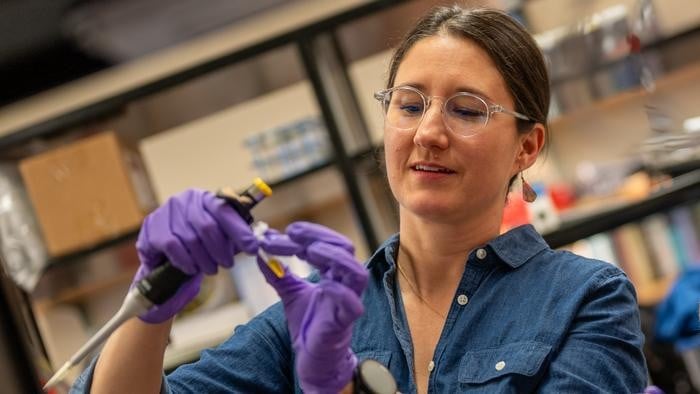
In a surprising twist for marine science, researchers have discovered that copepods—tiny but crucial creatures at the base of the ocean food chain—use not one but two molecular toolkits to survive in a warming, acidifying ocean.
The discovery reveals a two-pronged strategy: one genetic, the other epigenetic, that helps these animals rapidly adjust and evolve across generations.
The findings, published July 15 in Proceedings of the National Academy of Sciences, offer a rare dose of optimism in climate research. Led by Melissa Pespeni at the University of Vermont, the study tracked 25 generations of marine copepods under simulated future ocean conditions. The result? Clear evidence that these organisms are not just adapting genetically over time, but also deploying rapid, reversible changes through epigenetic modifications—chemical tags on DNA that influence which genes get expressed.
“This is a story of molecular hope in the face of a rapidly changing planet,” said Pespeni. “We found that evolution is not working from one toolbox, but two—and they’re complementary.”
A Long-Term Look at Ocean Evolution
The team raised populations of Acartia tonsa—a globally abundant copepod species—in lab conditions mimicking ocean warming, acidification, and their combination. Over one year and 25 generations, researchers measured everything from egg production to genome-level changes. Using cutting-edge sequencing, they tracked:
- Genetic adaptation (DNA sequence changes)
- Epigenetic variation (DNA methylation)
- Gene expression patterns (which genes were turned on or off)
What they found was startling: genetic and epigenetic changes occurred in different regions of the genome and seemed to operate independently. Yet both mechanisms contributed to the copepods’ ability to tolerate stressful environments.
Epigenetics: A Fast-Acting Ally
Unlike genetic mutations, which take generations to accumulate, epigenetic changes can happen within a single lifetime. These modifications—like chemical tags that switch genes on or off—can be passed to future generations, at least temporarily. That makes them especially valuable in fast-changing environments.
“Epigenetic changes are reversible and fast,” said Pespeni. “Exactly what a copepod wants when facing a heat wave or a spike in ocean acidification.”
In regions of the genome with high epigenetic change, the team found two to two-and-a-half times lower genetic change, suggesting the two modes of adaptation may avoid overlap. But both mattered. Epigenetic changes were most common in genes tied to stress response and the regulation of transposable elements—so-called “jumping genes” that can reshuffle the genome in times of stress.
Why This Matters for the Ocean—and Us
Copepods may be just a millimeter long, but they power marine ecosystems. They feed fish, cycle nutrients, and help sequester carbon. If they can survive short bursts of extreme climate stress, that resilience could ripple upward through the food web.
“Without copepods, you don’t have fish, you don’t have whales, you don’t have the ocean system we know,” said Pespeni. “And they are arguably the most abundant animal on Earth.”
The new findings suggest that even when genetic diversity is low or evolutionary pressures mount quickly, epigenetic mechanisms might offer a critical buffer—buying time for long-term adaptation to catch up.
Redefining Evolution for the Anthropocene
This study is among the first to trace genetic and epigenetic changes together over many generations. The implications go far beyond copepods. It suggests we may need to expand our understanding of evolution itself.
“We’re not rewriting Darwin,” Pespeni clarified, “but we are expanding the Modern Synthesis to include this player.”
The researchers even found weak but statistically significant links between epigenetic divergence and changes in gene expression. Genes with dynamic methylation changes showed shifts in how much they were turned on or off—offering clues into how organisms physically adapt to their environments over time.
Experimental Evolution in Action
The copepods were subjected to four conditions: ambient, acidified, warmed, and combined warming and acidification. Each condition had four replicate populations, and each replicate contained thousands of individuals. After 25 generations, whole-genome bisulfite sequencing and RNA sequencing revealed:
- 753 methylation sites significantly changed in the combined stress condition
- Negative correlation between epigenetic and genetic divergence
- Higher genetic diversity in genome regions with epigenetic changes
- Weak but significant correlation between methylation and gene expression
The combined effects suggest that epigenetics may allow populations to persist during stress, buying time for slower genetic changes to take root—a modern take on the classic “Baldwin Effect.”
A Molecular Safety Net
Perhaps the most hopeful note from the study is what it implies for biodiversity under stress. If epigenetic flexibility allows animals to hold on just a bit longer during extreme events, it could mean more time for ecosystems to adjust, more opportunities for genetic adaptation, and less risk of sudden collapse.
“Allowing an organism to survive a few extra generations during a stress event could preserve genetic diversity and buy time for longer-term adaptation,” said Pespeni.
Future Questions
The researchers acknowledge that their reduced representation sequencing covers only part of the genome and that more work is needed to fully understand how epigenetic marks persist across generations. But their findings suggest that evolution isn’t working with just one set of tools—it’s wielding a backup system that can respond in real time.
In a world where climate change is outpacing biology’s traditional rhythms, that’s a comforting revelation. Evolution may still be slow, but it turns out it’s also surprisingly flexible.
Journal: Proceedings of the National Academy of Sciences
Article Title: Complementary genetic and epigenetic changes facilitate rapid adaptation to multiple global change stressors
Publication Date: July 15, 2025