

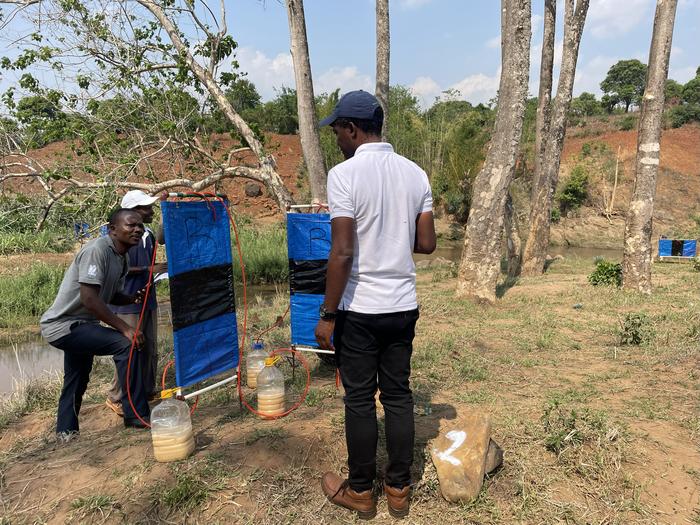
For decades, trained volunteers have sat by West African riverbanks with their skin exposed, waiting to be swarmed by blackflies so they could catch the insects before they bit. The work was essential: these tiny flies spread Onchocerca volvulus, the parasite that causes river blindness, and tracking their populations has been central to elimination efforts across the continent. But the job came with serious risks, including painful bites, exposure to other disease-carrying insects, and the occasional snake encounter. Now, researchers have found a replacement that works just as well and smells considerably worse: worn socks.
The new findings, presented by Sightsavers and partners at the American Society of Tropical Medicine and Hygiene meeting, describe how simple window traps baited with carbon dioxide and human scent can match the performance of human flycatchers. The study tested 16 variations of Esperanza window traps across Ghana, Cote d’Ivoire, Malawi and Mozambique, revealing that seven pairs of optimized traps capture as many flies as a single human sitting exposed by the water. The traps cost little to build, require minimal maintenance, and eliminate the ethical problem of asking people to serve as living bait.
Yeast, Socks, And The End Of A Risky Job
The research team experimented with different trap designs, testing combinations of colors, frame orientations, CO2 sources and scent attractants. Blackflies hunt by following carbon dioxide plumes and body odor, so the traps needed to mimic a breathing, sweating human without actually requiring one. In high fly density regions like Ghana and Malawi, traps using yeast-generated CO2 paired with worn socks performed as effectively as synthetic CO2 and commercial scent blends. In Cote d’Ivoire and Mozambique, where fly populations were lower, the yeast and sock combination actually produced the strongest results.
“Flycatchers sit for hours at a time with their skin exposed, braced to collect any blackfly that land on them. They are given precautionary treatment and try to catch the insects before they bite, but it’s hard work and I know from experience how painful the bites can be. Sitting by water all day also puts them at risk of tsetse flies’ and mosquitoes’ bites which can lead to other diseases, as well as snake bites.”
The implications go beyond worker safety. When the research team deployed traps in dense arrays at breeding sites, they discovered the devices could suppress local blackfly populations by intercepting females before they laid eggs. That dual function, monitoring transmission while simultaneously reducing fly numbers, could provide measurable protection to nearby communities. In regions where up to 250 million people remain at risk of onchocerciasis, any reduction in biting flies matters.
A Toolkit For Countries Closing In On Elimination
The broader DISSECT project, led by Sightsavers with ministries of health and the Global Institute for Disease Elimination, developed a complete toolkit to help national programs locate breeding sites, position traps and standardize data collection across teams with varying levels of scientific training. The toolkit performed well in all four test countries and may become the new standard for ethical, scalable blackfly monitoring. Ivermectin treatment remains the primary weapon against river blindness, but proving elimination requires ongoing surveillance, and that surveillance has historically depended on people willing to endure hours of insect assault.
“The completion of the DISSECT project marks an important step forward in the fight against river blindness. Through innovation, collaboration and shared purpose, we have shown what’s possible when science and partnership come together to address cross-border health challenges. This model of cooperation not only strengthens disease elimination efforts but also brings us closer to the ultimate goal: a world free from neglected tropical diseases.”
Niger recently became the first African country recognized by the WHO as having eliminated river blindness, proof that eradication is possible with sustained effort. Other nations are closing in on the same milestone, and the shift to trap-based surveillance may accelerate progress. The method is cheaper, safer, and easier to scale than human landing catch, which means more countries can afford comprehensive monitoring. And perhaps most importantly, it means no one has to sit by a riverbank offering their bare legs to clouds of biting insects, just to gather the data that keeps their neighbors safe. The worn socks can handle it from here.