

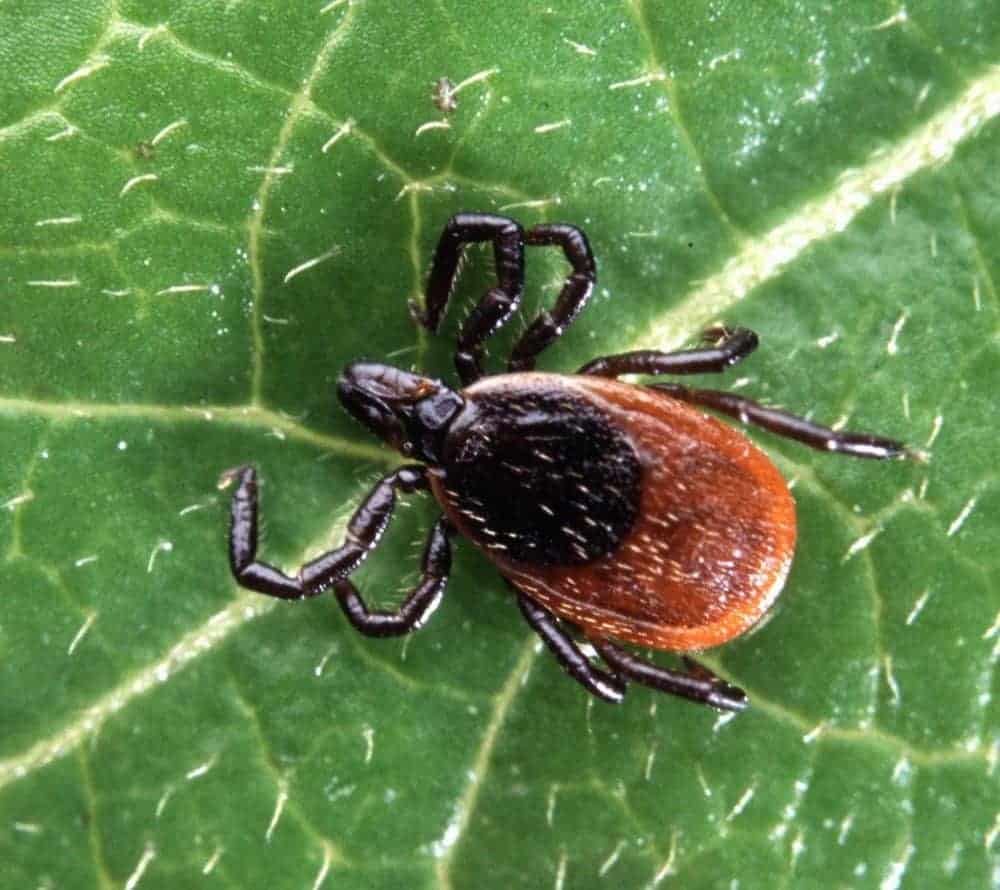
Every time a tick buries its mouthparts into your skin, something chemically audacious is happening. The animal needs perhaps several days anchored there, drinking. Your immune system, normally a hair-trigger early-warning network, should be screaming. But it isn’t. The tick’s saliva quietly floods the bite site with proteins that intercept the molecular alarm signals before they can summon defensive cells. The tick feeds undisturbed, then drops off. You probably never knew it was there.
These proteins, known as evasins, have been studied for years as potential anti-inflammatory drugs. They work by grabbing chemokines, the small signalling molecules that orchestrate immune cell recruitment, and physically sequestering them before they can reach their receptors. Problem solved — from the tick’s point of view, at least. From a therapeutic standpoint, the interest is obvious: diseases like rheumatoid arthritis, multiple sclerosis, and certain cancers involve chemokines running amok, over-recruiting immune cells to places they shouldn’t be in the numbers they arrive. Block the chemokines, and you might damp down the pathology.
There was, however, a frustrating limitation. Chemokines come in two main flavours, CC and CXC, distinguished by the spacing of a pair of cysteine residues near the protein’s tail end. Every evasin characterised until now has been selective. Class A evasins grab CC chemokines only; class B grabs CXC. Many inflammatory diseases simultaneously involve both families, which means a single evasin could never be enough. Researchers had assumed ticks managed broad coverage by secreting cocktails — multiple evasin types working together, each handling one class.
That assumption has just been overturned by a team at Monash University’s Biomedicine Discovery Institute in Melbourne. Working through the tick species Amblyomma tuberculatum (a reptile-specialist tick found in the southeastern United States), biochemists Surendra Kunwar and Shankar Raj Devkota, together with colleagues led by Professor Martin Stone and Dr Ram Prasad Bhusal, have characterised an evasin called EVA-ATL that binds both CC and CXC chemokines. The same small protein. The same binding surface. Both families simultaneously neutralised.
“We have identified a naturally occurring evasin that can inhibit both major classes of chemokines,” said Kunwar. “This is a novel finding and represents a significant advance in the field.”
The discovery was prompted by a phylogenetic anomaly. EVA-ATL belongs to the A3 subclass of class A evasins, sharing perhaps 25 to 40 per cent sequence identity with its relatives. Yet when the team mapped its evolutionary relationships, it sat apart from the other A3 members in a way that suggested something unusual was going on. They screened it against every available human chemokine and got a surprise: binding to 16 of 24 CC chemokines, and also to 6 of 16 CXC chemokines. No evasin had done that before.
Binding, of course, is not the same as blocking. The researchers went on to show that EVA-ATL inhibited CC-chemokine-driven receptor signalling with IC50 values in the range of 13 to 49 nanomolar — genuinely potent — and suppressed CXCL8-induced cell activation at around 83 nanomolar. In chemotaxis assays, watching actual cells migrate through membrane pores toward a chemical gradient, EVA-ATL shut down movement induced by both CC and CXC chemokines. The functional inhibition was real.
How it achieves this structural flexibility turns out to be elegantly simple. Class A3 evasins have a defining architectural feature: a hydrophobic pocket at their core that accommodates a specific residue of the chemokine immediately adjacent to the CC motif, the so-called CC+1 position. In previously characterised A3 evasins, this pocket is relatively deep. That depth creates a problem when the evasin encounters CXC chemokines: the extra amino acid that separates the two cysteines in CXC proteins (present in CC proteins they’re directly adjacent) causes a steric clash, a physical collision that prevents binding. The CXC chemokine simply won’t fit.
EVA-ATL carries two bulkier residues — a valine and an isoleucine — where related evasins have smaller alanines. The pocket is shallower. Not much, but enough: the CXC+1 residue can now nestle in without colliding. To confirm this, the team built a double mutant in which both bulky residues were swapped back to alanines. The mutant retained CC chemokine binding entirely but lost all measurable binding to the CXC chemokine CXCL8. Shallow pocket, broad specificity. Deep pocket, CC only.
They couldn’t obtain crystal structures of the complexes (inherent flexibility in the terminal regions of both evasin and chemokines disrupted crystal packing, a perennial frustration in structural biology), so structural interpretation rested on AlphaFold 3 co-folding models and more than 1,000 nanoseconds each of molecular dynamics simulations. Five independent simulations per complex, each exceeding a microsecond of simulated time. The hydrogen bonds predicted at the binding interface held throughout, the CXC+1 residue stayed parked in the pocket, and the overall structures remained consistent with the predictions.
The CXC affinity, it should be noted, is weaker than the CC affinity by roughly a factor of 100 in binding constants. EVA-ATL’s grip on CC chemokines runs from sub-nanomolar to around 787 nanomolar; for CXC chemokines it ranges from about 240 to 3,000 nanomolar. This isn’t surprising given the structural compromise involved. The CXC motif can only form two of the four conserved hydrogen bonds that anchor CC chemokines to the evasin’s beta-1 strand. The evasin partially compensates through other contacts, including contributions from its N-terminal region and a flexible beta-1-beta-2 loop. But there’s clearly room for engineering.
“The discovery opens up new opportunities to develop therapies that target chemokines driving inflammatory diseases such as RA and MS,” said Devkota. “While treatments are available, there remains a significant need for therapies that more effectively prevent disease progression.”
There’s also a broader evolutionary question hovering at the edge of this research. A. tuberculatum feeds almost exclusively on reptiles — gopher tortoises, various snakes, the occasional lizard. Its saliva has presumably co-evolved with reptilian immune systems over millions of years, producing chemokine-inhibitory strategies that may be quite different from those refined against mammalian immunity. Whether the dual specificity of EVA-ATL is unique to this species, or whether it represents a wider evolutionary strategy in reptile-adapted ticks, isn’t yet known. The evasin sequence databases for A. tuberculatum are sparse.
What the Monash team has established is a structural blueprint for dual-family chemokine inhibition, one that could guide the engineering of next-generation biologics for diseases where both CC and CXC chemokines are simultaneously dysregulated — which, it turns out, describes many of the conditions where existing chemokine-targeted therapies have most conspicuously failed.
The tick, as ever, got there first.
Summary
Researchers at Monash University have discovered a tick-derived protein called EVA-ATL (EVA-ATL1001) that can simultaneously inhibit both major classes of immune-signalling molecules linked to inflammatory and autoimmune diseases. The protein, sourced from the tick species Amblyomma tuberculatum, is the first naturally occurring evasin shown to block both CC chemokines and CXC chemokines — the two families of small proteins that direct immune cells toward sites of inflammation. All previously identified evasins were selective for one class only.
Chemokines drive immune cell recruitment and are central to the pathogenesis of diseases including rheumatoid arthritis, multiple sclerosis, inflammatory bowel disease, and cancer. Because many of these conditions involve simultaneous overexpression of both CC and CXC chemokines, single-class inhibitors have shown limited therapeutic efficacy. EVA-ATL overcomes this constraint by binding 16 of 24 human CC chemokines and 6 of 16 CXC chemokines, with functional inhibition confirmed in receptor signalling assays (IC50 13–83 nanomolar) and cell migration assays.
The structural basis for this dual activity is a shallower hydrophobic binding pocket in EVA-ATL, created by two bulkier amino acid residues (valine and isoleucine) in place of the smaller alanines found in CC-only evasins. This architectural difference allows the protein to accommodate the chemokine residue adjacent to the CXC motif without steric clash, while retaining the conserved hydrogen-bond interactions used to bind CC chemokines. The findings, published in the journal Structure (Cell Press, February 2026), establish EVA-ATL as a scaffold for engineering broad-spectrum anti-inflammatory biologics.