

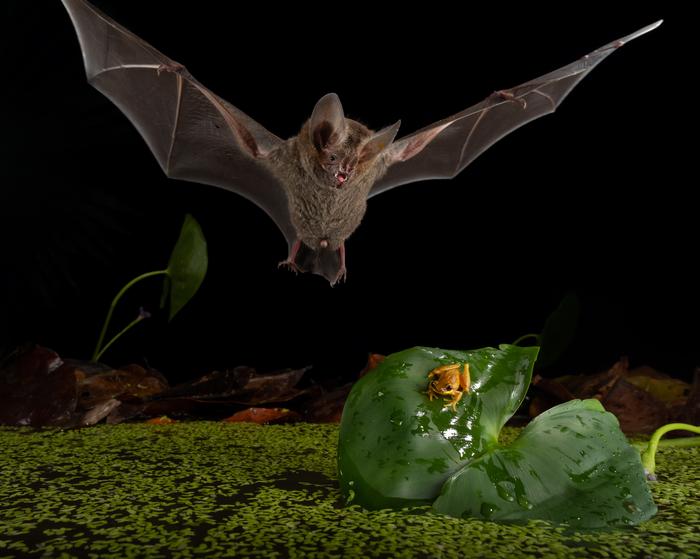
High in the humid dark of Panama, a tiny predator does something that should not be possible. Using patience instead of speed, fringe-lipped bats conserve energy and still bring down surprisingly large prey, according to a new study from Aarhus University and the Smithsonian Tropical Research Institute published in Current Biology.
Armed with miniature biologging backpacks that captured sound and motion, researchers followed 20 Trachops cirrhosus as they moved through forests around Soberanía National Park. The recordings revealed a strategy that looks far more like big cats than the typical bat routine. Rather than hawking countless insects on the wing, these bats spent most of the night still, often hanging near ponds or perches, then striking when the moment was right.
What makes this remarkable is the math. Small predators have little energy to spare and high metabolic rates in flight, so the textbook expectation is many tiny meals, not a few big ones. Yet the tagged bats were stationary for roughly 89 percent of their recorded time. When they did fly, most flights lasted less than three minutes, and the median hunting flight took just eight seconds. Despite so little aerial effort, their success rate hovered around 50 percent, higher than lions at about 14 percent and far beyond polar bears near 2 percent.
The sensory trick is eavesdropping. Fringe-lipped bats are famous for listening to frog mating calls, using low-frequency hearing to pick out targets in noisy forest soundscapes. The tags showed they combine that passive listening with vision and echolocation, switching between short flights guided by loud frog choruses and quiet, hang-and-wait ambushes to detect faint rustles from larger quarry. In a striking vignette from the dataset, chewing sounds continued for 84 minutes after a capture, implying a meal close to the bat’s own mass.
Big Prey, Small Engine
On average, prey weighed about seven percent of a bat’s 30 gram body mass, but the team documented cases approaching parity, such as Rosenberg’s gladiator tree frogs near 20 grams. If you are picturing it, imagine a bat the size of a small plum hovering over a broad green leaf, then lifting off with a frog almost as heavy as itself. The researchers even confirmed in controlled trials that such prey is manageable.
The work reframes a long-standing paradox. How do small predators meet steep nightly energy needs without burning excess fuel on long searches and failed chases? The answer, at least for this species, is to compress the hunt into short bursts with high reward and to rest in between. That pattern depends, however, on intact habitats where vertebrate prey in the one to 30 gram range are abundant and close to roosts. The authors are careful here: the bats’ playbook works because the ecosystem still does.
“Instead of spending the night constantly on the wing, they wait patiently, strike with high precision, and sometimes end up catching enormous, energy-rich prey.”
Lead author A. Leonie Baier, a Marie Skłodowska-Curie postdoctoral fellow at Aarhus University and research fellow at STRI, says the behavior turned expectations on their head. In effect, these are big predators trapped in small bodies. Older bats also handled larger prey more often, hinting that experience sharpens both tactics and target choice over years in the forest.
The Physics Of Patience
From an energetics perspective, the approach is elegant. Short commutes, short pursuits, and big meals balance the ledger. Median flight bouts were just seconds long, typical distances were on the order of tens of meters, and many attacks occurred near roosts. Nights became a sequence of ambushes rather than a marathon of continuous flying. Given the high cost of flapping flight, the savings add up fast.
There is a cautionary note. If frog choruses thin out and small vertebrates decline, the bats lose the acoustic cues and prey density that make a high-gain ambush strategy viable. The study explicitly links their extreme efficiency to pristine ecosystems. In an era of amphibian declines and fragmented forests, that dependence is a vulnerability, not a luxury.
“With the data from our biologging tags, which combine high-resolution sound recordings with movement data, we were able to reconstruct entire hunting sequences in the wild.”
Senior author Laura Stidsholt describes an auditory window into the night, and the picture is vivid: brief bursts of wingbeats, a soft impact on a leaf, then the long, steady rhythm of chewing. The numbers back up the sounds. Across half-nights of recording, bats made only a handful of attempts and still met estimated daily energy demands. That is not luck; it is a refined strategy.
Predators are often cast as the sum of their teeth and speed. This paper argues for a different lens, one that favors information, timing, and restraint. In the end, the smallest hunters can act like the largest, not by overpowering the physics of flight, but by listening hard, moving little, and taking their chances when the forest itself speaks up.