

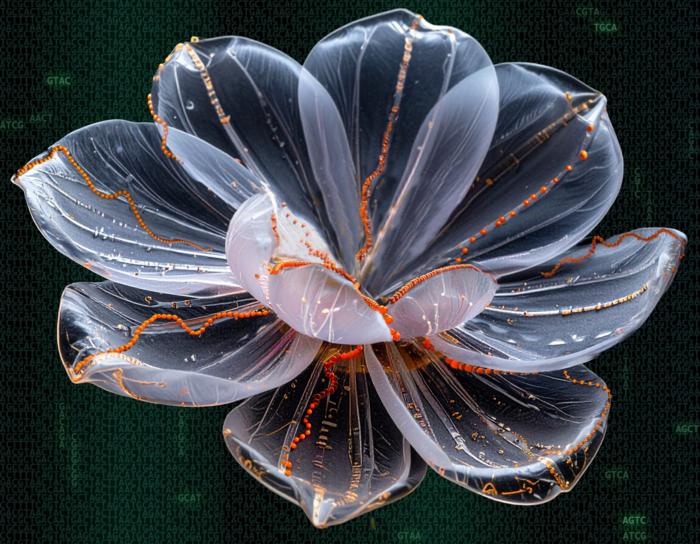
Scientists at the University of North Carolina have built microscopic robots that behave less like machines and more like organisms. These flower-shaped crystals, made from DNA and inorganic materials, can fold and unfold in seconds when their surroundings change, mimicking the way real flower petals respond to sunlight or a Venus flytrap snaps shut on prey.
The breakthrough lies in how the DNA is arranged inside each tiny structure. When acidity rises in the environment, segments of the DNA fold tightly, causing the petals to close. When conditions normalize, the DNA relaxes and the petals open again. It is a simple motion with potentially profound implications: these flowers could one day deliver medicine directly to diseased tissue, perform biopsies, or even clean up toxic spills.
“People would love to have smart capsules that would automatically activate medication when it detects disease and stops when it is healed. In principle, this could be possible with our shapeshifting materials,” said Dr. Ronit Freeman, senior author of the study and director of the Freeman Lab at UNC.
A New Kind of Smart Material
Freeman’s team drew inspiration from natural processes: petals unfurling at dawn, coral pulsing with the tide, tissues forming in developing embryos. These are behaviors that have long been difficult to replicate in artificial materials at microscopic scales. The challenge was not just to create movement, but to make it reversible, rapid, and responsive.
The DNA inside each flower acts like a tiny computer program, encoding instructions for how the structure should move and react. When the environment shifts, such as when a tumor’s acidity triggers the flower to close, the petals can release a payload of medicine or capture a tissue sample. If the tumor resolves, the flower reopens, ready to respond again if the disease returns.
What makes these flowers particularly unusual is that their mechanical metamorphosis happens across multiple organizational length scales. As the microscale flowers close and open, their nanoscale crystal organization changes reversibly, suggesting that the entire structure is transducing information from one scale to another, much like living tissue does.
“We take inspiration from nature’s designs, like blooming flowers or growing tissue, and translate them into technology that could one day think, move, and adapt on its own.”
Beyond Medicine
The applications extend far beyond targeted drug delivery. Freeman envisions swallowable or implantable flowers that could clear blood clots, or environmental cleanup agents that release detoxifying chemicals into polluted water and then dissolve harmlessly when the job is done. The same DNA-based architecture could also store massive amounts of digital information, up to two trillion gigabytes in just a teaspoon, offering a greener and more efficient alternative to current data storage technologies.
The flowers are built using template-independent DNA polymerization, a process that allows the researchers to tune the hierarchical assembly and spatial localization of DNA within the crystals. By varying the DNA polymer sequence and its subcrystal localization, the team can control not just whether the flower closes, but how it closes, bending or shrinking in specific ways depending on where the contractile DNA motifs are placed.
The technology is still in early testing, but the researchers demonstrated that the adaptability of flowers to environmental changes can activate cascaded biocatalytic reactions and reveal gel-encrypted information. These are not just passive structures responding to a single trigger; they are dynamic systems capable of performing multiple tasks in sequence.
This work marks a significant step toward materials that can sense and respond to their environment, bridging the gap between living systems and machines. The research, published in Nature Nanotechnology, suggests that the future of soft robotics may not be about building machines that mimic life, but about creating materials that embody some of the same principles that make living organisms so remarkably adaptable.