

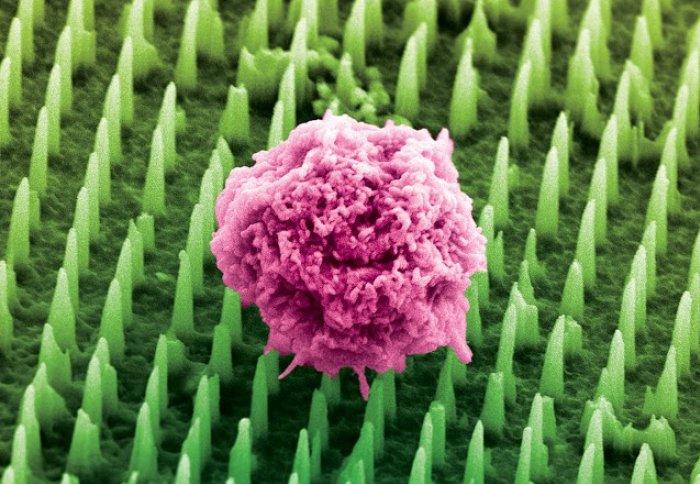
Scientists have developed a patch covered with tens of millions of microscopic needles that could replace painful cancer biopsies.
The new technology offers a painless alternative for detecting and monitoring diseases like cancer and Alzheimer’s without removing tissue from patients. Each nanoneedle is 1,000 times thinner than human hair and causes no damage to surrounding tissue, potentially transforming how doctors diagnose and track diseases worldwide.
The patch works by painlessly collecting molecular information from tissues through these ultra-thin needles. Unlike traditional biopsies that remove pieces of tissue, the nanoneedles create what researchers call “molecular replicas” – detailed chemical maps that reveal disease patterns without harming the original tissue.
Revolutionary Detection Without Destruction
“We have been working on nanoneedles for twelve years, but this is our most exciting development yet,” said Dr. Ciro Chiappini, who led the research published in Nature Nanotechnology. “It opens a world of possibilities for people with brain cancer, Alzheimer’s, and for advancing personalised medicine. It will allow scientists—and eventually clinicians—to study disease in real time like never before.”
The breakthrough addresses a major limitation in current medical practice. Biopsies are among the most common diagnostic procedures worldwide, performed millions of times annually. However, they’re invasive, can cause complications, and often deter patients from seeking early diagnosis or follow-up tests.
What makes this technology particularly promising is its ability to provide repeated measurements from the same tissue area. Traditional biopsies can only sample a location once, but nanoneedles allow doctors to monitor how diseases progress or respond to treatment over time.
Brain Surgery Applications
The technology shows particular promise for brain cancer diagnosis. During surgery, applying the patch to suspicious tissue could provide results within 20 minutes, helping surgeons make real-time decisions about removing cancerous areas.
“This approach provides multidimensional molecular information from different types of cells within the same tissue,” Chiappini explained. “Traditional biopsies simply cannot do that. And because the process does not destroy the tissue, we can sample the same tissue multiple times, which was previously impossible.”
Key Advantages Include:
- Painless procedure with needles 1,000 times thinner than human hair
- No tissue damage or removal required
- Multiple samples possible from the same location
- Results available within 20 minutes during surgery
- Real-time disease monitoring capabilities
Machine Learning Meets Molecular Detection
One crucial aspect not highlighted in initial reports involves the sophisticated analysis system behind the nanoneedles. The researchers developed machine learning algorithms that can distinguish between healthy tissue, different types of brain tumors, and areas of tissue death with remarkable accuracy.
In testing on 23 human brain tumor samples, the nanoneedle molecular replicas performed just as well as traditional tissue sections for determining tumor grade – a critical factor in treatment decisions. The machine learning system achieved classification accuracy rates of 71-75%, matching the performance of conventional biopsy analysis.
The artificial intelligence component identifies specific molecular “fingerprints” including lipids, proteins, and genetic material that characterize different disease states. This molecular profiling revealed that certain lipid patterns could accurately distinguish between low-grade and high-grade tumors, potentially helping doctors choose appropriate treatments more quickly.
Manufacturing Meets Medicine
The nanoneedles are manufactured using the same techniques that produce computer chips, making them potentially scalable for widespread medical use. This semiconductor manufacturing approach allows precise control over needle dimensions and surface properties.
Researchers can integrate the nanoneedles into common medical devices like bandages, endoscopes, and even contact lenses. This versatility opens possibilities for monitoring various types of tissue throughout the body.
The patch contains tens of millions of individual nanoneedles, each designed to penetrate just a few micrometers into tissue – deep enough to collect molecular information but shallow enough to avoid causing damage or pain.
Temporal Tracking Reveals Treatment Effects
Perhaps most significantly, the research demonstrated that nanoneedles can track how tumors respond to chemotherapy over time. In experiments with brain tissue treated with temozolomide – a standard brain cancer drug – the nanoneedles detected specific changes in tumor metabolism that occurred within days of treatment.
The longitudinal analysis revealed that certain lipid molecules disappeared from treated tumors while remaining present in untreated tissue. This capability could help doctors determine whether treatments are working much earlier than current methods allow.
Traditional monitoring often requires weeks or months to assess treatment effectiveness through imaging or repeat biopsies. The nanoneedle approach could potentially provide feedback within days, allowing for rapid treatment adjustments.
Beyond Cancer Detection
While brain cancer applications dominate current research, the technology has broader implications. The ability to repeatedly sample tissue without damage could benefit monitoring of various conditions including Alzheimer’s disease, autoimmune disorders, and organ transplant rejection.
“This could be the beginning of the end for painful biopsies,” said Dr. Chippani. “Our technology opens up new ways to diagnose and monitor disease safely and painlessly—helping doctors and patients make better, faster decisions.”
The research team emphasizes that this breakthrough required collaboration across multiple fields including nanoengineering, clinical oncology, cell biology, and artificial intelligence. Each discipline contributed essential tools that together unlocked this new diagnostic approach.
The Path Forward
Before reaching patients, the technology must undergo clinical trials to establish safety and effectiveness in human applications. However, the preclinical results suggest the nanoneedles could fundamentally change how medicine approaches tissue diagnosis.
For millions of patients who currently face painful, invasive biopsies, this technology offers hope for a future where disease monitoring becomes as simple as applying a patch. The ability to track diseases in real-time without tissue damage could enable earlier interventions and more personalized treatment approaches.
The research was supported by the European Research Council, Wellcome Leap, and various UK research councils, indicating strong institutional backing for bringing this technology to clinical practice.
