

The next time you check your smartphone or start your electric car, consider this: the rare metals powering these devices might exist because of ghostly particles that barely interact with matter at all.
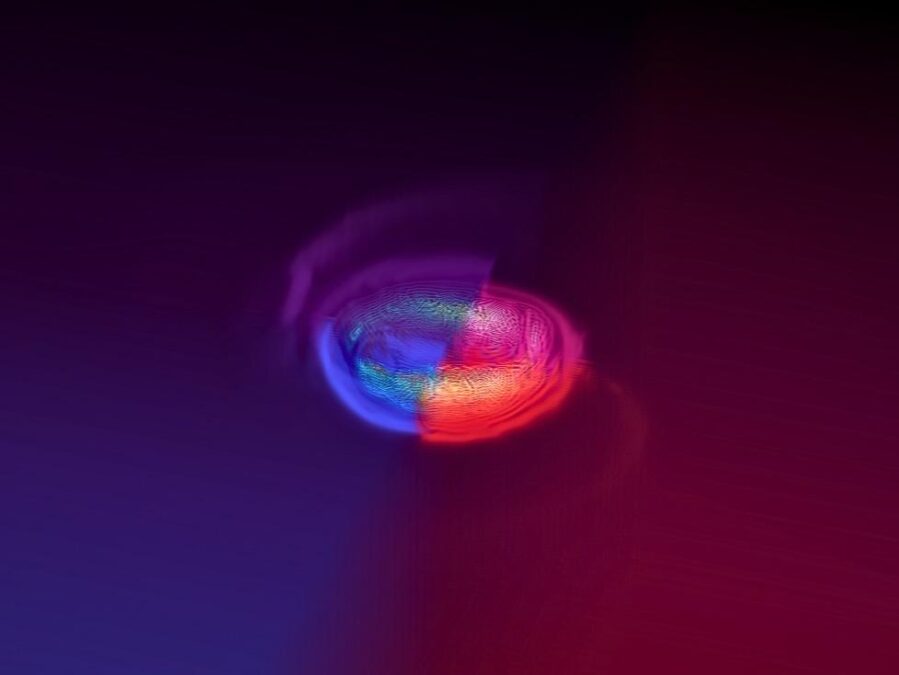
New simulations from Penn State reveal that neutrinos – nearly massless particles that zip through your body by the trillions every second – dramatically alter what happens when neutron stars collide. These cosmic smash-ups, among the universe’s most violent events, forge heavy elements like gold and platinum. But the process isn’t quite what scientists thought.
The Flavor-Changing Game Changer
Neutrinos come in three “flavors” – electron, muon, and tau – named after the particles they associate with. Under extreme conditions, they can switch identities, transforming from one flavor to another. It’s a quantum quirk that sounds abstract until you realize its profound consequences.
“Electron type neutrinos can take a neutron, one of the three basic parts of an atom, and transform it into the other two, a proton and electron. But muon type neutrinos cannot do this.”
That’s David Radice, Penn State physicist and co-author of the groundbreaking study published in Physical Review Letters. The distinction matters because neutrons are the raw material for creating heavy elements during stellar collisions.
When two neutron stars – each containing more mass than our sun compressed into a sphere just 12 miles across – spiral into each other at nearly the speed of light, they create conditions so extreme that the normal rules of physics bend. Temperatures soar to billions of degrees. Pressures exceed anything imaginable on Earth. In this cosmic furnace, neutrons get flung around like cosmic bullets, smashing into atomic nuclei and building up heavier and heavier elements.
But neutrinos, it turns out, control the neutron supply.
The research team, led by graduate student Yi Qiu, built computer simulations from scratch to model these collisions. Unlike previous attempts, they included neutrino flavor transformations – a process happening on nanosecond timescales that had been too complex to capture until now.
“In our new simulations, we found that the extent and location of neutrinos mixing and transforming impacts the matter that is ejected from the merger, the structure and composition of what remains after the merger – the remnant – as well as the material around it.”
Implications Beyond Earth
The results suggest that accounting for neutrino behavior could boost heavy element production by up to 1,000 percent. This finding addresses a longstanding puzzle in astrophysics: where do Earth’s precious metals actually come from?
The simulations also revealed that neutrino mixing affects the gravitational waves and electromagnetic radiation these mergers produce – the very signals that astronomers detect on Earth. The Laser Interferometer Gravitational-Wave Observatory (LIGO) has already captured several neutron star collisions, and next-generation detectors like the proposed Cosmic Explorer could spot them regularly in the 2030s.
Understanding how neutrino transformations shape these signals will help scientists interpret future observations. It’s like having a better decoder ring for messages from the most extreme corners of the universe.
The researchers compared modeling these neutrino processes to balancing an inverted pendulum. Initially, rapid changes occur on incredibly short timescales, but eventually the system settles into equilibrium. Much about this process remains theoretical, though, since it ventures beyond the Standard Model of particle physics.
Neutron star mergers serve as natural laboratories for physics impossible to replicate on Earth. These collisions probe matter under pressures millions of times greater than in atomic nuclei, temperatures hotter than stellar cores, and magnetic fields trillions of times stronger than Earth’s.
The team’s breakthrough required accounting for gravity, general relativity, hydrodynamics, and neutrino mixing simultaneously – a computational feat that creates new possibilities for understanding cosmic element production. With the simulation infrastructure now established, other research groups can build on this work to explore neutrino effects further.
As we look toward an era of routine gravitational wave detection, these tiny, nearly invisible particles may prove crucial for decoding the universe’s most spectacular explosions. The next time LIGO detects ripples in spacetime from a distant neutron star collision, scientists will have a more complete picture of the cosmic alchemy creating the elements essential to modern technology.