

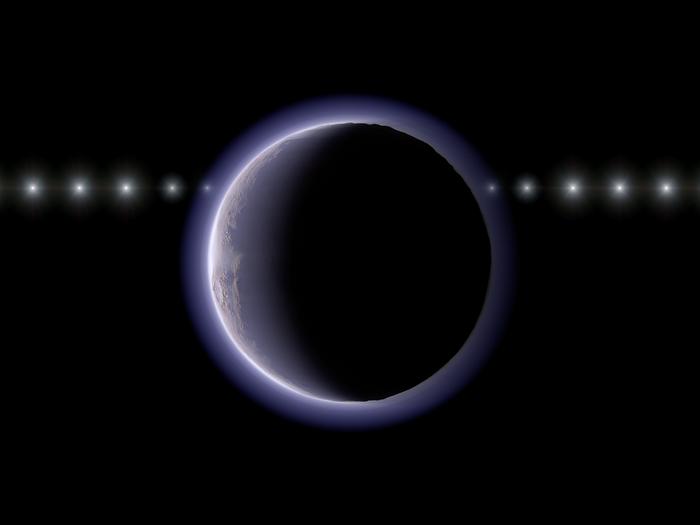
On January 10, 2024, a dim star in the constellation Gemini began to disappear. Not dramatically, not all at once, but gradually, its light thinning by degrees as something cold and dark slid in front of it. From three stations across Japan, astronomers watched the light curves on their monitors and saw what they hadn’t expected to see: a gradual fade where physics said there should be an abrupt wink-out. A fading that could only mean one thing. Whatever had passed in front of that star had an atmosphere.
The object responsible was (612533) 2002 XV93, a lump of ice and rock roughly 500 kilometres across, orbiting the sun out beyond Neptune in a region so frigid that the temperature hovers around 47 degrees above absolute zero. By every standard model of planetary science, something that small and that cold should be utterly airless. Its gravity is too weak, its surface too frozen. And yet.
A Lucky Experiment in the Dark
Stellar occultations, as astronomers call them, are natural gifts. When a solar system body passes directly in front of a star, the star’s light acts as a probe, feeling its way through whatever atmosphere might surround the occulting object. The technique has revealed Pluto’s nitrogen blanket, discovered rings around distant Centaur objects, and, now, done something nobody anticipated. Ko Arimatsu at the National Astronomical Observatory of Japan’s Ishigakijima station had organized the observation campaign under the name TABASCO (Trans-Neptunian Atmospheres and Belts Analysis through Stellar-occultation Coordinated Observations, a backronym that suggests perhaps astronomers have earned a little levity). The team operated three stations: a 1.05-metre Schmidt telescope at Kiso Observatory, a compact 20-centimetre setup at Kyoto University’s rooftop, and, crucially, a 25-centimetre backyard telescope operated by citizen astronomer Katsumasa Hosoi in Fukushima prefecture. High-sensitivity CMOS cameras, the same underlying technology used in smartphone sensors, made all three stations capable of detecting the subtle refractive dimming that a thin atmosphere would cause.
At Kiso, the light curve showed something textbook-troubling: rather than an instantaneous drop as the star slipped behind solid rock, the flux fell gradually over about 1.5 seconds at both entry and exit. Diffraction effects at 37 astronomical units could account for roughly 0.05 seconds of blurring. The star’s own angular diameter added perhaps 0.004 seconds more. Neither comes close to explaining 1.5 seconds of smoothing. Rings or dust shells were considered and essentially ruled out: the geometry was all wrong, the opacity too high, the dynamical situation too unstable. An atmosphere was the only interpretation that held together.
The derived surface pressure is somewhere between 100 and 200 nanobars depending on what you assume the atmosphere is made of, whether nitrogen, methane, or carbon monoxide. To give that number some context: Pluto’s own thin atmosphere runs around 10,000 nanobars, about 50 to 100 times denser. Mars, for comparison, sits at around five million nanobars. So this is an extremely tenuous wisp of a thing. But it’s real. And it’s roughly 100 times denser than any upper limit previously established for comparable trans-Neptunian objects of similar or even larger size. That’s not a small discrepancy. That’s a qualitative surprise.
The Problem of Where It Came From
Here’s the difficulty. The atmosphere can’t have been there long. At the surface pressure detected, with a Jeans parameter close to 1, meaning the thermal energy of gas molecules nearly matches the gravitational energy holding them down, the hypervolatile gases involved would hydrodynamically stream away into space on a timescale of perhaps 100 to 1,000 years. The Solar System is roughly 4.5 billion years old. Any primordial atmosphere 2002 XV93 might once have held is long gone. Whatever is there now was put there recently, in the cosmological sense at minimum, possibly quite recently in the literal sense.
James Webb Space Telescope observations of the object’s surface show no sign of frozen methane, nitrogen, or carbon monoxide sitting on the surface ready to sublimate. So the replenishment isn’t coming from a straightforward surface reservoir baking in what passes for sunlight at 38 astronomical units. Something else is going on.
Two candidate explanations survive scrutiny, though both are, to put it charitably, speculative. The first involves cryovolcanism: the idea that some internal heat source, perhaps radiogenic decay, residual formation energy, or the antifreeze effect of ammonia in a subsurface brine, is pushing volatiles up through the icy shell and into the surrounding space. Larger trans-Neptunian objects like Sedna and Gonggong show suggestive evidence of internal geochemical activity. JWST isotopic analyses of methane ice on the dwarf planets Eris and Makemake indicate the methane isn’t purely primordial but may have been processed by warm interiors. A 500-kilometre body has a smaller heat budget and a thicker cold lithosphere, making sustained cryovolcanism harder to sustain, but perhaps not impossible under special conditions.
The second possibility is stranger and, in some ways, more appealing precisely because of its strangeness. A comet hit it. A comet-like impactor of just 100 metres or so in radius, carrying sufficient frozen CO, methane, or nitrogen, could have delivered enough gas to account for the observed pressure upon impact. The low relative velocities typical among plutinos, objects in the same 2:3 orbital resonance with Neptune that Pluto occupies, would have helped retain the released gas rather than blasting it clean away. The probability of such an event over a century is tiny, around one in 100,000 by conservative estimates from Pluto’s crater record. But there are roughly 100 TNO occultation measurements in the literature, and the population of sub-kilometre impactors could be considerably larger than current models allow.
What Comes Next
The two scenarios make different predictions, which is the part of science that separates interesting puzzles from permanently mysterious ones. A comet-generated atmosphere should be steadily declining. Monitor 2002 XV93 over the next several years with the same occultation technique and, if the pressure is measurably lower, you have your answer. An endogenous, cryovolcanic source would show no monotonic decline, possibly seasonal fluctuations tied to the object’s 248-year orbit. Citizen-professional networks like TABASCO are uniquely positioned to run exactly this kind of long-term monitoring, and the participation of Hosoi at Fukushima demonstrates the technique can work with modest equipment in amateur hands.
JWST spectroscopy of the atmosphere itself, if achievable, would give direct molecular composition data. Mid-infrared observations have already worked for Pluto. Whether the telescope’s scheduling can accommodate such a faint and time-sensitive target is another matter.
What the discovery already does, without waiting for any of that, is break a consensus. The received view held that objects smaller than about 500 kilometres simply couldn’t host atmospheres over any meaningful timescale. 2002 XV93, at around 500 kilometres diameter, sits right at that nominal limit and blows through it regardless. If a few-hundred-kilometre body can transiently sport a nanobar-scale atmosphere, so perhaps can others in the Kuiper belt’s population of millions of icy objects. The outer solar system, it turns out, is livelier than we thought. The light curve dipping over Japan in January 2024 was, in a sense, those distant worlds announcing themselves.
Source: Arimatsu et al., Nature Astronomy (2026). doi:10.1038/s41550-026-02846-1
Frequently Asked Questions
How do astronomers detect an atmosphere on something so far away?
When a solar system object passes in front of a background star, any atmosphere bends and dims the starlight before the solid body blocks it completely. By timing how gradually the star fades rather than winking out instantly, researchers can calculate the pressure and even constrain what the atmosphere is made of. It’s a technique that works even with relatively modest telescopes, which is why citizen astronomer Katsumasa Hosoi was able to contribute usable data from a 25-centimetre backyard telescope in Fukushima.
Why can’t a small object this far from the sun keep an atmosphere for long?
It comes down to gravity versus heat. At the surface temperature of around 47 degrees above absolute zero, even the most easily vaporized ices, such as nitrogen, methane, and carbon monoxide, have molecules moving fast enough to escape the weak gravitational pull of a 500-kilometre body. The relevant quantity, called the Jeans parameter, comes out close to 1 for 2002 XV93, meaning the atmosphere is barely gravitationally bound and should bleed away into space within 100 to 1,000 years. On a solar-system timescale, that’s essentially overnight.
Could this mean other small icy bodies in the outer solar system have temporary atmospheres too?
That’s precisely the implication the researchers flag. The Kuiper belt contains millions of icy objects, many of them in the 100-to-500-kilometre size range. If occasional impacts or bursts of internal activity can briefly supply enough gas to create a measurable atmosphere, then transient atmospheric events could be a fairly regular occurrence across the outer solar system, even if no individual atmosphere lasts long. Whether any of this connects to habitability questions is a much longer conversation, but it does suggest these bodies are geochemically more dynamic than the standard frozen-wasteland picture allows.
Is cryovolcanism really plausible on something this small?
It’s the harder of the two explanations to make work. Cryovolcanism on larger dwarf planets like Quaoar or Sedna is plausible because they retain enough internal heat and possibly harbor subsurface liquid layers kept fluid by ammonia acting as an antifreeze. A 500-kilometre body has a smaller heat budget, cools faster, and develops a thicker cold shell. The researchers don’t rule it out, but they note it would require unusual circumstances, perhaps unusually high concentrations of antifreeze compounds or tidal forcing from an unseen satellite. A comet impact is perhaps the cleaner explanation, however low the probability.