

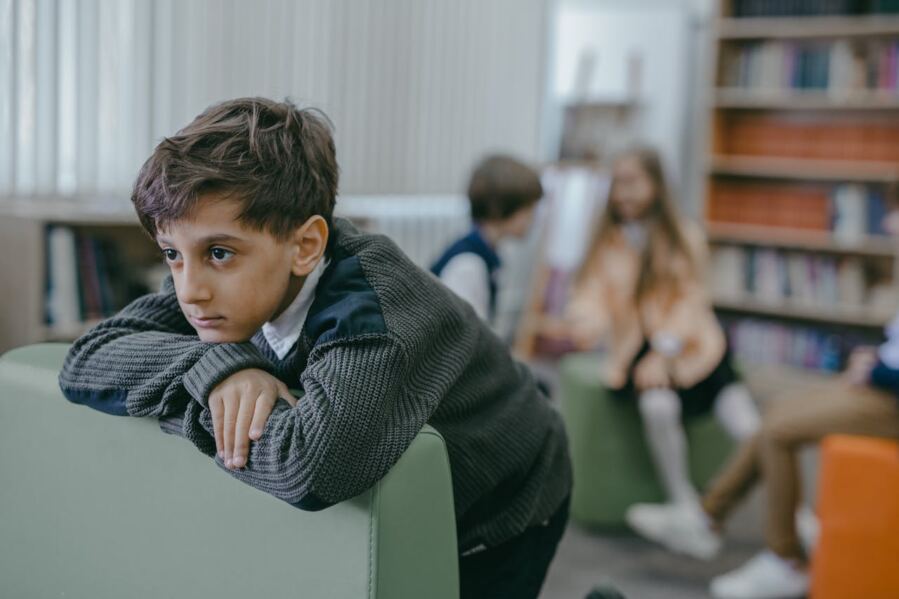
The instinct, when a child is struggling, is to point to the people around them. Friends, family, a parent who loves them. But for children who’ve grown up in homes where violence is ordinary, the social network that’s supposed to protect them turns out to be one of the more complicated parts of the picture. A new study from Radboud University in the Netherlands finds that children who’ve experienced interpersonal trauma, things like witnessing domestic violence or being abused by a parent, tend to have reasonably large social networks. They just can’t use them.
The research, published this week in the Journal of Child and Adolescent Trauma, followed ten children aged 8 to 12, all referred for trauma-focused treatment at a child psychiatry clinic. Researchers mapped each child’s social world in careful detail, asking them to place every person they considered significant within concentric circles of closeness. The average child named around 15 people. Which sounds, on its face, encouraging.
It wasn’t. “These children describe around 40 per cent of their relationships as negative or, at best, ambivalent,” says Mèlanie Sloover, a developmental psychologist at Radboud University and the study’s lead author. Some of the children reported bullying by the very peers they’d listed as friends. Others described fighting family members, or complicated relationships with siblings dragged into the same household chaos. And almost none of them talked about their traumatic experiences with anyone in their network at all. Seventy per cent had spoken to at least one person about what happened to them, but roughly three in ten of those found the conversation unsupportive. On average, children reported having supportive conversations about their trauma with about 10 per cent of their network. Just 10 per cent.
The Problem Starts at Home
For most children, the obvious first port of call would be a parent. For these children, that’s rarely straightforward. “It starts with a complex parent-child relationship,” Sloover says, noting that half the children in the study still placed their father within their social network even when he was the source of their trauma, and that they described those relationships in exclusively negative terms. The loyalty is painful to read about. Children this age often maintain bonds with abusive caregivers not from naivety but from something more evolutionary, a pull toward the attachment figure regardless of what that figure has done.
The situation with mothers was more nuanced, and in some ways more troubling. Most children reported going to their mother first when upset, and most described those relationships as positive. But when it came to actually discussing the traumatic experience, something broke down. Sloover explains: “That may be linked to the fact that mothers themselves are also traumatised by the same situation. It is then difficult to respond sensitively and openly to your child’s story.” In homes where a father has been abusive, the mother is often also a victim, carrying her own PTSD symptoms, her own unprocessed distress. She may love her child, want desperately to help them, and still be unable to hold space for a conversation that reopens her own wounds.
Research on parental PTSD backs this up. Mothers experiencing trauma symptoms tend (without necessarily meaning to) to use a harsher tone in charged conversations, and to be less able to read their child’s emotional needs. A shared narrative about what happened, something therapists consider pretty useful for recovery, becomes difficult to construct when both mother and child are carrying different pieces of the same fractured story, perhaps remembering it differently, or remembering things the other doesn’t know about at all.
The Gap Between Knowing What Friendship Is and Actually Having It
The peer data is where the study gets strange in a particular way. When children were asked to describe what friendship means, they gave lucid and rather touching answers. A friend helps you, they said. A friend doesn’t bully. A friend is kind and trustworthy. “When asked what friendship means, they mention things like being kind, helping each other and trust,” Sloover notes. “But when they describe their own friendships, a different picture often emerges.” Children who’d given warm, idealistic definitions of friendship then described friends who stole their other friends, who bullied them, who they weren’t quite sure why they were friends with in the first place. One child, asked about a peer he’d listed, said he wasn’t sure there were any good things about him. He named him a friend anyway.
There’s a plausible mechanism here that the study raises, though carefully. Children who’ve experienced chronic interpersonal trauma may develop internal working models that make trusting others harder, that orient them toward expecting relationships to be unreliable or unsafe. Evidence from adult PTSD research suggests that disrupted social cognition, difficulty reading others’ intentions, a tendency to interpret ambiguous signals as hostile, is a real feature of the disorder. Whether the same applies to children is less established. But these ambivalent friendships may not just be a result of bad luck.
Attempts to share their experiences with peers often went poorly, not through cruelty but through genuine incomprehension. Friends who’d never had reason to imagine such experiences sometimes simply didn’t believe them, or laughed awkwardly, or changed the subject. For a child already uncertain whether talking was safe, a response like that tends to close the door for a long time.
Where Support Actually Came From
The one setting where children consistently reported feeling understood was peer support groups, contexts where they were speaking to other children who’d been through something similar. “Contact with peers who have been through the same thing appears to feel safe and has a helpful effect,” Sloover says. “Recognition is very important: children don’t have to explain as much and feel understood more quickly.” It’s perhaps not surprising, but it matters. The relief of not having to explain your situation from scratch, of not watching someone’s face as they try to process something outside their experience, is apparently significant even for an 8-year-old.
The clinical implications the researchers draw are arguably as important as the findings themselves. A systemic approach to trauma treatment, one that attends to the child’s whole social world rather than just the child, becomes harder to argue against once you see the data. Sloover puts it carefully: “If a child avoids talking about the trauma, that can be a symptom of PTSD. But it may also mean that previous attempts did not feel safe or supportive. By strengthening and supporting safe relationships, you make an important contribution to a child’s recovery.” That includes working with parents, helping them manage their own trauma symptoms, building the kind of sensitivity and shared understanding that makes a trauma conversation with their child possible rather than retraumatising.
It also means asking better questions. Whether a child has friends is not, it turns out, the right question. The study suggests clinicians should be asking what those friendships look like, whether they provide real support, whether the child has any space at all in which they feel understood. Ten per cent of a network, maybe one or two people, might be all that’s needed. But first you have to find where that 10 per cent is, and for these children, it’s rarely where you’d expect.
Source: Sloover et al., Journal of Child and Adolescent Trauma, 2026
Frequently Asked Questions
Why do traumatized children struggle to talk about their experiences even with people they trust?
Several things tend to be happening at once. Parents, particularly mothers, may be carrying their own trauma from the same events, which makes it genuinely difficult for them to respond with the calm, open sensitivity a child needs. Peers often lack the experience to understand what they’re being told, and children who’ve received a bad reaction once, a laugh, a disbelieving comment, tend to stop trying. Avoidance is also a recognized PTSD symptom, so silence can be the disorder expressing itself rather than simply a choice.
Is it unusual for children to keep abusive parents in their social network?
Research on foster children suggests this kind of loyalty toward abusive parents is actually fairly common, and the study found it here too, with half the children placing their father, who in most cases was the source of their trauma, within their social network. Attachment theory offers one explanation: children may maintain bonds with harmful caregivers partly out of an evolved drive toward the primary attachment figure, regardless of how that figure has behaved. The children who did this described those relationships as negative, which suggests awareness rather than denial.
Could peer support groups help children who’ve experienced family violence?
The children in this study found interactions with peers who’d had similar experiences distinctly more helpful than talking with friends who hadn’t, largely because shared experience meant they didn’t have to explain themselves from scratch. Peer support groups have shown benefits in other contexts, such as bereavement, and the researchers suggest the mechanism is likely similar here: recognition and reduced isolation. Whether structured group programmes translate these informal benefits into consistent clinical outcomes is still an open question.
What does a “systemic” approach to child trauma treatment actually mean in practice?
Rather than treating only the individual child, a systemic approach attends to the relationships around them. That might mean working with the non-offending parent to address their own PTSD symptoms, helping parents develop the sensitivity needed for trauma-related conversations, or building what researchers call a “shared narrative” so that parent and child have a coherent, mutually recognized account of what happened. Trauma-focused cognitive behavioral therapy already incorporates some of this through joint sessions, but the study suggests the relational work deserves more consistent attention than it typically gets.