
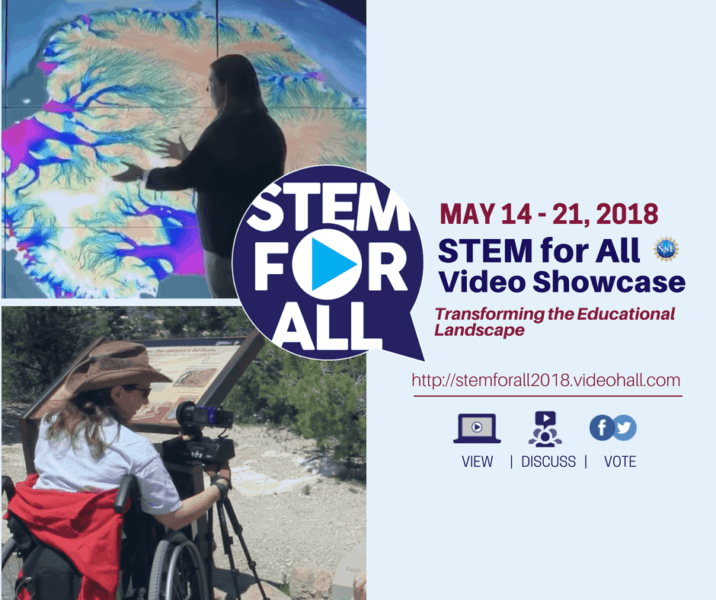
More than 29,143 people from 142 countries have already viewed, voted or commented on their favorite videos in the week-long, National Science Foundation (NSF)-funded 2018 STEM for All Video Showcase, and there’s still time to participate.
The STEM for All showcase is an annual online event that features three-minute video presentations from federally funded projects aimed at improving science, technology, engineering, mathematics (STEM) and computer science education.
Until May 21st at 8 p.m. EDT, visitors to the STEM for All Video Showcase are invited to post to the online discussions related to each of the 214 videos. Visitors are also encouraged to vote for Public Choice award by selecting those videos that they think are most creative and meritorious.
To cast a vote, visitors can choose to tweet, share on Facebook or fill out an email ballot on the site. The Public Choice vote serves to spread word of the event through social media and spotlight NSF-funded work to a broad public audience.
The public, federally funded researchers, practitioners of science and engineering, administrators, policymakers, and industry personnel are encouraged to participate over the event’s seven days.
This year’s three-minute presentations feature innovative projects supported by NSF and six other federal agencies. Featured projects follow these themes:
- Partnerships that advance education
- Broadening participation and access to high quality STEM experiences
- Innovative practices transforming education
- Research informing STEM learning and teaching
The showcase, called “Transforming the Educational Landscape,” features 186 NSF-funded projects, with nearly 150 projects supported by NSF’s Education and Human Resources Directorate.
Visitors to the showcase website can filter video presentations by grade level (kindergarten through graduate school) or by the submitting researcher’s organization, state, topic and more.
ScienceBlog.com has no paywalls, no sponsored content, and no agenda beyond getting the science right. Every story here is written to inform, not to impress an advertiser or push a point of view.
Good science journalism takes time — reading the papers, checking the claims, finding researchers who can put findings in context. We do that work because we think it matters.
If you find this site useful, consider supporting it with a donation. Even a few dollars a month helps keep the coverage independent and free for everyone.