
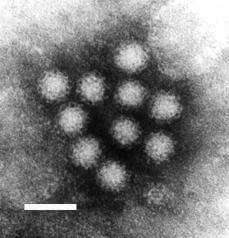
Noroviruses, a group of viruses responsible for over 50% of global gastroenteritis cases, can spread by air up to several meters from an infected person according to a new study by Université Laval researchers. The discovery, details of which are presented in the latest issue of Clinical Infectious Diseases, suggests that measures applied in hospitals during gastroenteritis outbreaks may be insufficient to effectively contain this kind of infection.
The team led by Caroline Duchaine, professor at Université Laval’s Faculty of Science and Engineering and researcher at the Québec Heart and Lung Institute (IUCPQ) Research Centre, conducted the study at 8 hospitals and long-term care facilities affected by gastroenteritis outbreaks. Researchers gathered air samples at a distance of 1 meter from patients, at the doors to their rooms, and at nursing stations.
Noroviruses were found in the air at six of the eight facilities studied. The viruses were detected in 54% of the rooms housing patients with gastroenteritis, 38% of the hallways leading to their rooms, and 50% of nursing stations. Virus concentrations ranged from 13 to 2350 particles per cubic meter of air. A dose of 20 norovirus particles is usually enough to cause gastroenteritis.
According to Professor Duchaine, this previously unknown mode of norovirus propagation could explain why gastroenteritis outbreaks are so hard to contain: “The measures applied in hospital settings are only designed to limit direct contact with infected patients. In light of our results, these rules need to be reviewed to take into account the possibility of airborne transmission of noroviruses. Use of mobile air filtration units or the wearing of respiratory protection around patients with gastroenteritis are measures worth testing.”
ScienceBlog.com has no paywalls, no sponsored content, and no agenda beyond getting the science right. Every story here is written to inform, not to impress an advertiser or push a point of view.
Good science journalism takes time — reading the papers, checking the claims, finding researchers who can put findings in context. We do that work because we think it matters.
If you find this site useful, consider supporting it with a donation. Even a few dollars a month helps keep the coverage independent and free for everyone.