

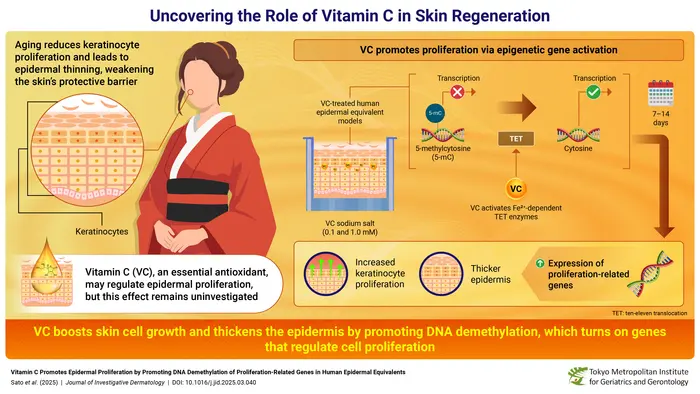
Vitamin C does more than just protect skin from damage—it actually helps regenerate thicker, healthier skin by directly reactivating genes that control cellular growth.
New research reveals that this essential vitamin works at the genetic level, removing molecular “off switches” from DNA to boost skin cell production and potentially reverse age-related thinning.
The study, published in the Journal of Investigative Dermatology, shows that vitamin C promotes DNA demethylation—a process that reactivates silenced genes involved in cell proliferation. This mechanism could explain why vitamin C supplementation appears to improve skin texture and may offer new therapeutic approaches for age-related skin conditions.
Genetic Switches and Skin Renewal
Using laboratory-grown human skin models that closely mimic real tissue, researchers applied vitamin C at concentrations comparable to those naturally transported from blood vessels into the epidermis. The results were striking: skin treated with vitamin C showed significantly thicker cell layers and increased numbers of actively dividing cells.
“VC seems to influence the structure and function of epidermis, especially by controlling the growth of epidermal cells,” explained Dr. Akihito Ishigami, Vice President of the Division of Biology and Medical Sciences at Tokyo Metropolitan Institute for Geriatrics and Gerontology. “In this study, we investigated whether it promotes cell proliferation and differentiation via epigenetic changes.”
The key discovery involves how vitamin C affects DNA methylation—a natural process where methyl groups attach to DNA and essentially turn genes “off.” When vitamin C promotes the removal of these methyl groups, previously silenced genes become active again, particularly those involved in cellular growth and division.
The Molecular Machinery
Vitamin C achieves this genetic reactivation by supporting TET enzymes—specialized proteins that convert methylated DNA back to its active form. These enzymes require iron in a specific chemical state to function properly, and vitamin C helps maintain that requirement by donating electrons to keep the enzymes operational.
The research team identified several key findings about this process:
- Timing: Effects were visible after 7 days and became more pronounced by day 14
- Concentration: Both 0.1 and 1.0 mM vitamin C showed benefits, matching physiological levels
- Specificity: Over 10,000 DNA regions became less methylated, with 12 key proliferation genes showing 1.6- to 75-fold increases in expression
- Cellular activity: Treated skin showed higher numbers of Ki-67-positive cells, indicating active cell division
Beyond Antioxidant Effects
While vitamin C is well-known for its antioxidant properties and role in collagen synthesis, this research reveals an entirely different mechanism of action. The genetic reactivation occurs independently of vitamin C’s traditional functions, suggesting multiple pathways through which this vitamin supports skin health.
When researchers blocked TET enzyme activity using a specific inhibitor, vitamin C’s beneficial effects disappeared. This confirmed that the skin-thickening benefits depend specifically on DNA demethylation rather than other vitamin C functions.
The study also revealed that vitamin C treatment increased global levels of 5-hydroxymethylcytosine—a chemical marker indicating active DNA demethylation—by 5- to 7-fold compared to untreated skin samples.
Targeting Age-Related Changes
As skin ages, the epidermis gradually becomes thinner and loses protective strength. About 90% of epidermal cells are keratinocytes, which originate in deeper layers and migrate upward to form the skin’s barrier. This study suggests vitamin C could help restore this natural renewal process.
“We found that VC helps thicken the skin by encouraging keratinocyte proliferation through DNA demethylation, making it a promising treatment for thinning skin, especially in older adults,” Ishigami concluded.
The research identified 12 specific genes that become reactivated through vitamin C treatment, including ROS1, which showed particularly strong upregulation. These genes are involved in various aspects of cell growth, division, and tissue maintenance.
Clinical Implications
The findings could have significant implications for treating skin conditions characterized by epidermal thinning, including age-related changes and certain genetic disorders. Unlike treatments that simply add protective layers to skin, vitamin C appears to enhance the skin’s own regenerative capacity from within.
The research used human epidermal equivalents—sophisticated laboratory models that recreate the structure and function of real human skin. These models showed proper differentiation markers and realistic tissue architecture, providing confidence that the results translate to actual human skin.
While the study focused on understanding mechanisms rather than immediate clinical applications, the discoveries open new avenues for developing targeted therapies that work at the genetic level to restore youthful skin function and resilience.