

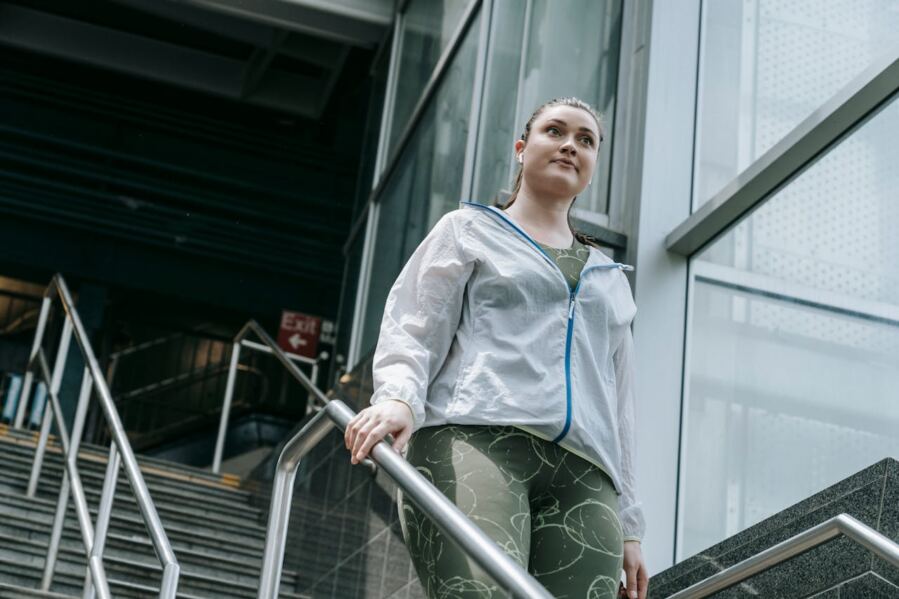
Every gym in the world is built around the wrong half of the movement. The curl, the press, the squat (what we celebrate, what burns, what coaches count) is the lifting phase, the shortening of muscle under load. But there is another half, the lowering, the lengthening, the part where you catch yourself against gravity, and for decades exercise science has been quietly accumulating evidence that this neglected phase does something remarkable. It builds more strength. It costs less energy. And it barely raises your heart rate. Eccentric exercise, as researchers call it, has been hiding in plain sight: in every flight of stairs you descend, every time you lower yourself slowly into a chair.
Ken Nosaka has spent much of his career trying to get people to take this seriously. As director of exercise and sports science at Edith Cowan University in Australia, he’s one of the field’s most persistent advocates, and a new opinion paper in the Journal of Sport and Health Science lays out his case in full: eccentric exercise, he argues, should become the new normal.
The physics here is slightly counterintuitive. When a muscle contracts eccentrically, it is actively resisting a force that is stretching it; think of your quadriceps during stair descent, fighting gravity step by step. The muscle is producing force, but losing the battle in a controlled way. What’s strange is that muscles are actually stronger in this mode than when shortening; they can generate more than 20 percent greater force eccentrically than concentrically, yet they burn substantially less oxygen to do it. The reason likely involves titin, a giant elastic protein within muscle fibers that engages during lengthening to help carry the load, though the exact mechanics remain somewhat murky.
The upshot is a kind of biological free lunch. More mechanical stimulus, less metabolic cost. “You can gain strength without feeling as exhausted,” Nosaka said. “So, you get more benefit for less effort.”
Why Soreness Has Been the Wrong Story
Which raises the obvious question: if this is so good, why don’t people do it deliberately? Part of the answer is that unaccustomed eccentric exercise does have a downside. It causes delayed onset muscle soreness, that familiar ache that arrives the morning after a hard workout and peaks somewhere between 24 and 72 hours later. Gyms have perhaps overcorrected here, treating soreness as a badge of effort rather than a warning sign of novelty. But the soreness issue, Nosaka argues, is largely a solved problem. The mechanism causing it turns out not to be what most people assume. Microscopic muscle fiber tears (the traditional explanation) are probably not the main culprit; damage appears instead to occur primarily in the connective tissue matrix surrounding the fibers, where pain-sensing nerve endings are concentrated. And critically, the body adapts fast. A single bout of eccentric exercise confers lasting protection against soreness from subsequent sessions, sometimes for months. You essentially only have to suffer through it once.
“The idea that exercise must be exhausting or painful is holding people back,” Nosaka said.
Five Minutes a Day, Down the Stairs
The clinical implications of all this are potentially significant, particularly for populations who struggle with conventional exercise. Standard resistance training is limited by what a person can lift concentrically; you can only load the muscle as much as its weakest phase allows. Eccentric-biased exercise sidesteps that constraint entirely. Because the heart and lungs are less taxed, it’s better tolerated by older adults, people with cardiovascular conditions, and those who are simply very deconditioned. A 12-week study of elderly obese women who walked down stairs twice weekly (rather than up) found striking results: resting heart rate dropped by roughly 10 percent, systolic blood pressure fell by around 9 percent, LDL cholesterol by some 13 percent, and strength gains were more than double those achieved by a group doing the same stair-climbing protocol in reverse. The exercise was, in a literal sense, downhill all the way.
A separate 8-week trial tested something simpler still: a home program of five minutes per day involving chair squats, wall push-ups, heel drops, and chair reclines, all movements that emphasize the lowering phase. Not only did participants improve in strength and flexibility; more than 90 percent kept exercising after the study ended. That kind of adherence is close to unheard-of in exercise research. “These movements mirror what we already do in daily life,” Nosaka noted. “When exercise feels achievable, people keep doing it.”
There are wrinkles, naturally. Eccentric training places cognitive demands that concentric exercise doesn’t; you have to concentrate more, control the movement more precisely. Arm muscles are considerably more susceptible to damage than leg muscles, probably because legs spend all day handling low-grade eccentric loads (walking, descending, decelerating) while arms rarely do. And while the repeated bout effect is real, it fades; protection that lasts months will eventually need topping up.
The sports science findings add another layer of interest. In team sports like soccer and rugby, where muscle damage from matches is substantial, Nosaka’s analysis suggests that scheduling matters more than coaches might reckon: teams with longer recovery intervals between games tend to outperform those compressed into tighter schedules. Eccentric training also appears to strengthen the opposite, untrained limb, an effect likely driven by neural adaptations rather than local structural changes, and one with real relevance for rehabilitation after injury.
What Nosaka seems to want, ultimately, is a shift in how we think about the architecture of movement. Exercise culture has fetishised effort as its own reward, made soreness a proxy for progress, built industries around the idea that more pain means more gain. The emerging picture from eccentric research suggests that’s mostly backwards. The muscles best adapted to strength, the lowest injury risk, perhaps even the longest health span, might belong to the people who’ve quietly been paying attention to coming down the stairs.
Source: https://doi.org/10.1016/j.jshs.2026.101126
Frequently Asked Questions
What exactly is eccentric exercise and how does it differ from regular exercise?
Eccentric exercise refers to movements where a muscle generates force while lengthening rather than shortening. Familiar examples include lowering a dumbbell, walking downstairs, or slowly sitting into a chair. Unlike the more celebrated “lifting” phase of exercise, this lengthening phase produces greater force with less energy expenditure, making it unusually efficient as a training stimulus.
Is muscle soreness from eccentric exercise something to worry about?
Not particularly, and the soreness diminishes rapidly with repetition. Research suggests the soreness arises mainly from damage to the connective tissue matrix around muscle fibers rather than to the fibers themselves, and a single bout of eccentric exercise can provide protection against soreness for weeks or even months afterward. Starting at low intensity and progressing gradually virtually eliminates the problem.
Can eccentric exercise really improve cardiovascular health, not just strength?
The evidence suggests yes, particularly for accessible, low-intensity forms like stair descent. A 12-week study found that elderly obese women who walked downstairs twice weekly saw meaningful reductions in resting heart rate, blood pressure, and LDL cholesterol, improvements that exceeded those achieved by a comparison group walking upstairs. Because eccentric exercise is less taxing on the heart and lungs at any given mechanical load, it may suit people who struggle with conventional aerobic exercise.
Do you need gym equipment to do eccentric exercise?
No, and this may be one of its most useful features. Chair squats, heel drops, wall push-ups, and stair descent are all effective eccentric movements that require no equipment and can be done at home. An 8-week trial of a five-minute daily home program using exactly these exercises found substantial improvements in strength, flexibility, and mental health, with unusually high rates of long-term adherence.
Who benefits most from eccentric exercise?
Eccentric exercise appears particularly valuable for older adults, people with chronic health conditions, and those who are very deconditioned, because it can deliver strong mechanical loading without the cardiovascular strain of conventional training. Children and older adults also tend to experience less muscle soreness than young adults in response to it, which may make the transition easier. Athletes also benefit, especially for injury prevention and deceleration performance, but the population with perhaps the most to gain is the one that currently exercises least.