

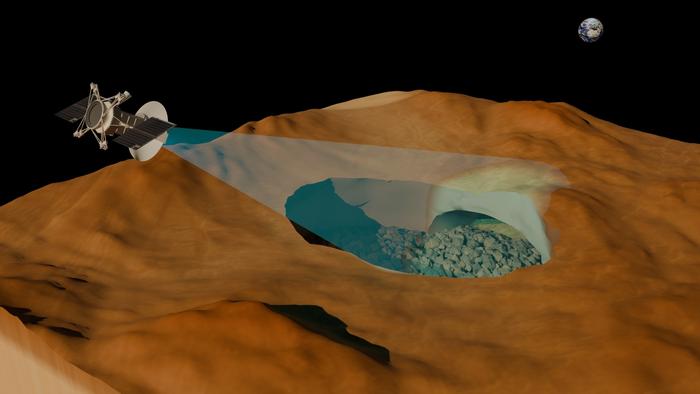
Somewhere on Venus, in a volcanic region named after the Greek goddess of the night, the roof of a tunnel has caved in. The hole is roughly 1.5 kilometres across and about 450 metres deep, a yawning pit on the flank of a massive shield volcano called Nyx Mons. And leading away from it, stretching into the darkness beneath the Venusian surface, is what appears to be a lava tube, a natural tunnel carved by rivers of molten rock perhaps millions of years ago.
We’ve known about lava tubes on the Moon and Mars for some time now. But Venus, shrouded in its thick carbon dioxide atmosphere, has always been harder to read. You can’t just point a camera at its surface and snap a photo. The clouds are too dense, the conditions too hostile. So when NASA’s Magellan spacecraft mapped Venus with radar between 1990 and 1992, it gave us our best (and for decades, only) detailed look at the terrain below.
Now a team at the University of Trento in Italy has gone back to that old Magellan data with fresh eyes and a clever radar analysis technique. What they found, published in Nature Communications, is the first direct evidence of an empty lava tube beneath the surface of Venus. “Our knowledge of Venus is still limited, and until now we have never had the opportunity to directly observe processes occurring beneath the surface of Earth’s twin planet,” says Lorenzo Bruzzone, who heads the Remote Sensing Laboratory at the university’s Department of Information Engineering and Computer Science. “The identification of a volcanic cavity is therefore of particular importance, as it allows us to validate theories that for many years have only hypothesised their existence.”
The tube itself is, by any earthly standard, enormous. Its diameter is about a kilometre, with a roof at least 150 metres thick sitting above an empty void no less than 375 metres tall. To put that in perspective, the largest lava tubes on Earth (like the Corona system on Lanzarote in Spain) reach widths of perhaps 28 metres. We are talking about a structure roughly 35 times wider.
How did the team spot it? Lava tubes form underground, so they’re invisible unless a section of the roof collapses, creating what geologists call a skylight. Venus has plenty of pit chains, long lines of craters that have been spotted in Magellan images before. But most of these pits show radar signatures consistent with simple holes, steep-walled depressions with no tunnel leading away from them. The pit near Nyx Mons was different. Its radar return showed a distinctive asymmetric bright signal extending well beyond the pit margin, a pattern that in previous studies on Earth had been linked to collapsed lava tube roofs providing access to subsurface voids.
Leonardo Carrer, Elena Diana and Bruzzone compared this signature against a known terrestrial analog, Jameo Agujerado on Lanzarote, a collapsed section of the Corona lava tube that has been extensively studied with satellite radar. The backscattering patterns were strikingly similar. Both showed that characteristic well-defined shadow paired with an asymmetric bright return, the sort of radar fingerprint you get when electromagnetic waves travel down through a skylight and bounce off the interior walls of a tunnel stretching away underground.
And the Venusian tube could be far bigger than what the radar directly confirmed. The team can only measure the portion of the cavity close to the skylight (the radar signal penetrated at least 300 metres into the conduit before fading). But surrounding terrain features, the slope of the surface, and the presence of other similar pits in a winding chain all suggest the tube might extend for at least 45 kilometres beneath the surface. “The available data allow us to confirm and measure only the portion of the cavity close to the skylight,” says Bruzzone. “However, analysis of the morphology and elevation of the surrounding terrain … supports the hypothesis that the subsurface conduits may extend for at least 45 kilometres.”
Why should Venus have such oversized plumbing? It comes down to physics, really. Venus has lower gravity than Earth and a much denser atmosphere, conditions that would favour the rapid formation of a thick insulating crust over flowing lava as soon as it leaves the vent. That crust then acts like a lid on a pipe, keeping the molten rock flowing underneath and allowing the tube to grow. Venus also has lava channels far larger and longer than those seen anywhere else in the solar system, so it perhaps shouldn’t surprise us that its underground tunnels are supersized too.
The discovery could matter for reasons beyond Venus alone. Lava tubes on the Moon have been proposed as potential shelters for future human habitats, shielded from radiation and micrometeorite impacts. Understanding how these structures form and how stable they remain across different planetary environments, with different gravities, temperatures and pressures, feeds into that broader question of where we might one day set up camp off-world.
For now though, we are still working with 30-year-old data. Magellan’s radar had a resolution of 75 metres per pixel, which means smaller skylights and tubes would have been invisible. Two upcoming missions could change everything. The European Space Agency’s EnVision and NASA’s VERITAS will both carry radar systems capable of imaging the surface at resolutions of 15 to 30 metres, sharp enough to pick out much smaller pits. EnVision will also carry a ground-penetrating radar able to probe hundreds of metres into the subsurface, potentially detecting intact tubes that have no surface opening at all.
“Our discovery therefore represents only the beginning of a long and fascinating research activity,” says Bruzzone. He’s probably right. We have barely scratched Venus’s surface, quite literally, and there could be an entire hidden network of tunnels down there waiting to be mapped.
Study link: https://www.nature.com/articles/s41467-026-68643-6