

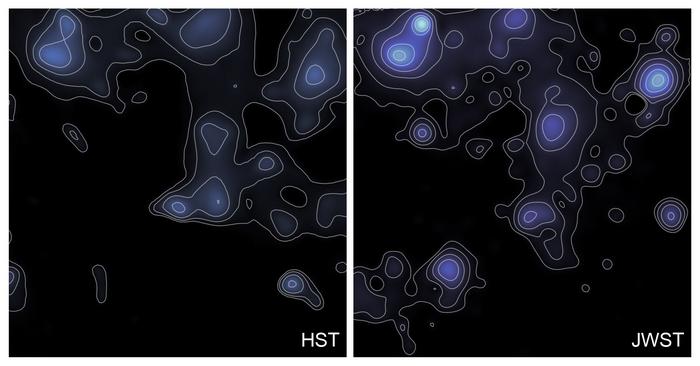
Light bends when it passes through glass. But glass is visible; you can watch the distortion happen. Dark matter is different. You can’t see it at all, yet the universe’s light bends around it just the same, warping and twisting like light through a warped windowpane made of pure gravitational force. Now, for the first time, we’re seeing the invisible scaffolding with stunning detail.
The James Webb Space Telescope has created the highest-resolution map of dark matter ever made, peering at a patch of sky roughly 2.5 times the area of the full Moon and finding something remarkable: everywhere you look, dark and ordinary matter are dancing together, locked in a gravitational embrace that built everything we can see.
To understand what’s happening here, start with a simple fact: roughly five-sixths of all matter in the universe is invisible. That dark stuff doesn’t emit light, doesn’t absorb it, doesn’t reflect it—it simply passes through ordinary matter like a ghost. Yet gravity betrays it. The team at Durham University, NASA’s Jet Propulsion Laboratory, and Switzerland’s École Polytechnique Fédérale de Lausanne spent 255 hours watching light from distant galaxies bend and distort as it travelled through the cosmic web. Each galaxy’s shape got slightly warped by the invisible mass in front of it. Measure thousands of these subtle distortions, and a picture emerges.
Dr Gavin Leroy of Durham’s Institute for Computational Cosmology describes what they found: “By revealing dark matter with unprecedented precision, our map shows how an invisible component of the Universe has structured visible matter to the point of enabling the emergence of galaxies, stars, and ultimately life itself.” The map doesn’t just show isolated clumps. It reveals a cosmic network—filaments connecting galaxy clusters, underdensities where matter is sparse, structures stretching across billions of light-years.
Webb’s resolution is extraordinary. It spotted 129 galaxies per square arcminute, nearly double what the Hubble Space Telescope managed. The result is a map more than twice as sharp as anything Hubble produced, containing ten times as many galaxies as ground-based surveys. These aren’t academic upgrades—they reveal new details about the Universe’s architecture that were literally invisible before.
Among the discoveries: fifteen known galaxy clusters that previous observations could barely detect now stand out clearly. But more intriguingly, the map shows something else entirely. Between these massive structures, the team detected extended filaments of dark matter, tendrils connecting the cosmic web. These structures are too diffuse to shine in X-rays, too spread out to form obvious galaxy overdensities. Yet the gravitational lensing betrays them. They exist, and they’re tracing the paths that normal matter followed billions of years ago.
“This map reveals the invisible but essential role of dark matter,” Leroy continues, “the true architect of the Universe, which gradually organises the structures we observe through our telescopes.” It’s an apt description. In the early universe, shortly after the Big Bang, both dark and ordinary matter were scattered thinly throughout space. Dark matter clumped first, its gravity pulling inward before anything else. Then ordinary matter—the gas and dust that becomes stars and galaxies—gathered into the gravitational wells dark matter created. Dark matter shaped where galaxies could form, how large they’d grow, and where they’d clump together.
Without this invisible architecture, there would be no galaxies, no stars, no planets, no life. We exist in gravitational canyons carved by something we can’t see.
Professor Richard Massey from Durham puts it in perspective: “Wherever you find normal matter in the Universe today, you also find dark matter.” It’s more than a clever observation—it’s a statement about cosmic geography. The alignment isn’t random. The two forms of matter have evolved together, pulled by each other’s gravity, each shaping the other’s destiny. Massey’s next thought makes the connection visceral: “Billions of dark matter particles pass through your body every second. There’s no harm, they don’t notice us and just keep going.”
The scale is difficult to grasp. These aren’t particles slowing down, interacting, leaving traces. They’re just passing through—indifferent ghosts flowing through the cosmos, through us, through galaxies. Yet collectively, they hold everything together. “But the whole swirling cloud of dark matter around the Milky Way has enough gravity to hold our entire galaxy together. Without dark matter, the Milky Way would spin itself apart,” Massey explains. The galaxy’s rotation is so rapid that ordinary matter alone—the stars, gas, dust we can see—doesn’t provide enough gravity to keep it bound. Dark matter fills the gap, providing the invisible glue.
What makes Webb’s achievement particularly striking is how it sees dark matter at different cosmic distances simultaneously. The team measured galaxies at redshifts reaching z ≈ 2, meaning they’re observing light that travelled for over 10 billion years to reach us. At those distances, closer to the beginning of cosmic time, dark matter was assembling the first great structures of the universe—the environments where galaxies formed most vigorously.
Dr Diana Scognamiglio from NASA’s Jet Propulsion Laboratory led the technical work. “This is the largest dark matter map we’ve made with Webb, and it’s twice as sharp as any dark matter map made by other observatories,” she says. The difference between this and previous attempts is almost startling: “Previously, we were looking at a blurry picture of dark matter. Now we’re seeing the invisible scaffolding of the Universe in stunning detail, thanks to Webb’s incredible resolution.”
The technique itself is elegant but demanding. Webb didn’t find dark matter by detecting it—that remains impossible. Instead, astronomers measured how light bends around it, a phenomenon called gravitational lensing. When you observe a distant galaxy, its light has travelled through the universe for billions of years. If invisible matter sits between us and that galaxy, the light bends slightly. The galaxy appears fractionally distorted, elliptical rather than perfectly round. This distortion is tiny—just a few per cent of the galaxy’s natural shape. Measuring it requires extreme precision.
Webb’s infrared vision proved essential. Operating above the blurring effects of Earth’s atmosphere, and looking in infrared wavelengths, it can resolve galaxy shapes with remarkable clarity. The team measured shapes across multiple infrared filters, reducing measurement noise. They identified nearly 800,000 galaxies in the COSMOS field—named for the Cosmic Origins Survey that’s been investigating the same patch of sky across multiple decades with different telescopes. Many of these galaxies were detected for the first time.
The science isn’t finished—it’s only beginning. The team is planning to use this patch of sky as a reference benchmark for future dark matter mapping with the European Space Agency’s Euclid telescope and NASA’s upcoming Nancy Grace Roman Space Telescope. They want to map dark matter across far larger regions of sky, eventually the entire universe. They want to understand how dark matter properties change across cosmic time, and how it might have evolved since the Big Bang.
More immediately, the map raises questions. Some weak lensing peaks—locations where dark matter appears to be concentrated—don’t align neatly with X-ray emission from hot galaxy cluster gas, nor with galaxy overdensities. These could represent dark-matter-dominated structures that produce little light. Or they could result from projection effects, where multiple structures along the line of sight happen to align. The universe, it turns out, is more complex than the simple pictures suggest.
This is what makes the map so valuable. It doesn’t just confirm existing theories, though it does that—the close correlation between dark and ordinary matter’s location matches theoretical predictions. It goes further, revealing fine details of the cosmic web that even simulations struggled to predict. It shows how the universe’s invisible skeleton sculpted the visible cosmos, from the largest galaxy clusters down to structures previously too faint to detect. It captures dark matter at the moment when the universe was forming its most stars, at an epoch called cosmic noon, when star formation reached its peak.
For nearly a century, dark matter was just a hypothesis. Astronomers noticed that galaxies rotated too fast—that the visible matter alone couldn’t provide enough gravity to hold them together. Something invisible had to be there, adding weight, holding systems intact. Over decades, the evidence accumulated until dark matter became as accepted as any invisible phenomenon in physics (like gravity itself, in a sense). But acceptance isn’t understanding. Understanding requires seeing it, mapping it, watching how it behaves across cosmic time and space.
Webb has taken a significant step toward that understanding. Not by detecting dark matter directly—that remains beyond our current technology—but by revealing its gravitational influence with unprecedented clarity. The next generation of surveys will refine this picture further, eventually creating a three-dimensional map of dark matter throughout the observable universe. That map will show us the invisible bones of creation, the gravitational architecture that determined the universe’s fate before the first stars ever ignited.
Until then, we have this map: a portrait of invisible matter in extraordinary detail, showing us the hidden hand that shaped everything visible. It’s a reminder that the universe’s most important ingredient is one we can’t see—and that seeing its effects is sometimes more revealing than seeing the thing itself.