

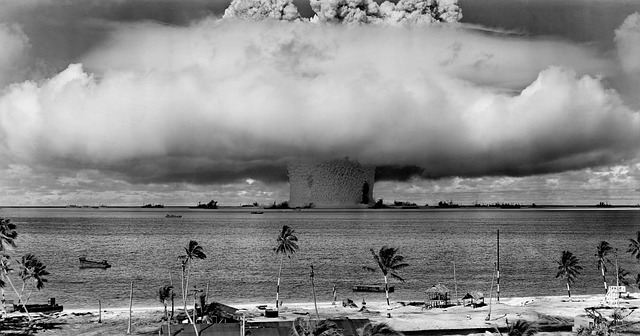
If nuclear war erupts, the blast zone may not be the only place where lives are lost.
According to new simulations from Penn State, a prolonged nuclear winter could devastate agriculture around the world, slashing global corn production by up to 80 percent and triggering food crises lasting more than a decade. The study used one of the most advanced agroecosystem models available to explore how soot in the atmosphere, reduced sunlight, and increased ultraviolet radiation would alter the global growing environment. The researchers say the results point to an urgent need for “agricultural resilience kits” filled with fast-growing, cold-tolerant seed varieties that could keep food systems afloat in the aftermath of catastrophe.
Simulating a Future No One Wants
In a paper published in Environmental Research Letters, researchers modeled six different nuclear war scenarios using the Cycles agroecosystem model, developed at Penn State. These ranged from a smaller regional war between India and Pakistan to a full-scale global exchange involving the U.S. and Russia. Each scenario assumed different levels of soot entering the atmosphere—ranging from 5 to 150 teragrams (Tg)—leading to abrupt global cooling, shortened growing seasons, and dramatic crop losses.
Maize, the world’s most widely grown grain, was used as a proxy to assess the global food supply’s vulnerability. Lead author Yuning Shi said an 80 percent drop in annual corn production could “lead to a widespread global food crisis.” Even the smallest modeled scenario predicted a 7 percent decline, which could still produce major ripple effects in trade, prices, and food security.
Key Findings From the Nuclear Winter Simulations
- A 5 Tg soot injection (regional war) could cause a 7% decline in global corn production.
- A 150 Tg soot injection (global war) could lead to an 80% drop in annual maize yield.
- UV-B radiation from ozone destruction could cause an additional 7% loss.
- It could take 7 to 12 years for crop yields to recover—assuming adaptation strategies are in place.
- Adapting with short-season, cold-tolerant maize could boost production by 10% compared to no adaptation.
Simulations ran at high spatial resolution across 38,572 locations, accounting for soil type, climate, planting schedules, and crop maturity. “This investigation advances our understanding of global agricultural resilience and adaptation in response to catastrophic climatic disruptions,” said Shi.
Damage From the Sky
Nuclear winter isn’t just about cold. The study incorporated UV-B damage for the first time, showing how atmospheric changes from nuclear explosions would dismantle ozone and expose crops to harmful radiation. “This would damage plant tissue and further limit global food production,” said Shi.
While soot initially shields the Earth from UV, it dissipates within years. By then, ozone depletion allows UV-B to reach the surface at damaging levels, peaking six to eight years after a large-scale war. The cumulative effect could push total maize losses to 87 percent.
Can We Adapt in Time?
Switching to short-season, fast-growing maize varieties adapted to cooler temperatures could help. The model showed this strategy could boost production by 10% during the recovery phase. But there’s a catch: availability of the right seeds.
“Seed availability may become a critical adaptation bottleneck,” the team warned. Modern agriculture relies on global supply chains to distribute hybrid seed varieties tailored to specific regions. A breakdown in those systems would make adaptation much harder.
Agricultural Resilience Kits: A Lifeline After Disaster
The team proposes preemptively assembling “Agricultural Resilience Kits” (ARKs) containing region-specific seeds and information for emergency planting. These kits could include cold-hardy wheat, barley, or potatoes, not just maize.
“These kits would help sustain food production during the unstable years following a nuclear war,” said Armen Kemanian, professor of production systems and modeling at Penn State and corresponding author. He added that the ARK concept could also be adapted for other crises, such as volcanic eruptions or extreme weather events.
Shi was candid about the challenges: “Proactive, internationally coordinated planning for such kits is unlikely, but simply increasing awareness could help lead to better preparedness.”
Learning From the Past, Planning for the Future
The researchers compared their predictions to historical events, including the 1815 eruption of Mt. Tambora, which caused the infamous “Year Without a Summer.” That volcanic eruption disrupted global climate for over a year, triggering widespread crop failure and famine.
“One may think that studies of this nature are just navel gazing,” Kemanian said. “But they force us to realize the fragility of the biosphere.”
With global tensions rising, understanding these worst-case scenarios isn’t just academic. As the authors conclude, our society is poorly prepared for global catastrophes—but it doesn’t have to be.
Journal: Environmental Research Letters
DOI: 10.1088/1748-9326/adcfb5
Publication Date: May 13, 2025
Title: Adapting agriculture to climate catastrophes: the nuclear winter case