

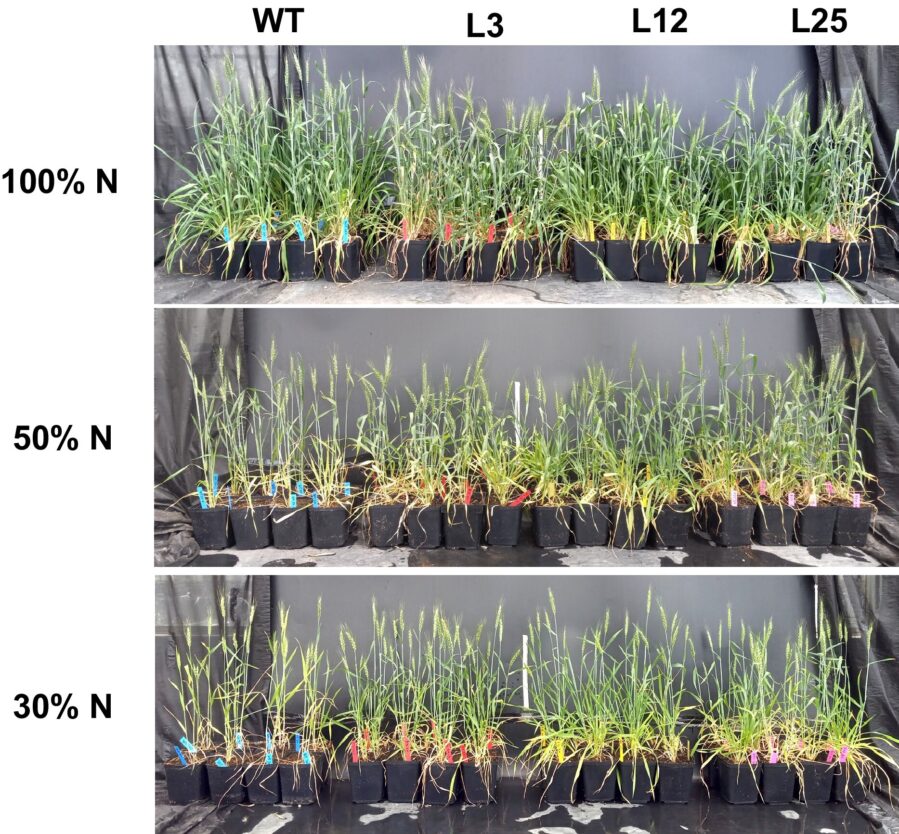
A quiet revolution may be sprouting in wheat fields. Scientists at the University of California, Davis, have used CRISPR gene editing to coax wheat into producing extra apigenin, a natural chemical that nudges soil bacteria to fix nitrogen from the air. The breakthrough, published in Plant Biotechnology Journal, could reduce fertilizer use, cut pollution, and lower costs for farmers worldwide. Wheat, the second most-grown cereal crop, consumes nearly one-fifth of global nitrogen fertilizer. By helping plants fuel themselves, researchers believe the new approach could ease pressure on waterways and the climate, while boosting yields in poor soils.
Turning a Limitation Into an Asset
For decades, crop scientists have dreamed of cereals that fertilize themselves the way beans and peas do. Legumes host nitrogen-fixing bacteria inside nodules on their roots. Wheat and other cereals lack such nodules, leaving farmers reliant on synthetic fertilizer. Eduardo Blumwald, UC Davis plant sciences professor, decided to stop chasing nodules and instead engineer wheat to help free-living bacteria do the job.
“We said the location of the nitrogen-fixing bacteria is not important, so long as the fixed nitrogen can reach the plant, and the plant can use it,” Blumwald explained.
His team screened 2,800 plant-made chemicals, pinpointing 20 that stimulate bacteria to form biofilms. Biofilms act like oxygen shields, protecting the fragile nitrogenase enzyme that converts atmospheric nitrogen into ammonia. Among those compounds, apigenin—a flavone already produced by wheat—proved especially effective. With CRISPR, the researchers edited wheat genes to increase apigenin production. The modified plants exuded surplus apigenin into the soil, triggering bacteria to make biofilms and churn out usable nitrogen. In greenhouse tests, the edited wheat thrived under low-fertilizer conditions, out-yielding unmodified controls.
A Pollution and Cost Problem
Global fertilizer production topped 800 million tons in 2020, and farmers spent nearly $36 billion on it in the U.S. alone last year, according to USDA estimates. Yet crops absorb only about 30 to 50 percent of applied nitrogen. The rest leaks into rivers and oceans, where it fuels algal blooms and oxygen-depleted “dead zones,” or escapes as nitrous oxide, a greenhouse gas 300 times more potent than carbon dioxide.
“Imagine, you are planting crops that stimulate bacteria in the soil to create the fertilizer that the crops need, naturally. Wow! That’s a big difference!” Blumwald said.
In poor regions, the stakes are even higher. Many African farmers cannot afford fertilizer, leading to lower yields and food insecurity. A crop that can self-supply nitrogen could be transformative. Blumwald notes that wheat covers nearly 500 million acres in the United States. Even a 10 percent cut in fertilizer needs, he calculates, could save farmers more than a billion dollars annually.
From Rice to Wheat, and Beyond
The wheat advance builds on the group’s earlier success with rice. In that project, also published in recent years, rice plants engineered for higher apigenin recruited more nitrogen-fixing bacteria and delivered bigger harvests in nitrogen-poor soils. Now, with wheat joining the list, the researchers hope to expand the approach to other major cereals, including maize. Each step matters because cereals, unlike legumes, dominate global diets and fertilizer consumption.
The method is elegant because it avoids tinkering with the bacteria directly. Instead, the plant tweaks its root chemistry to shape a friendlier microbial community. That indirect strategy may skirt some of the bottlenecks that stalled past attempts to transplant bacterial nitrogenase genes into cereals, or to induce pseudo-nodules in roots.
Challenges and Next Steps
Of course, controlled experiments differ from farm fields. Questions remain about stability across soil types, climates, and microbial communities. Farmers will also want to see consistent gains without yield penalties in high-fertilizer environments. Regulatory and patent hurdles loom too: UC Davis has filed for intellectual property, and Bayer Crop Science helped support the work. Still, the idea of engineering crops to better cooperate with their microbial partners is gaining momentum in sustainable agriculture circles.
For now, the prospect of wheat that partly feeds itself is enough to stir some excitement. Fertilizer may not vanish, but even partial reductions could relieve both farmer budgets and environmental stress. And it all starts with a single plant chemical, multiplied through careful editing.
Plant Biotechnology Journal, DOI: 10.1111/pbi.70289