

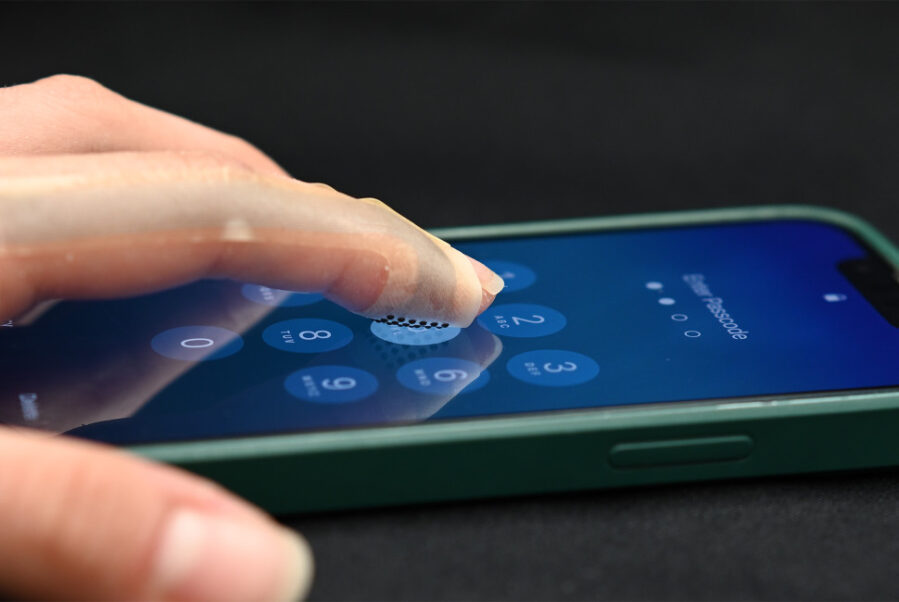
The first moment you hear about a fingertip bandage that lets you feel digital textures, something in you tilts toward disbelief, then curiosity. Northwestern University engineers say their new wearable device, called VoxeLite, can finally match the spatial and temporal acuity of the human fingertip, a claim that carries surprising weight in Science Advances and pushes the field of haptics into territory it has chased for decades.
The idea sounds simple enough. Wrap an ultra thin sheet of soft actuators around a finger, let each tiny node press and tilt with hair trigger independence, and suddenly a flat screen is no longer flat. But simplicity is the wrong word. VoxeLite is a wafer of engineered subtlety: 0.1 millimeters thick, lighter than a gram, and dense with soft electroadhesive nodes that fire patterns faster than touch receptors can blink. The research team sees it as a pathway to genuine digital texture, something the field has long promised and never quite delivered.
“Touch is the last major sense without a true digital interface,” said Northwestern’s Sylvia Tan, who led the study. “We have technologies that make things look and sound real. Now, we want to make textures and tactile sensations feel real.”
A New Kind Of Pixel
What VoxeLite brings to the table is not one big breakthrough, but the combination of two things haptic devices usually can’t do at the same time: produce fine spatial details and respond fast enough to feel natural. Even fewer have done it in a skin conformal, wearable format that stays out of the way during everyday tasks. VoxeLite attempts all three. Its nodes, spaced as tightly as one millimeter apart, act like pixels of touch that can tilt, indent or grip a surface depending on voltage. At high frequencies, they vibrate up to 800 times per second, painting tactile information the way a monitor paints light.
Tan’s team built versions with densities up to 110 nodes per square centimeter. In active mode, the nodes engage an electrically grounded surface and create patterns of friction that generate realistic cues. In passive mode, the nodes retreat into near invisibility, transmitting the geometry of real textures with only a small amount of discretization. Participants in user studies could distinguish directional cues, identify virtual patterns, and, crucially, maintain many of the rough versus smooth distinctions of natural fabrics even while wearing the device.
There is something quietly striking about this duality. A fingertip that can feel the digital world and the physical world without removing its synthetic skin suggests a boundary between virtual and real that is less fixed than we assume. You sense the researchers know this, even if they describe it in the technical language of node spacing, electroadhesion and skin mechanics.
“This work represents a major scientific breakthrough in the field of haptics by introducing, for the first time, a technology that achieves human resolution,” said Northwestern’s J. Edward Colgate, senior author of the study.
Into The Future Of Touch
In practice, VoxeLite’s fiber thin form factor creates possibilities more varied than the research team can realistically explore in a single paper. It could support tactile maps for people with vision impairments, provide fine grained cues in robotics, make virtual reality interactions feel less ghostly, or bring online shopping closer to the tactile certainty of holding fabric in a store. Even the ordinary touchscreen might become something more textured, more conversational, as though its flatness always contained a hidden vocabulary waiting to be unlocked.
Yet the researchers are blunt about the unfinished work. The current electronics are tethered, and scaling the device beyond small fingertip arrays introduces yield and routing challenges. Long term adhesion, sweat, temperature and individual differences in skin mechanics remain practical issues. And the deeper question of how humans perceive densely layered spatiotemporal stimulation has barely been scratched. The team knows wearability is only half the battle. The other half is learning what kinds of tactile patterns feel natural, meaningful or intuitive when mediated by technology.
Still, the ambition is unmistakable. VoxeLite moves digital touch toward realism not by brute force vibration but by a kind of tactile intelligence: tiny nodes that behave less like motors and more like miniature fingertips. It signals a shift in how we might someday read a screen, not with sight alone but with the complex, fast, emotionally fluent language of human touch.
Journal: Science Advances