

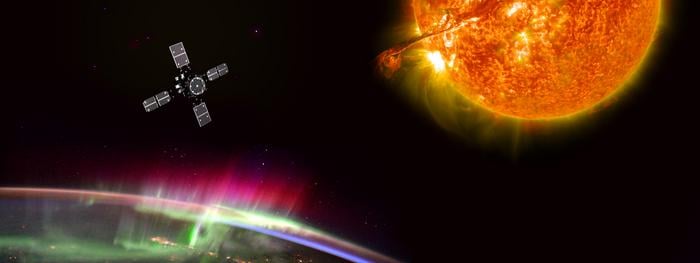
The May 2024 Gannon superstorm squeezed Earth’s plasmasphere to a fraction of its usual size, a planetary contraction so violent it rippled through satellites, GPS signals, and the upper atmosphere. New measurements from Japan’s Arase spacecraft reveal just how dramatically Earth’s protective plasma cocoon collapsed and why it struggled to recover.
In a peer reviewed study published in Earth, Planets and Space, researchers led by Atsuki Shinbori at Nagoya University analyzed Arase spacecraft data along with ground based GPS sensors to capture the most detailed look yet at how Earth’s plasmasphere and ionosphere behaved during the strongest geomagnetic storm in more than twenty years. The team found that the plasmasphere’s outer boundary plummeted from roughly 44,000 kilometers above Earth to just 9,600 kilometers within nine hours, and that recovery stretched beyond four days, far longer than any storm in the Arase era. These observations anchor new insights into how extreme solar events disrupt the plasma environment that protects satellites and communications infrastructures.
Before the storm, the plasmasphere formed a broad, quiet ring of cold plasma co rotating with Earth’s magnetic field. As the Mother’s Day superstorm arrived, multiple coronal mass ejections hammered the magnetosphere, driving a sudden compression that Arase happened to witness from an unusually advantageous orbit. Its instruments recorded a steep plunge in electron density as the plasmasphere shrank to nearly one fifth its normal radius. That collapse was soon mirrored in ground based GPS measurements, which showed unusual daytime surges in total electron content over high latitudes and a strong stream of dense plasma flowing across the polar cap.
A Satellite in the Right Place at the Right Moment
“We tracked changes in the plasmasphere using the Arase satellite and used ground based GPS receivers to monitor the ionosphere, the source of charged particles that refill the plasmasphere. Monitoring both layers showed us how dramatically the plasmasphere contracted and why recovery took so long,” Dr. Shinbori explained.
Arase crossed the inner magnetosphere repeatedly during the storm’s most intense hours, mapping a region of space almost never observed during a disturbance this strong. Its measurements confirmed that the plasmapause, the sharp outer edge of the plasmasphere, plunged from an L value of 7 to 1.5, a location so deep that only a handful of documented storms have ever pushed it that far inward. The collapse was immediate, but the recovery was anything but.
As the storm waned, the plasmasphere should have begun recharging with fresh ions drifting upward from the ionosphere. Instead, Arase saw a sluggish, uneven rebound that took longer than four days, a refilling timescale significantly slower than typical CME driven storms. On the ground, GPS receivers showed why. The ionosphere had entered a major negative storm phase, a chemical and density depletion triggered by intense heating at high latitudes. The loss of oxygen ions starved the plasmasphere of the hydrogen needed to rebuild its structure, cutting off its supply chain at the source.
The Invisible Disruption That Slowed the Plasmasphere’s Healing
“The negative storm slowed recovery by altering atmospheric chemistry and cutting off the supply of particles to the plasmasphere. This link between negative storms and delayed recovery had never been clearly observed before,” Dr. Shinbori said.
These negative storms occurred across magnetic latitudes from the polar cap to the midlatitudes and persisted for more than two days. GPS mapping showed widespread depletion of electron content, confirming that the ionosphere’s chemistry had shifted enough to reduce the flow of ions into near Earth space. The plasmasphere could not rebuild without that pipeline. The team also found that this prolonged depletion coincided with the longest refilling timescale of any storm documented by Arase since its launch in 2016.
The implications are practical and immediate. During the 2024 event, several satellites experienced electrical anomalies, GPS accuracy degraded, and radio communications were disrupted. Knowing how deeply a superstorm can compress the plasmasphere, and how long that system takes to recover, offers an essential constraint for forecasting the impacts of future extreme space weather. More broadly, the findings reveal a tight coupling between ionospheric chemistry and magnetospheric structure during the most powerful solar storms, a relationship that will shape how scientists prepare for the next solar maximum.