

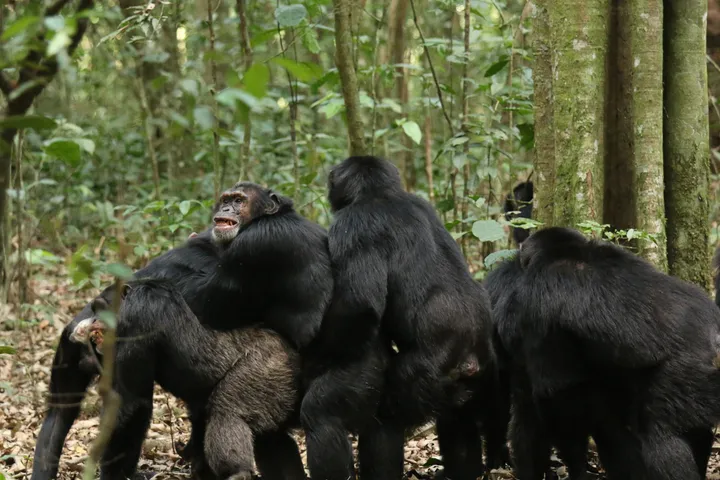
Look at any troop of macaques long enough and you’ll see it: males mounting males, females rubbing genitals with females. Same-sex sexual behaviour has been documented in roughly 1,500 animal species, yet scientists have struggled to explain why it persists. A new study spanning nearly 500 primate species offers the clearest picture yet, and the answer has less to do with genetics than with where animals live and how complicated their social lives have become.
Researchers at Imperial College London compiled data on 491 non-human primate species, finding confirmed same-sex sexual behaviour in 59 of them. The behaviour ranged from rare events (roughly once every 300 hours of observation in common marmosets) to frequent ones (nearly three times per hour in Japanese macaques).
They then asked a simple question: what do those 59 species have in common? The patterns that emerged were striking. Primates living in drier habitats with scarcer food and more predators were significantly more likely to engage in same-sex mounting and genital contact. So were species with pronounced size differences between males and females, longer lifespans, and (here’s the crux) more complex social hierarchies.
When Life Gets Hard, Bonds Get Closer
The logic isn’t difficult to follow. In harsh environments, survival depends on cooperation. Foraging together, watching for leopards together, raising infants together: all of this requires trust. And trust, in primate societies, is built through physical contact. Grooming is the obvious example, but same-sex mounting appears to serve a similar function, reducing tension after conflicts and cementing alliances that pay dividends when food is short or rivals are circling.
Consider the golden snub-nosed monkey, which endures brutal winters in the mountains of central China. Researchers have observed that same-sex interactions spike when temperatures drop and food becomes scarce. Or take bonobos, famously promiscuous apes that use genital rubbing between females to defuse arguments and strengthen friendships. Post-conflict genital contact in bonobos is associated with reduced tension, the researchers note, a proximate effect that may facilitate reconciliation and strengthen alliances. In both cases, same-sex behaviour isn’t a quirk. It’s social glue.
Strict hierarchies present their own challenges. In male rhesus macaques, same-sex mounting helps individuals navigate aggression and shifting dominance. Males who engage in such behaviour are more likely to form coalitions and support each other in competition. The pattern holds across species: solitary primates showed significantly less same-sex behaviour than group-living ones, and species with highly stratified hierarchies showed significantly more. When rank matters, it seems, so does the ability to cultivate allies.
“Same-sex sexual behaviour is an integral part of many non-human primate societies, and it seems to help the animals to bond and maintain group harmony,” said Vincent Savolainen, director of Imperial College’s Georgina Mace Centre for the Living Planet and the study’s senior author.
Genes Play a Modest Role
Earlier work on rhesus macaques estimated that same-sex behaviour is only about 6 percent heritable, meaning the vast majority of variation comes from environment and experience. The new study reinforces this. Using structural equation modelling, the researchers found that ecological pressures shape life history traits (lifespan, body size, degree of sexual dimorphism), which in turn shape social structures. Social complexity then directly promotes same-sex behaviour. Environment and life history matter, but they work indirectly, filtering through the demands of group living.
The researchers are careful to note what their findings do not mean. They examined behaviour in monkeys and apes, not human sexual orientation or identity. Evolutionary patterns in other species cannot justify or explain the full range of human experience, and the authors explicitly reject any misuse of their work to diminish LGBTQ+ lives. What the study does suggest is that same-sex behaviour in primates is neither rare nor aberrant. It appears across lemurs, New World monkeys, Old World monkeys, and apes, pointing to deep evolutionary roots and, quite possibly, multiple independent origins.
For anyone inclined to see animal sexuality as a simple matter of reproduction, the primate evidence is humbling. Sex, it turns out, has always been about more than making babies. It’s about making friends, too.