

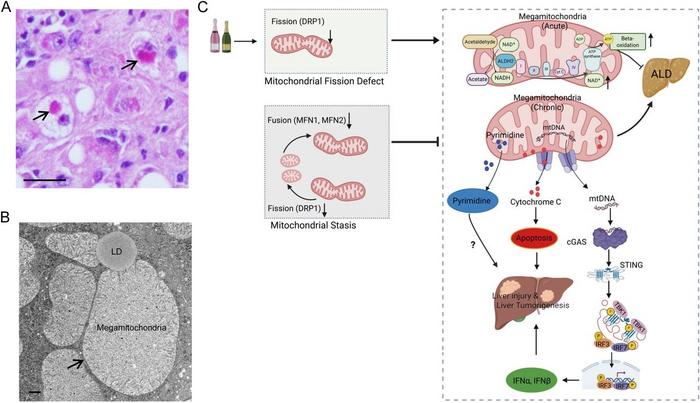
Inside a liver cell soaked in alcohol, something strange starts to swell. The mitochondria, normally a teeming population of small power plants splitting and merging by the minute, begin to balloon. They fuse into giants, swollen spheres and stretched-out tubes that pathologists have been spotting in alcoholic livers since the 1970s. Megamitochondria, they called them. For half a century nobody could say whether they were a wound or a shield.
Now a group at the University of Kansas Medical Center, led by Wen-Xing Ding, thinks the answer is both, just not at the same time. The catch is timing.
Here’s the thing that long puzzled clinicians. Patients whose biopsies showed these oversized organelles tended to do better, not worse: milder symptoms, less cirrhosis, fewer complications, longer survival. An odd result, if you assume a giant mitochondrion is a sick one. Ding and his colleagues, writing in the journal eGastroenterology, pull together several years of their own mouse work to explain why that paradox might hold up, and where it eventually breaks down.
Mitochondria are restless. They constantly divide and rejoin in a cycle called mitochondrial dynamics, fission splitting one into two, fusion welding two into one. It’s quality control, basically. The team found that chronic alcohol throttles a protein called DRP1, the molecular scissors that drive fission. With the scissors blunted, the cutting stops, and the organelles drift into giants. So a megamitochondrion isn’t a mitochondrion that grew. It’s a mitochondrion that never got divided.
And the surprise was what those giants could do. Using bench techniques that measure how hard a cell is breathing, plus a sweep of the liver’s metabolites, the researchers saw alcohol-fed mice ramp up oxygen consumption, push out more NAD+ (the molecule alcohol notoriously drains), and burn fat more efficiently. Not the picture of a poisoned cell at all. The megamitochondria, at least the fresh ones, were pulling extra shifts to detoxify the alcohol and protect the tissue.
Which could explain one of the stubborner mysteries of this disease: why only a minority of heavy drinkers ever progress to severe hepatitis or cirrhosis. Genetics plays a part, certainly. But so, perhaps, does this adaptive scramble, some livers mounting a better metabolic defence than others.
The trouble is that the defence has a shelf life. New megamitochondria help; old ones turn on their host. As the giants persist, they take on damage, mutated mtDNA, broken proteins, and they can’t be cleared away. Mitophagy, the cell’s housekeeping system for junking spent mitochondria, needs them chopped small first, and these are far too big to swallow. So the damaged hulks pile up. Worse, they start leaking their own DNA into the cell’s interior, where it trips an ancient alarm system called cGAS-STING that’s meant to detect invading viruses. The liver, in effect, mistakes its own broken machinery for an infection and lights a slow inflammatory fire, the kind that scars tissue into fibrosis over years.
When the Scissors Go Missing
To see what losing fission really does, the team engineered mice whose liver cells lack DRP1 entirely. These animals developed elevated liver enzymes, fibrosis, and, by 12 to 18 months, spontaneous liver tumours. No carcinogen required; jamming the dynamics was enough on its own.
Then came the genuinely counterintuitive bit. You might assume the fix would be to restore fission, get the scissors working again. Instead the researchers knocked out the fusion machinery too, both mitofusins, MFN1 and MFN2, on top of DRP1. With neither side of the cycle running, the mitochondria settled into a kind of frozen equilibrium the team calls mitochondrial stasis. And these triple-knockout mice fared markedly better: less injury, less fibrosis, fewer tumours, whether the cancer arose spontaneously or was provoked by oncogenes. The cGAS-STING alarm, blaring in the DRP1-only mice, fell almost silent. Delete the cGAS sensor directly and the tumours dwindled too, which nails the inflammatory pathway to the cancer rather than leaving it a bystander.
There was a metabolic tell, as well. The DRP1-deficient livers showed a buildup of dihydroorotate and orotate, intermediates in the manufacture of pyrimidines, the raw nucleotides a cell needs to copy its DNA and keep dividing. Exactly the sort of supply line a growing tumour wants. In the stasis mice, that signal was blunted.
The Guardian That Turns Traitor
It adds up to an argument that balance, not abundance, is what keeps a liver healthy. Not more fission, not more fusion, but the two held in check against each other. Lurch too far either way and the organelles stop being power plants and start being a problem, feeding inflammation, scarring and, eventually, cancer.
The therapeutic reading is tentative but tempting. If stasis protects, then drugs that pin the dynamics in place, a DRP1 blocker such as Mdivi, or mitofusin inhibitors, or compounds that quiet cGAS-STING, might one day slow alcohol-associated liver disease or the cancer it can breed. None of that is settled, and a fair few questions are still open (the adaptive response showed up in mice but, oddly, not in rats, which nobody has fully explained yet). Nor does anyone yet know the moment a helpful young megamitochondrion tips over into a harmful old one, the window clinicians would most want to catch. With alcohol-related liver disease climbing worldwide, working out when the guardian turns traitor may matter more than almost anything else this field could measure.
Frequently Asked Questions
How can a giant, damaged-looking mitochondrion actually protect the liver?
Early on, these enlarged organelles aren’t damaged at all, they’re working overtime. In alcohol-fed mice the fresh megamitochondria consumed more oxygen, produced more NAD+ and burned fat more efficiently, helping the liver detoxify alcohol and limit injury. The protection only fades as the giants age and accumulate damage they can’t repair.
Is it true that scientists fixed the problem by breaking mitochondria even more?
In a sense, yes. Rather than restoring the lost fission machinery, the team also disabled the fusion machinery, freezing the organelles into a state they call mitochondrial stasis. Those triple-knockout mice had less fibrosis and fewer tumours, suggesting it’s the balance between splitting and merging that matters, not the raw amount of either.
How does failing mitochondria lead to cancer rather than just tissue damage?
Old megamitochondria leak their own DNA into the cell, which trips the cGAS-STING alarm normally reserved for viruses, driving chronic inflammation. They also skew pyrimidine metabolism, stockpiling the nucleotide precursors a dividing cell needs. Deleting the cGAS sensor reduced tumours in the mice, tying the inflammatory pathway directly to the cancer.
Could this lead to a treatment for alcohol-related liver disease?
Possibly, though it’s early. Because stasis appeared protective, drugs that lock mitochondrial dynamics in place or quiet the cGAS-STING pathway are candidates worth testing for both liver disease and liver cancer. Researchers still don’t know exactly when a helpful young megamitochondrion becomes a harmful old one, which is the window any such therapy would need to target.
Editor’s note: This article was updated on September 14, 2026, to align its headline and wording more closely with the evidence and sources.