
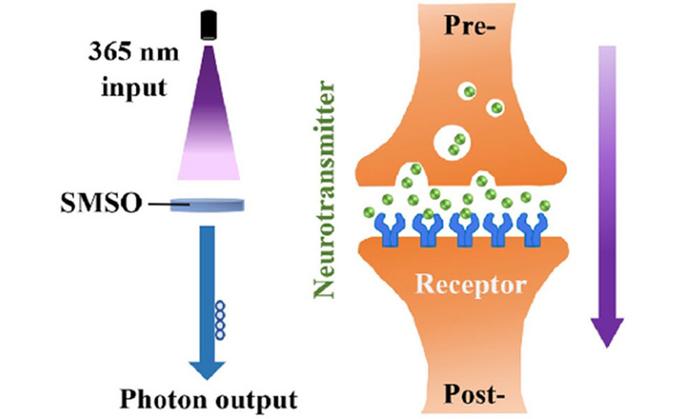
Shine an ultraviolet pulse onto a particular crystal and it glows a soft blue. Switch off the lamp and the glow does not vanish. It lingers, fading slowly, the way a struck bell keeps ringing after your hand leaves the metal. Roughly a quarter of that first burst of light is still there ten seconds later.
That stubborn afterglow, the sort of thing you find in glow-in-the-dark stars stuck to a child’s ceiling, turns out to be the raw material for something rather more ambitious. A team at Nanjing Normal University in China has built an artificial synapse that runs on light alone.
Why does that matter? Because the way most computers handle information is, frankly, a bit daft. Data shuttles back and forth between memory in one place and processing in another, and that constant ferrying eats time and power. The brain does not bother with the round trip. In a biological synapse, the junction where one neuron passes a signal to the next, memory and computation happen in the same spot, which is part of why your head runs on roughly the wattage of a dim light bulb. Building hardware that copies this trick is the whole point of neuromorphic computing.
Plenty of groups have had a go. Most so-called optical synapses, though, still smuggle electricity in somewhere, usually to read out or update the signal, and that electrical step throttles speed and adds noise.
The Nanjing device, reported in Advanced Photonics, dispenses with electricity entirely. Both the incoming signal and the change to the synapse’s internal state are carried by photons. The crystal at its heart, a strontium-magnesium silicate laced with europium and dysprosium, is riddled with what physicists call trap states: tiny energy pockets that can catch a charge carrier and hold it for seconds before letting it go.
Here is where the afterglow earns its keep. When UV light hits the crystal, some excited carriers emit light straight away while others fall into traps and are released later. Fire a second pulse soon after the first and it shines brighter, because the earlier pulse has already filled some of the traps, leaving more carriers free to glow immediately.
A Memory Made of Trapped Light
Neuroscientists have a name for that. It’s called paired-pulse facilitation, and it’s one of the building blocks of short-term memory in real brains, the mechanism by which a synapse briefly strengthens when stimulated in quick succession. The crystal reproduces it without a single wire. And it manages the opposite trick too: swap the ultraviolet for near-infrared light and the second pulse comes back weaker than the first, a suppression effect known as paired-pulse depression. To make sense of all this the team built a mathematical model tracking how the traps fill and empty over time, and the experimental measurements, reassuringly, landed almost exactly where the model said they would, suggesting the behaviour really does come from the trap states rather than from light simply hanging about. A synapse that can both amplify and dampen signals is a far more useful thing than one that only knows how to shout, because suppressing the unimportant is half of what perception is for.
So far, so elegant. But a glowing crystal on a lab bench is not a computer, and to show it could do real work, the researchers slipped a thin film of the material in front of an ordinary silicon camera sensor.
The clever part is that strong light signals linger in the crystal longer than weak ones, so faint speckles of noise fade fast while the genuine image hangs on, and the picture effectively cleans itself up before any processing chip gets involved.
A Camera That Thinks While It Looks
That in-sensor tidying paid off. Feeding the device’s measured behaviour into a simulated neural network, the team had it sort handwritten digits, the MNIST dataset that is the field’s standard proving ground. On noisy images, recognition limped along at about 78 percent. After the crystal’s built-in denoising, accuracy jumped to 95.99 percent, within a whisker of the 97.87 percent you would get from idealised software on clean images. Doing the sensing and the cleaning in the same physical layer, in other words, beat treating them as separate jobs.
There is a catch, and the authors are upfront about it. The crystal works on a timescale of milliseconds to seconds, glacial next to the nanosecond flicker of electronic memristors. It is never going to win a drag race against silicon.
But that sluggishness might be a feature, not a bug. Human vision also runs on hundreds of milliseconds, all afterimages and short-term persistence, which is exactly the regime where this device feels at home. Shrinking it and tweaking the chemistry, the team reckons, could sharpen both the speed and the energy bill.
What you are left with is a single platform that senses, remembers and computes in the same sliver of material, with light doing all the talking. That combination is the long-promised dream of optical computing, and it has stayed a dream partly because the pieces never quite fitted together. A camera that thinks while it looks could matter most at the edges of our networks, in robots and small devices where there is little power to spare and no time to send everything off to a distant processor.
Whether a humble afterglow phosphor, the same broad family of stuff that makes watch hands visible in the dark, ends up underpinning the next generation of seeing machines is anyone’s guess. The brain spent a few hundred million years learning to fold memory and perception into one organ. Catching up, it seems, might start with a crystal that simply refuses to stop glowing.
Source: Y. Yan et al., Advanced Photonics (2026), doi:10.1117/1.AP.8.4.046001
Frequently Asked Questions
How can a crystal store information without any electronics?
The material is shot through with microscopic energy traps that can catch a light-excited charge carrier and hold it for several seconds before releasing it. That delayed release is the memory: the crystal’s response to a new light pulse depends on how full its traps already are from previous pulses. Because both the input and the change in state are purely optical, no wires or electrical readout are involved at any stage.
Why would anyone want a synapse that is slower than ordinary computer chips?
Speed is not always the goal. The crystal operates on a timescale of milliseconds to seconds, which happens to match how biological vision actually works, with afterimages and brief persistence. For tasks like cleaning up and recognizing images at the point of capture, that pace is an asset rather than a handicap, and it sidesteps the energy cost of shuttling data to a separate processor.
Could this lead to cameras that process images on their own?
That is exactly the direction the work points. By placing a thin film of the material in front of a standard silicon sensor, the researchers built a prototype that suppresses visual noise before any processing chip sees the picture. Such self-cleaning, self-computing sensors could be especially valuable in robots and small edge devices where power and processing time are scarce.
Is in-sensor denoising actually better than cleaning images afterward?
In the team’s tests it was. A neural network reading noisy handwritten digits managed only about 78 percent accuracy, but once the crystal cleaned the images at the sensor itself, accuracy climbed to nearly 96 percent. Folding sensing and processing into one physical layer, it turns out, can beat handling them as separate steps.
ScienceBlog.com has no paywalls, no sponsored content, and no agenda beyond getting the science right. Every story here is written to inform, not to impress an advertiser or push a point of view.
Good science journalism takes time — reading the papers, checking the claims, finding researchers who can put findings in context. We do that work because we think it matters.
If you find this site useful, consider supporting it with a donation. Even a few dollars a month helps keep the coverage independent and free for everyone.