

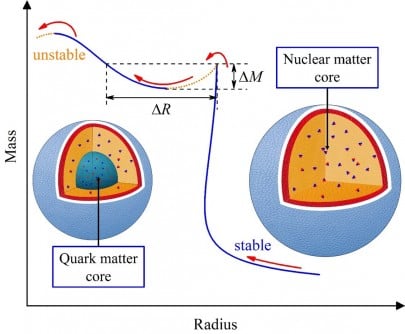
Neutron stars are already some of the universe’s strangest objects—ultra-dense stellar remnants just a few miles wide but more massive than our Sun.
But what happens when two neutron stars have the same mass yet different sizes? A new study offers fresh insight into these “twin stars,” revealing which physical factors allow these mysterious pairs to coexist and how we might detect them in the future.
Decoding the Equation of State
At the heart of the mystery is something called the equation of state (EOS), a formula that connects the pressure and energy density of nuclear matter inside a neutron star. Since direct experiments inside such stars are impossible, scientists use a variety of models and observations to narrow down what the EOS might look like. In this case, researchers used a meta-model—essentially a flexible template capable of simulating many different EOS scenarios—to explore when and how twin stars can form.
“Twin stars—two stable neutron stars with the same mass but different radii—have long been proposed to appear as a consequence of a possible first-order phase transition in NS matter,” wrote study authors Nai-Bo Zhang and Bao-An Li in their paper.
What Makes a Twin Star Possible?
The team analyzed how specific EOS parameters influence twin star formation. These included properties of both nuclear and quark matter, as well as details of the phase transition between them. While the symmetric nuclear matter (SNM) EOS had little effect, the nuclear symmetry energy—particularly its slope (L) and curvature (Ksym)—played a much larger role.
Key findings included:
- Twin stars typically coexist only within a narrow mass range of about 0.05 solar masses (ΔM).
- The maximum radius difference (ΔR) between twin stars was less than 2 km—below current detection thresholds.
- Higher transition densities and energy discontinuities (Δε) between nuclear and quark matter favor twin formation.
- The slope L and curvature Ksym of the nuclear symmetry energy substantially affect twin star likelihood.
The study also confirmed that “the EOS of SNM does not significantly influence the formation of twin stars,” but the symmetry energy components do. The curvature Ksym and slope L influence the star’s radius and behavior at the phase transition, which is crucial for distinguishing twins observationally.
Why Twin Stars Are So Hard to Spot
Although the study confirmed that twin stars can exist within realistic EOS scenarios, they remain frustratingly difficult to detect. The predicted radius difference is less than 2 km—too small for current X-ray or gravitational wave instruments to resolve with confidence.
However, the authors are optimistic that future observatories, including next-generation X-ray telescopes and gravitational wave detectors, could pinpoint these elusive twins. “Such high precision radius measurements certainly will help identify twin stars,” they wrote.
Implications for Physics and Observation
Why does it matter whether twin stars exist? Confirming their existence would provide strong evidence for a phase transition inside neutron stars—from regular nuclear matter to exotic quark matter. That, in turn, would open a new window into how matter behaves under some of the most extreme conditions in the universe.
The authors also note the possibility of “thermal twin stars”—a variant that could form at temperatures around 30 million degrees Kelvin, relevant to the early stages of supernova remnants or neutron star mergers. This further expands the search space for finding twins across cosmic events.
Looking Ahead
For now, twin stars remain a theoretical but tantalizing possibility. But thanks to this work, scientists now have a clearer map of where to look and what signs to focus on. With improved models and sharper observations, the question of whether nature produces these cosmic doppelgängers might soon be answered.
Journal and Study Information
Published in: EPJ Manuscript (preprint via arXiv)
Title: Impact of the nuclear equation of state on the formation of twin stars
Authors: Nai-Bo Zhang and Bao-An Li
DOI/Preprint: arXiv:2406.07396v2