

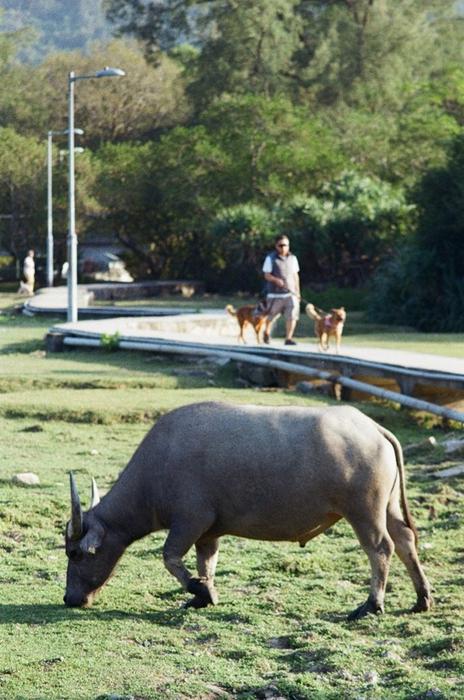
In the marshlands of Hong Kong’s South Lantau Island, where skyscrapers give way to wetlands, roughly 115 feral water buffalo have become unlikely neighbors to humans—and opinions about these massive ungulates are as diverse as the city itself.
A comprehensive study published in People and Nature reveals that demographic factors like age, ethnicity, and proximity dramatically shape how residents view their bovine cohabitants.
Researchers from City University of Hong Kong surveyed 657 residents to understand public attitudes toward the buffalo population that has roamed the island since the 1970s, when rapid urbanization led farmers to abandon their livestock. The findings paint a complex picture of human-wildlife coexistence in one of the world’s most densely populated regions.
Four Shades of Opinion
“Some see the buffalo as a living link to the territory’s rural past, while others worry about safety, environmental impact, or traffic disruptions,” explains lead investigator Alan McElligott, a specialist in animal behaviour at City University’s Jockey Club College of Veterinary Medicine and Life Sciences.
The research identified four distinct attitude categories toward the buffalo:
- Tolerance and Appreciation: 61% neutral, 25% highly positive, 14% highly negative responses
- Social Benefits and Advocacy: 66% neutral, 19% highly positive, 15% highly negative
- Preservation and Education: 46% neutral, 41% highly positive, 13% highly negative
- Daily Life Impact: 49% neutral, 27% highly positive, 23% highly negative
Perhaps most striking were the demographic patterns that emerged. Older residents, women, and Caucasian respondents showed significantly higher tolerance and appreciation for the buffalo. South Lantau residents—those living closest to the animals—expressed the strongest positive attitudes across all categories.
Geography of Attitudes
“We found that familiarity with wildlife in rural areas often leads to more positive perceptions,” McElligott notes. The study revealed stark differences between urban Hong Kong Island and Kowloon residents versus those in the New Territories, where the buffalo roam.
Hannah Mumby, a specialist in applied behavioural ecology at the University of Hong Kong and co-author of the study, observed that “emotional responses were common in interviews, with a majority expressing fondness for the buffalo or neutral attitudes, and a minority noting concern over safety risks.”
The research went beyond simple surveys, collecting 207 additional comments from 56 participants that revealed three major themes: safety concerns, emotional connections, and livelihood impacts. Twenty-nine participants mentioned buffalo blocking roads, damaging crops, or rummaging through rubbish bins. Twenty-six raised safety concerns, including five reports of buffalo injuring people.
Cultural Divides
The study uncovered intriguing cultural patterns. Respondents of Chinese origin showed lower tolerance compared to Caucasian participants, while those born in mainland China expressed less appreciation than Hong Kong natives or overseas-born residents. These differences likely reflect varying cultural perspectives on conservation and animal welfare.
Despite challenges, many participants valued the buffalo for their ecological role and cultural significance. As Kate Flay, a livestock health specialist at City University, points out: “Yet they provide an accessible link to nature and an opportunity to understand human-animal interactions in such landscapes.”
The buffalo’s story mirrors broader global trends of human-wildlife coexistence in increasingly urbanized landscapes. These animals help preserve freshwater marshland biodiversity through grazing and trampling, preventing the conversion of wetlands to dry land.
For Hong Kong—a territory where three-quarters of the land remains covered in subtropical landscapes despite extreme urban density—the buffalo represent both a conservation success and a management challenge. The findings suggest that fostering coexistence requires understanding and respecting the diverse perspectives of all human neighbors in this unlikely urban-wildlife partnership.