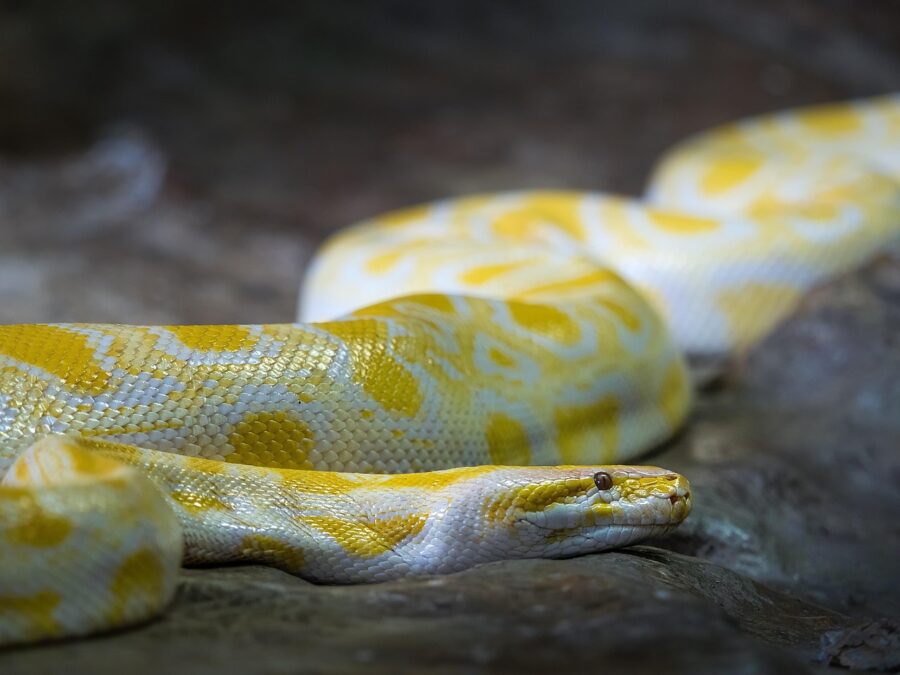
Most predators leave bones behind when they eat, but Burmese pythons swallow their prey whole—skeleton and all. Now scientists have discovered how these massive snakes accomplish this feat: they’ve evolved specialized intestinal cells that capture excess calcium and phosphorus from dissolved bones, preventing potentially fatal mineral overload.
The discovery, published in the Journal of Experimental Biology, reveals a previously unknown cell type that functions like microscopic waste management centers. These cells create calcium-rich particles and store them in internal crypts before expelling them as waste.
The Bone-Dissolving Challenge
“We wanted to identify how they were able to process and limit this huge absorption of calcium through the intestinal wall,” explains Dr. Jehan-Hervé Lignot, a Professor at the University of Montpellier who led the research.
When pythons digest entire skeletons, massive amounts of calcium and phosphorus flood their intestines. Too much calcium in the bloodstream can prove lethal, yet snakes fed boneless prey develop calcium deficiencies. The research team wondered: how do pythons extract what they need while avoiding toxic overload?
Using light and electron microscopy, the scientists analyzed python intestinal cells after feeding the snakes three different diets: whole rodents, “boneless prey,” and boneless rodents injected with calcium carbonate supplements.
Microscopic Mineral Factories
The analysis revealed extraordinary cellular architecture. Unlike typical intestinal cells that absorb nutrients, these specialized cells are narrow with short microvilli and feature an internal fold forming a crypt—essentially a storage chamber.
“A morphological analysis of the python epithelium revealed specific particles that I’d never seen in other vertebrates,” Lignot notes. These particles, composed of calcium, phosphorus, and iron, accumulate within the cellular crypts like mineral deposits.
The cells respond dynamically to diet:
- Fasting snakes: crypts remain empty
- Boneless prey diet: no particles form, only iron elements appear
- Whole rodent or calcium-supplemented diet: crypts fill with large mineral particles
- Repeated low-calcium feeding: blood calcium drops while hormone levels spike
Crucially, researchers found no bone fragments in python feces, confirming complete skeletal dissolution. The specialized cells capture dissolved minerals and package them for elimination rather than allowing dangerous accumulation in the bloodstream.
Evolutionary Implications
The research team identified these bone-processing cells in multiple python and boa species, plus the Gila monster—a venomous lizard from the American Southwest. This suggests the cellular adaptation evolved independently or represents an ancient vertebrate mechanism.
The discovery raises intriguing questions about other whole-prey predators. “Marine predators that eat bony fish or aquatic mammals must face the same problem,” Lignot observes. “Birds that eat mostly bones, such as the bearded vulture, would be fascinating candidates too.”
Blood analysis revealed that pythons fed low-calcium diets showed elevated parathyroid hormone and calcitonin levels—the same hormones that regulate calcium metabolism in humans. This suggests the cellular mechanism integrates with broader physiological systems.
Nature’s Waste Management
The findings illuminate how evolution solves complex physiological challenges. Rather than simply avoiding bones like most predators, pythons developed cellular machinery to safely process skeletal material—transforming a potential toxin into a manageable waste product.
This research, presented at the Society for Experimental Biology Annual Conference, opens new avenues for understanding mineral metabolism across species. The python’s solution—specialized cells that capture and concentrate excess minerals—represents a unique biological innovation that may prove more widespread than previously imagined.
Discover more from Wild Science
Subscribe to get the latest posts sent to your email.
