

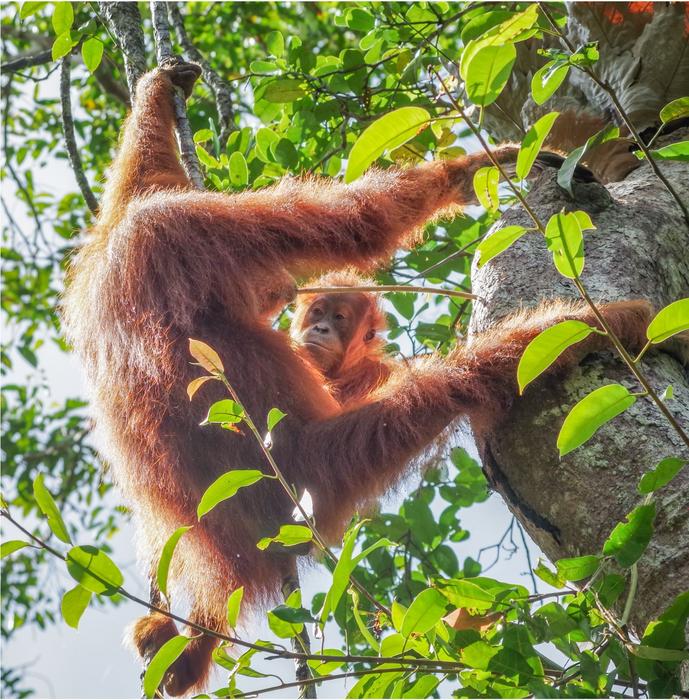
Before a young orangutan ever forages alone in the forest, its mind is already carrying a crowded library of cultural knowledge. A new study in Nature Human Behaviour, led by researchers at the Max Planck Institute of Animal Behavior and based on 12 years of field data from Sumatran orangutans, shows that this library does not come from trial and error alone. Instead, orangutan diets form what the authors call a culturally dependent repertoire, a body of knowledge that no single individual could assemble without years of social learning.
The numbers are stark. Wild adult orangutans at the Suaq Balimbing site in Indonesia regularly exploit close to 250 different food items, from plant parts to termites. By the time immatures break from their mothers and begin ranging independently, they already command about 90 percent of this menu. The central question of the new work is deceptively simple: could a solitary youngster, relying only on its own curiosity and the sheer number of encounters with foods, ever reach that breadth in time to survive?
Simulating A Cultural Cuisine
To answer that, first author Elliot Howard-Spink and colleagues did not try to manipulate real orangutan families. Instead, they turned an enormous archive of observational records into an agent based model that plays out an orangutan life, day by day, from birth to age fifteen.
The raw ingredients for the simulation came from 22,547 hours of observation on 132 Sumatran orangutans followed between 2007 and 2019. From these data, the team estimated how many feeding patches mothers visit per day (about 27), how often immatures are near other individuals, when they stare intently at others while they feed, and how frequently they explore unfamiliar items in each of these social situations.
In the virtual forest, each simulated youngster began life knowing nothing about the 262 possible food items available in the environment. Every day, the model sent that immature through a realistic sequence of feeding patches. If it had already learned a given item, it fed. If not, it faced a choice: explore the unknown food or move on.
Crucially, the probability of exploration changed with both age and social context. The model tracked three major types of social input identified in the field:
- Exposure: simply being guided by a mother to feeding sites across the home range.
- Enhancement: being in close proximity to a feeding conspecific, which boosts the chance of trying similar foods.
- Peering: close range observing of another individual processing food, which further increases exploration in the moments that follow.
When all three processes were switched on, simulated orangutans accumulated diets that matched the real animals remarkably well. Most reached an adult like repertoire of around 224 foods by roughly 7.5 years of age, in line with the observed age at which wild immatures become energetically independent from their mothers.
“We provide convincing evidence that culture enables wild orangutans to construct repertoires of knowledge that are much broader than they could otherwise learn independently,”
said Howard-Spink, who conducted the work at the Max Planck Institute of Animal Behavior and is now at the University of Zürich. That breadth, the team argues, is not just a reflection of general intelligence or patience. It is the product of a social environment that steers exploration toward the right foods at the right moments in development.
What Happens When Culture Is Stripped Away
The real test of cultural dependence came when the modelers began systematically removing social learning opportunities. First they disabled peering, leaving only exposure and enhancement. Under these conditions, youngsters still learned, but their diets grew more slowly and plateaued at about 85 percent of the wild adult repertoire. Most never reached the adult like threshold by the end of immaturity.
Then the authors went further, removing both peering and close proximity enhancement, leaving only exposure to feeding sites. Now, despite encountering an average of nearly 148,000 feeding patches over their youth, simulated orangutans stalled far below wild diet breadths. None achieved an adult like repertoire by age fifteen.
In other words, mere contact with foods, even repeated hundreds of thousands of times, was not enough. Without the bias provided by watching and shadowing others, especially during the long years of dependence on mothers, the cultural cuisine of the forest remained out of reach.
“In the wild, the constant presence of a mother, and fleeting associations with other individuals, are critical for orangutan learning and development during the early years,”
“It offers a crucial apprenticeship that paves the path to independence.”
said senior author Caroline Schuppli, who leads the study at the Max Planck Institute of Animal Behavior. Her word choice, apprenticeship, captures what the model quantifies: orangutan childhood is not just a time to grow stronger bodies, it is a structured learning period in which culture is densely downloaded.
Rethinking Great Ape Culture
The authors frame these findings in terms of culturally dependent repertoires. In humans, many domains of knowledge are so broad or so technically intricate that no individual could recreate them from scratch, from local medicinal traditions to modern engineering. This work suggests that, at least for diet, orangutans occupy a similar conceptual space. Their everyday survival depends on a menu that, in practice, only emerges from many lives of exploration and innovation layered across generations.
The implications reach beyond theory. Conservation programs for orphaned orangutans already try to teach basic foraging skills before release. The new study underscores that it is not enough to show a few iconic foods. To approximate a wild life, these animals may need access to a far richer cultural menu, tailored to the specific forests where they will live, and delivered through sustained social learning rather than isolated lessons.
The authors also point out that adult orangutans are mostly solitary, which concentrates cultural transmission into a relatively short, early window. If that window is disrupted, by habitat loss, hunting, or the fragmentation of social groups, what is at risk is not only population numbers but the accumulated diets that those populations carry.
Seen this way, orangutan conservation is about protecting lineages of knowledge as much as lineages of genes. The cultural roots of our own species may reach deep into a shared past with great apes, and one of the clearest traces of that shared inheritance may be written not in stone tools, but in the invisible mental maps that tell a youngster which leaf to chew, which stem to strip, and which log to pierce for termites.
Journal: Nature Human Behaviour
Article title: Culture is critical in driving orangutan diet development past individual potentials
DOI: 10.1038/s41562-025-02350-y