

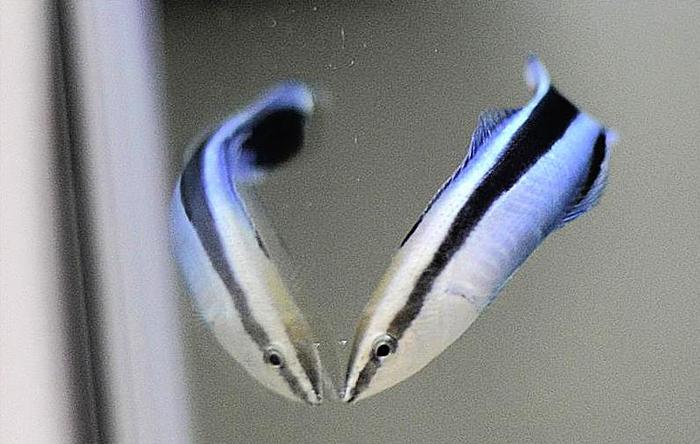
The fish had never seen a mirror before. It had, however, been injected with a small brown mark on its throat — the sort of patch that, to a cleaner wrasse living on a coral reef, signals something rather alarming. A parasite. The kind of thing you’d want off you immediately. The trouble was, with no mirror and no angle of vision that could reach its own throat, the fish couldn’t see it.
Then the mirror appeared.
Within half an hour, the fish was scraping its throat against the substrate, trying to remove the mark it had just, for the first time, glimpsed on its own reflection. Not days later, as previous experiments had always found. Thirty minutes. The cleaner wrasse, it turns out, already knew what it looked like.
This is the finding at the centre of a study published in Scientific Reports by Shumpei Sogawa and colleagues at Osaka Metropolitan University, and it has a way of quietly dismantling some long-held assumptions about the nature of animal minds. The classic mirror test — marking an animal and watching whether it tries to remove the mark when it sees itself reflected — has been used for more than 50 years to probe self-awareness. Chimpanzees passed. So did dolphins, elephants, a magpie. Most animals failed. The standard interpretation: true self-recognition is rare, cognitively demanding, possibly the signature of an elite club of large-brained species.
Cleaner wrasse started complicating this picture a few years ago, when they too passed the mark test. Sceptics pushed back, hard. The fish, critics argued, couldn’t really be self-aware — the cognitive architecture just wasn’t there. Perhaps they were responding to some odd visual stimulus, not recognising a self at all.
What Sogawa’s team did was deceptively simple. Instead of exposing fish to a mirror for days before applying the mark — the usual sequence — they reversed the order. Mark first. Mirror second. “In earlier cleaner wrasse mirror studies,” says Sogawa, “the procedure was typically the fish see a mirror for several days, they habituate to it and stop reacting socially, and a mark is added.” Here, though, the fish encountered the mirror as a complete novelty, already carrying something strange on their body they couldn’t see. “The fish were likely aware of something unusual on their body, but they couldn’t see it. When the mirror appeared, it immediately provided visual information that matched an existing bodily expectation, hence scraping occurred much faster.”
Six of nine fish attempted to remove the mark within two hours. The fastest managed it within 30 minutes. The previous benchmark was 4 to 6 days. That gap is not incidental — it’s the whole argument. An animal that needs days of mirror exposure to eventually, laboriously, work out that the reflection is itself might plausibly be doing something other than self-recognition. An animal that glances in a mirror and immediately reaches for the strange patch on its own throat is harder to explain any other way. It already had a mental model of its own body. The mirror just told it something that model didn’t cover.
The behavioural data grew richer the longer the researchers watched. Before self-recognition occurred, the fish behaved predictably: brief aggression toward the stranger in the glass, then a period of careful contingency-testing — hovering close, mirroring their own movements, apparently checking whether the reflection mimicked them. These stages were sharp and distinct. Non-overlapping. Aggression stopped before contingency-testing began; contingency-testing stopped before the fish tried to remove the mark. The sequence was clean in a way that previous studies, which had never pinned down the exact moment of recognition, couldn’t have detected.
Then came something stranger. Days after passing the mark test, three of the fish were observed picking up small pieces of shrimp from the tank floor, lifting them about 10 to 25 centimetres, and dropping them close to the mirror. They then followed the shrimp down the glass with their mouths, watching its descent in the reflection. They weren’t trying to eat it. They were, the researchers argue, testing the mirror itself — watching how an external object behaved in mirror space, exploring the logic of reflection with a prop that wasn’t their own body. Similar behaviour has been recorded in manta rays watching rising bubbles, and in bottlenose dolphins that produce and play with bubbles in front of their reflections. Highly social, cognitively sophisticated animals, both of them.
A small coral reef fish doing the same thing changes the shape of the question.
The implications fan out quickly. There are two broad evolutionary hypotheses for how self-awareness came to exist. One holds that it evolved once, in the common ancestor of the great apes — a kind of cognitive Big Bang. The other allows for a more gradual spread, a gradient from simple to complex self-awareness across taxa. Neither quite anticipated a cleaner wrasse. “These findings suggest that self-awareness may not have evolved only in the limited number of species that passed the mirror test but may be more widely prevalent across a broader range of taxonomic groups, including fish,” says Sogawa. His co-author Professor Masanori Kohda goes further, suggesting the work will influence not just evolutionary theory but animal welfare, medical research, and even AI studies.
What the research really implies, though, is that the mark test itself may have been producing false negatives for decades. An animal fails the mark test; researchers conclude it lacks self-awareness. But what if the experimental setup — weeks of mirror exposure before the mark is applied, attention directed to a body part the animal rarely inspects — simply doesn’t match how that animal’s self-recognition works? The cleaner wrasse might have been self-aware all along. We just weren’t asking the right way.
Sogawa’s team now suspect that many species currently listed as failing the mirror test — pigs, rhesus monkeys, various corvids — might pass a version better suited to how they actually process information about themselves. The shrimp-dropping behaviour, the rapid throat-scraping, the clean behavioural transitions: they all suggest self-awareness is less a rare prize awarded by evolution to a handful of exceptional species and more a feature that bony fishes may have possessed for, at a rough estimate, 450 million years.
That’s rather a long time for us not to have noticed.
Study link: https://www.nature.com/articles/s41598-025-25837-0