

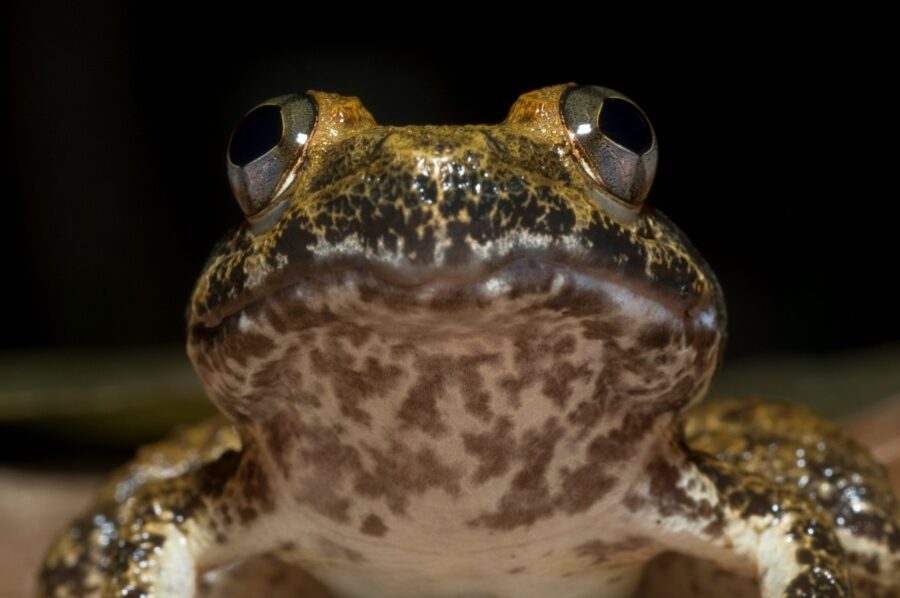
The species boundary is one of biology’s oldest fictions. A line we draw, then argue about, then redraw. In the rainforests of Malaysian Borneo, a group of small brown frogs with tooth-like projections on their jaws has been making that argument embarrassingly concrete for the last two decades, and a new genomic study has now tried to settle it, with results that satisfy nobody and illuminate everything.
Chan Kin Onn, a herpetologist at Michigan State University, did not find his new species in a jungle. “Most people have this image of an intrepid explorer braving an isolated mountain or some other remote place, and stumbling across a creature that no one has ever seen before,” he said. “But most of the time it’s far less glamorous.” Chan’s discoveries happened in a sequencing machine, sorting through more than 13,000 genes extracted from 79 museum specimens collected across Bornean mountain streams.
The frogs in question belong to a group called Limnonectes kuhlii, known to science since 1838 and long considered a widespread species across Southeast Asia. Then genetic studies started complicating the picture. Mitochondrial DNA, the cheap and expedient workhorse of species identification, found striking divergence across the group, divergence substantial enough that by 2024 taxonomists had split the Bornean populations alone into 18 formally named species. “Animals that look similar but are genetically distinct are called cryptic species,” Chan said. “A ton of cryptic species are being discovered left and right.”
There was just one problem. The frogs were mating across those genetic boundaries with notable enthusiasm.
Chan and colleagues used a far more comprehensive approach than previous studies, combining data from multiple genomic marker types and applying methods that account for gene flow rather than assuming it absent. Under that framework, the 18 species collapsed. Only six or seven clusters qualified as genuinely independent evolutionary lineages. “It’s not just one species. But it’s not 18 species, either,” Chan said. The remainder, it turned out, were probably an artefact of the methods used to find them.
This matters because the world’s frogs are in serious trouble. A 2023 assessment of roughly 8,000 amphibian species concluded that two in five are threatened with extinction, making amphibians the most endangered vertebrate group on the planet. Chan was a co-author on that study. He knows the stakes. “There are so many species in the world that we still haven’t discovered, and that could go extinct before we can give them a name,” he said. Cryptic species represent a genuine gap in conservation coverage: if you don’t know something exists, you cannot protect it.
But the Bornean fanged frogs illustrate the uncomfortable flip side. “We cannot possibly conserve everything, so we have to triage and decide how to allocate limited resources towards what we think are the highest priorities. We could be putting names on things that shouldn’t be prioritized.” When a species gets split into many smaller ones, the apparent range of each shrinks accordingly. Conservation status depends partly on range size. Shrink the ranges enough, and species that are actually doing reasonably well get listed as critically endangered micro-endemics confined to a single ridge. This is not a theoretical concern. Among the 14 Bornean fanged frog lineages Chan’s team assessed, eight that fail his species test have already been assigned restricted ranges, several of them calculated to fall outside protected areas.
The technical core of the problem is what Chan calls the speciation “gray zone.” Genetic divergence between populations does not proceed as a clean staircase, first populations, then subspecies, then species, each step cleanly separable. “It’s not like all of a sudden, boom. It’s more of a continuum,” he said. The Bornean frogs, when measured across genome-wide metrics, show net divergences between 0.5 and 2 per cent, a range that corresponds precisely to a window identified by comparative genomics as the zone where speciation is actively, messily in progress. In that zone, gene flow creates two specific confusions. Admixed lineages can appear as long, phylogenetically distinct branches, mimicking deep evolutionary separation when they’re really just well-travelled hybrids. And within-species divergence can exceed between-species divergence, meaning the entire conceptual scaffold on which species identification rests starts to wobble.
“We found a ton of gene flow going on,” Chan said. The frogs share DNA across the boundaries that taxonomy had drawn around them, and this sharing doesn’t just blur the lines. In a mathematical sense it creates lines that look sharp but aren’t.
The broader implications reach well beyond frogs. The older estimate for total species on Earth was around 8.7 million. More recent models that account for cryptic diversity have suggested the true number could be anywhere from seven to 250 times that, with some reaching 2 billion. The fanged frog study suggests those extrapolations are built on methods prone to overcounting. Standard mitochondrial DNA analyses, tree-based species delimitation, genetic distance thresholds: all of these tend to inflate diversity estimates when populations are still exchanging genes with their neighbours.
“This study shows that there’s a speciation ‘gray zone’ that can make it hard to draw the line,” Chan said. Where exactly that line should fall, for any given group of animals, will require the kind of expensive, data-intensive analysis his team applied here: thousands of loci, migration rate estimation, explicit tests of lineage independence. Not every taxonomist has those tools. Not every conservation decision can wait for them. The fanged frogs, in other words, have not resolved the argument about species boundaries. They’ve just revealed how much that argument still has left to run.
Study link: https://academic.oup.com/sysbio/advance-article/doi/10.1093/sysbio/syag001/8425371