

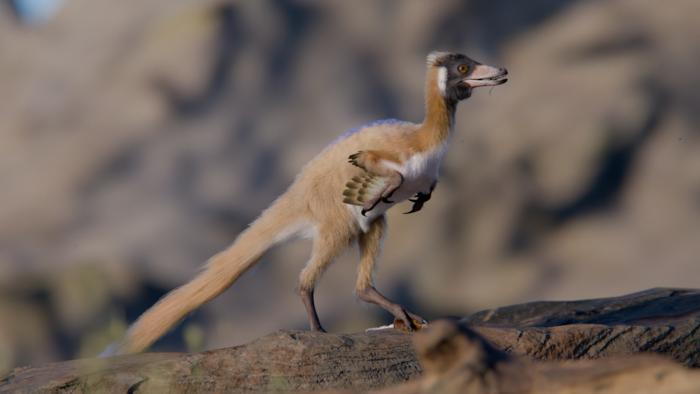
THE BONES had been sitting in a Patagonian hillside for 90 million years when a field team finally coaxed them out in 2014. Even then, it would take another decade before the fossil of Alnashetri cerropoliciensis — a bird-like dinosaur about the size of a large chicken, weighing under a kilogram — was ready to tell its story. The preparation work alone, picking matrix from paper-thin bones without destroying them, consumed years. Small dinosaurs demand patience.
That patience has now paid off spectacularly. The nearly complete skeleton, described this week in Nature by Peter Makovicky of the University of Minnesota and colleagues, has resolved one of palaeontology’s more baffling long-running puzzles: how a group of peculiar little dinosaurs, the alvarezsaurs, came to be scattered across Asia and South America, with almost nothing in between.
Alvarezsaurs are easy to spot, once you know what you’re looking at. They belong to the broader theropod lineage — the same branch that gave rise to birds — but somewhere along the way they veered into a deeply strange evolutionary cul-de-sac. Their forelimbs shrank and stiffened until the arm became a single massive thumb claw, while their other digits dwindled to near-nothing. Their teeth became tiny and numerous, and they apparently developed a specialist taste for ants and termites, a lifestyle reconstructed from comparisons with modern ant-eating mammals. The most derived forms, the parvicursorines of Late Cretaceous Asia, look almost comically specialised — like a dinosaur designed by committee to do exactly one thing.
For decades, none of this made obvious biogeographical sense. The best-preserved specimens came overwhelmingly from Mongolia and China. South American examples were fragmentary, difficult to place, and kept raising awkward questions about how the animals got from one continent to the other, or whether they evolved twice. The prevailing explanation involved multiple dispersal events — animals somehow crossing water as the ancient supercontinent Pangaea split apart and ocean barriers widened. It always seemed a lot to ask of a chicken-sized dinosaur.
Alnashetri changes the picture entirely. “Going from fragmentary skeletons that are hard to interpret, to having a near complete and articulated animal is like finding a palaeontological Rosetta Stone,” says Makovicky. “We now have a reference point that allows us to accurately identify more scrappy finds and map out evolutionary transitions in anatomy and body size.” And when the team fed the new anatomical data into their phylogenetic analyses, alvarezsaur biogeography snapped into a different focus.
The key insight came from looking not just at what Alnashetri was, but when its ancestors must have lived. The new phylogenetic analysis placed the Argentine animal in an unexpected position on the family tree — not tucked alongside the other South American forms, but branching off much earlier. That implied long ghost lineages: ancestral populations leaving no fossil record while their descendants diverged. To explain those gaps, Makovicky and his team went hunting through museum collections and found two previously unrecognised alvarezsauroid specimens hiding in plain sight — one from the Late Jurassic Morrison Formation of North America, another identified as Calamosaurus foxi from the Early Cretaceous of the Isle of Wight. Both had been sitting in collections for decades, classified as something else.
These additions transformed the story. Instead of a group that originated in Asia and somehow colonised South America in discrete hops, the biogeographical analyses now recover alvarezsaurs as having had a Pangaean ancestral distribution — spread across multiple continents before the world’s landmasses began their slow divorce. The animals didn’t cross oceans. The oceans came to them. Continental breakup stranded different lineages on different fragments of the former supercontinent, and those isolated populations went on to evolve independently.
It is the kind of explanation that, once proposed, makes the earlier dispersal hypothesis seem strained. We know that many other vertebrate groups show the same pattern — dryolestoid mammals being a parallel case — but alvarezsaurs had stubbornly resisted this interpretation for lack of the right fossil evidence. Alnashetri provided it.
The skeleton also overturns a cherished idea about how these animals evolved their miniature bodies. The standard account held that small size in alvarezsaurs was tied to dietary specialisation — that the stubby arms, reduced teeth, and compact frame all evolved together as a package deal, part of the same adaptive push towards myrmecophagy. Alnashetri, at under a kilogram, is one of the tiniest non-avian dinosaurs ever found in South America. But its arms are proportionately long, comparable to the ancestral coelurosaur condition, and its teeth, while unserrated, are nowhere near the diminutive pegs of the more derived Asian forms. Alnashetri got small on its own terms, along a different path, without the full specialisation package. The microscopic bone histology, which revealed growth lines consistent with a subadult of several years, confirmed this was not a juvenile. This was just a genuinely small animal.
The implication, supported by the team’s macroevolutionary modelling across more than 41,000 time-calibrated trees, is that alvarezsaur body size did not evolve as a single directed trend towards miniaturisation. Instead, different lineages independently converged on small body sizes under different ecological circumstances, and some subsequently got bigger again. The group’s body mass range happens to overlap neatly with that of living mammalian ant-eaters — which is interesting — but the path to that range was anything but uniform.
Sebastian Apesteguía of Universidad Maimónides, who co-led the fieldwork, notes that the La Buitrera fossil area in northern Patagonia — which also produced ancient snakes and early saber-toothed mammals — keeps delivering. “After more than 20 years of work, the La Buitrera fossil area has given us a unique insight into small dinosaurs and other vertebrates like no other site in South America.” The team is already excavating what comes next. “We have already found the next chapter of the alvarezsaurid story there,” says Makovicky, “and it is in the lab being prepared right now.”
That next chapter might further complicate the picture. Possible alvarezsaur remains from Europe and Africa remain debated, their affinities uncertain. If confirmed, they would push the group’s ancient range even wider, strengthening the case that Pangaea’s breakup — not any animal’s adventurousness — wrote the geography of this peculiar dinosaur family. The continents did the travelling. The animals simply held on.
Study link: https://www.nature.com/articles/s41586-026-10194-3