
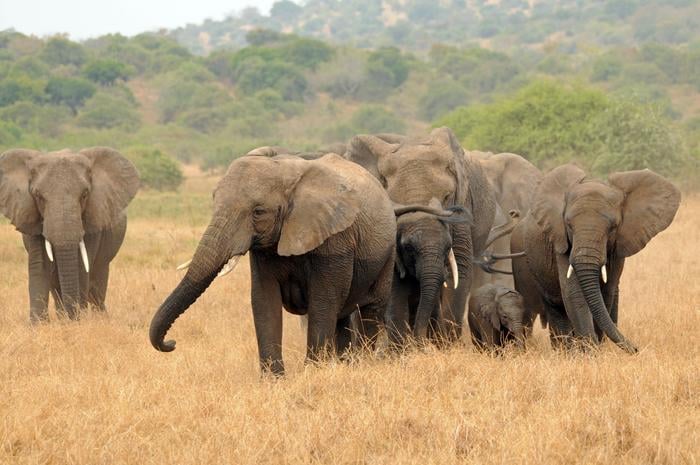
In tissue samples drawn from elephant skin biopsies across 17 African countries, in collections that have sat in biobanks for more than thirty years, something like a historical record was waiting to be read. Researchers at the University of Copenhagen and their collaborators have now done exactly that: sequenced 232 whole genomes from both savanna and forest elephants, producing the largest and most detailed genetic map of the species ever assembled. What they found was not just a picture of where elephants are, or even where they were. It was a record of how they used to move, how that movement shaped their survival, and how badly it is now being constrained.
Mobility, it turns out, is everything. For elephants, the freedom to roam across hundreds or thousands of kilometres wasn’t incidental to their evolutionary history; it was the engine of it.
A Continent Connected by Movement
The study, published this week in Nature Communications, is the first continent-wide genomic analysis to treat savanna elephants and forest elephants as the distinct species they are, having only received separate IUCN threat listings as recently as 2021. The two lineages diverged roughly four million years ago, and the genetic chasm between them is vast: more than 85 per cent of all elephant genetic variation on the continent exists between the two species, not within them. Within each species, however, the story is strikingly different. Savanna elephant populations across eastern and southern Africa show very little genetic differentiation, suggesting that for most of their history, elephants have moved freely enough to keep gene pools thoroughly mixed. The Kavango-Zambezi Transfrontier Conservation Area, which spans five southern African countries, is practically a single panmictic population, with FST values close to zero between localities hundreds of kilometres apart.
“Our study shows that until recently, elephants have been connected across vast distances,” says lead author Patrícia Pečnerová, an assistant professor at the University of Copenhagen and Lund University. “This freedom of movement has created genetic robustness because the populations have intermingled. Today, the picture is different.”
That different picture is inscribed in the genomes of populations at the edges of the species’ range. Elephants in Eritrea, isolated by more than 400 kilometres from the nearest population and enclosed by human settlements and farmland, show elevated inbreeding, reduced genetic diversity, and an accumulation of mildly harmful mutations that had no opportunity to be purged by natural selection. Ethiopian elephants tell a similar story. Both populations were nearly extirpated by the early twentieth century and have never recovered their former connectivity. Their genomes still carry the signature of those bottlenecks.
West Africa presents a more complicated variant of the pattern. Human population pressure and the ivory trade hollowed out elephant populations there before the First World War, earlier and more severely than in most other regions. Yet savanna elephants in Mali and Cameroon retain surprisingly high genetic variation, not because they escaped the bottleneck but because forest elephant genes flowed into their gene pool through hybridisation. The genetic damage of isolation was, in a sense, partially papered over by interspecific gene flow.
The Surprise of Widespread Hybridisation
The discovery that hybridisation between savanna and forest elephants has been far more widespread than previously suspected is perhaps the study’s most provocative finding. A few known hybrid zones along the DRC-Uganda border and in west-central Africa were already documented; one population near Uganda’s Queen Elizabeth National Park carries more than 20 per cent forest elephant ancestry. What the new genomic data revealed, however, is that trace amounts of forest ancestry turn up in savanna elephant populations across the continent, including in populations nowhere near any known hybrid zone. The signal is tiny, often around half a per cent, but it follows a detectable gradient: forest ancestry in savanna elephants tends to decline with distance from the Congo-Guinean rainforest belt (a pattern confirmed by Mantel test, p = 1e-04). Whether this reflects stepwise gene flow radiating outward from current hybrid zones, or a more ancient pattern when the forest itself occupied a different geographic footprint, remains an open question.
For conservation purposes, though, Alfred Roca, a professor at the University of Illinois Urbana-Champaign and a senior author of the study, is cautious about drawing the wrong conclusions. “Given this history, gene flow between the species is unlikely to be beneficial, and hybrid elephants should be avoided for translocations,” he says. The same logic applies within species: “there were sufficient genetic differences across southern, eastern and west-central Africa to suggest that translocations across regions should be avoided.”
Reading the Future in a 1990s Sample
There is an uncomfortable wrinkle in all of this. The tissue samples that made the study possible were collected in the 1990s, frozen in time approximately one elephant generation before the most recent poaching crisis that began around 2007. Chris Thouless, Director of Conservation at Save the Elephants, notes that “the evidence of inbreeding in isolated and depleted savanna elephant populations is a matter of concern, especially since the samples on which this study is based date from before the recent period of intense poaching for ivory.” The genomic baseline the researchers have established may already be describing a world that no longer exists; current populations, if they could be sequenced today, might show the isolation signals more starkly still.
Forest elephants, listed as Critically Endangered, provide one unexpectedly positive data point. Despite their steep numerical decline, estimated at roughly 90 per cent over recent decades, their genomic data reveals that they carry significantly less heterozygous genetic load than savanna elephants. This means the reservoir of potentially harmful mutations lurking in heterozygous form, waiting to be expressed in future inbred generations, is smaller. Their larger historical population size appears to have allowed natural selection to gradually purge deleterious variants over millions of years, a process that hasn’t had time to reverse even as their numbers have crashed. Small comfort, perhaps, but a meaningful one.
The study’s more pressing message, though, is about landscapes rather than animals. “Elephants are extremely intelligent animals that can live close to humans and adapt,” Pečnerová says, “but one of the most important forces for their evolution is that genes can move between populations. In southern Africa, the landscape still allows movement between protected areas, and here we see that the genetic health of the elephants remains relatively intact.” The human population of sub-Saharan Africa has grown fivefold since 1960, and is projected to triple again by 2100. The corridors that once stitched elephant populations together across the continent are closing. For now, KAZA shows what’s still possible when the politics and the geography align. The question is whether that alignment can be replicated elsewhere, and how quickly.
The researchers are turning the genomic atlas toward practical use. Collaborators from Save the Elephants and San Diego Zoo Wildlife Alliance are developing field-deployable DNA tools that could trace confiscated ivory back to specific populations. The continent-wide dataset, now publicly available, gives that forensic work a reference library it has never had before. Every tusk seized, potentially, becomes a data point about where the killing is concentrated. Where the connectivity is being severed.
Source: https://doi.org/10.1038/s41467-026-71262-w
Frequently Asked Questions
Why does it matter whether elephants can move between populations?
When elephants roam across large distances, they carry genes from one group to another, which keeps populations genetically diverse and resilient. Without that movement, related animals increasingly breed with each other, harmful mutations accumulate, and populations become less able to adapt to disease or environmental change. The new study found that southern African elephant herds connected by the vast Kavango-Zambezi conservation area are essentially one big interbreeding population, and show none of the genetic warning signs visible in isolated groups in Eritrea and Ethiopia.
Is it true that Africa’s two elephant species have been interbreeding?
Yes, though the extent surprised researchers. A few hybrid zones along the DRC-Uganda border were already known, but the new genomic analysis found trace amounts of forest elephant ancestry scattered across savanna elephant populations continent-wide, including groups far from any known hybrid zone. The signal is tiny, often around half a per cent, but statistically robust. Whether it reflects ancient forest expansion during past climate cycles or long-range gene flow from current hybrid areas remains unclear.
Could the DNA data be used to track down poachers?
That’s precisely one of the intended applications. The continent-wide genomic atlas, now publicly available, gives forensic scientists a reference library that can help identify which population a piece of confiscated ivory came from. Since different elephant populations have distinct genetic signatures, matching a tusk’s DNA to a region could help law enforcement trace illegal trade routes and identify poaching hotspots with much greater precision than is currently possible.
Why are forest elephants in a worse conservation position than savanna elephants if their genes look healthier?
The genetic load finding is good news for the short term but doesn’t change the threat picture. Forest elephants are listed as Critically Endangered and their numbers have declined by an estimated 90 per cent, compared with roughly 70 per cent for savanna elephants. Their lower genetic load simply means they’ve inherited fewer hidden harmful mutations, which reduces one particular extinction risk. The immediate threats, poaching and habitat loss in the Congo Basin, remain urgent and are not ameliorated by genomics.
What’s stopping conservationists from just moving elephants between isolated populations to fix the inbreeding problem?
Translocation is complicated by the fact that different regional populations carry distinct genetic signatures accumulated over long periods of separation. The researchers explicitly caution against moving elephants across broad regions, such as between southern, eastern and west-central Africa, because introducing genetically distant animals could disrupt local adaptations. The better solution, they argue, is to protect and restore landscape corridors that allow elephants to disperse naturally, as they have done for millions of years.
Discover more from Wild Science
Subscribe to get the latest posts sent to your email.