
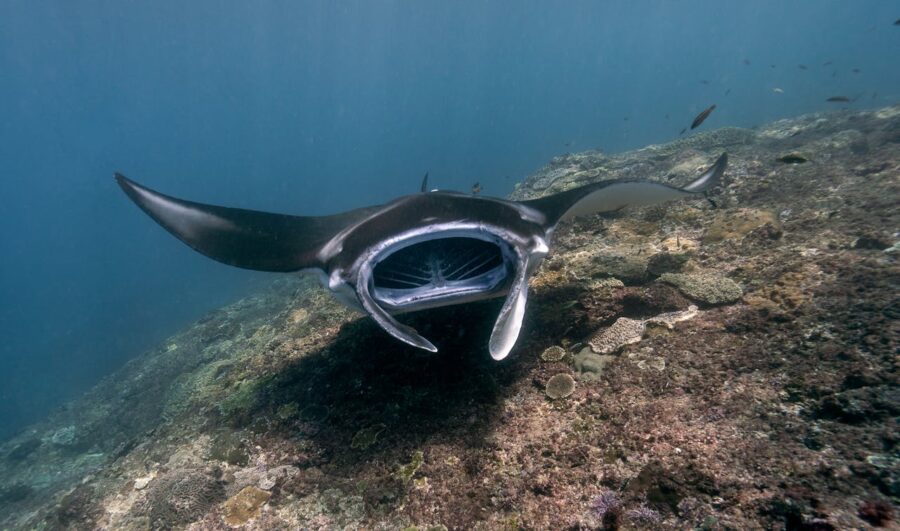
In the dim blue waters off New Zealand, a shadow larger than a car slips beneath the waves. Minutes later, it plunges more than a kilometer below the surface, into a realm of darkness and crushing pressure. What drives such a dive is the mystery researchers set out to solve by tagging oceanic manta rays, the largest species of ray on Earth.
According to a new study published in Frontiers in Marine Science, mantas may descend more than 1,200 meters below the surface, far deeper than previously thought, to help them navigate the open ocean. Using satellite and archival tags, scientists tracked 24 individuals across three regions—Indonesia, Peru, and New Zealand—collecting data over a decade.
“Far offshore, oceanic manta rays are capable of diving to depths greater than 1,200 meters, far deeper than previously thought,” said lead author Dr. Calvin Beale of Murdoch University. “These dives, which are linked with increased horizontal travel afterwards, may play an important role in helping mantas gather information about their environment and navigate across the open ocean.”
Signals From The Deep
Tag data revealed a pattern: the deepest dives occurred in the offshore waters near New Zealand, where the continental shelf drops away sharply into the abyss. Of the 2,705 total tag-days recorded, 79 featured extreme dives deeper than 500 meters, and nearly all of these happened as mantas left coastal zones and moved into the open sea. The rays descended in a stepped pattern, spending little time at the bottom before slowly resurfacing.
Such dive profiles, the team noted, suggest a purpose other than foraging or predator avoidance. At depths beyond 1,000 meters, water temperatures plunge below 5°C and light vanishes. Instead of chasing prey, mantas may be using these vertical excursions to sample environmental cues—like subtle changes in temperature, oxygen, and the Earth’s magnetic field—that help them orient themselves in featureless waters.
After each deep dive, the tagged mantas often traveled more than 200 kilometers over the next few days. That post-dive burst of movement strengthens the idea that the dives serve as a navigational aid rather than a feeding tactic. In Indonesia and Peru, where mantas tend to remain in shallower coastal habitats, such extreme dives were rarely recorded.
“By diving down and ‘sampling’ these signals, they could build a mental map that helps them navigate across vast, featureless stretches of open ocean,” Beale explained.
The Cost Of Curiosity
These dives are not without risk. Descending rapidly into the cold, oxygen-poor depths likely taxes the mantas’ physiology. Unlike some deep-diving relatives such as Chilean devil rays, oceanic mantas lack the special heat-retaining muscles that protect against thermal shock. To compensate, they appear to rest at the surface before and after dives, possibly to warm their bodies and recover from the exertion.
High descent speeds—up to nearly three meters per second—suggest the dives are actively powered, not passive glides. Mantas may also hold their breath to conserve heat, a strategy seen in hammerhead sharks during extreme dives. Once at depth, the rays pause briefly at certain layers, possibly reoxygenating or gauging changes in dissolved oxygen and temperature before rising again.
The study’s statistical models found that the farther a manta traveled from the continental shelf, the more likely it was to dive deeply. Chlorophyll concentrations—an indicator of surface productivity—were negatively associated with deep dives, implying the rays venture deeper when surface waters offer fewer cues or resources.
Understanding why mantas dive so deep could shed light on how they traverse entire ocean basins and connect distant ecosystems. It may also guide conservation strategies, since protecting these migratory giants requires safeguarding both their coastal feeding grounds and offshore routes.
As Beale noted, “Our study highlights how dependent migratory species are on both coastal and offshore habitats, stressing the need for international cooperation in their conservation. It also reminds us that the deep ocean, which regulates Earth’s climate and underpins global fisheries, remains poorly understood but vitally important.”
Frontiers in Marine Science: 10.3389/fmars.2025.1630451
Discover more from Wild Science
Subscribe to get the latest posts sent to your email.