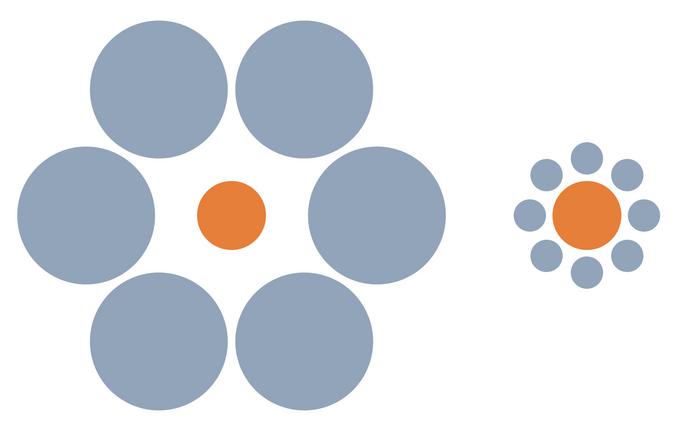
A guppy swimming through a cluttered stream and a dove pecking at seeds on bare ground live in radically different visual worlds. Now, scientists have put both species to the test with one of psychology’s oldest party tricks: the Ebbinghaus illusion, where a circle surrounded by smaller circles looks bigger than an identical circle ringed by larger ones. The results suggest that what you see depends not just on your eyes, but on the ecological pressures that shaped them.
Researchers at the University of Vienna presented guppies and ring doves with food placed at the center of circle arrays designed to mimic the famous illusion. For guppies, flakes of commercial fish food were cut into precise circles and surrounded by black inducer circles of varying sizes. For doves, millet seeds sat inside white plastic rings, again framed by different-sized circles. The question: would the animals, like humans, perceive the food as larger when surrounded by smaller circles?
Guppies See What We See
The guppies fell for it hard. They consistently chose food surrounded by smaller circles, behaving as if it were genuinely larger, even though both portions were identical. Out of 19 guppies tested, the group showed a strong preference for the “illusory larger” option, with some individuals choosing it more than 70% of the time. The pattern was so consistent that it mirrored human perception almost perfectly.
“Guppies displayed high susceptibility to the illusion, possibly reflecting their reliance on global visual processing for interpreting complex aquatic environments.”
This makes sense when you consider where guppies live. Shallow tropical streams are a visual mess: flickering light, dense vegetation, drifting particles, and the constant threat of predators. In such chaos, being able to quickly judge relative size at a glance, integrating the whole scene rather than obsessing over details, could mean the difference between nabbing a meal, choosing the right mate, or becoming lunch yourself.
Doves Tell a Different Story
Ring doves, by contrast, showed no clear group-level susceptibility. Some individuals behaved like humans, others did the opposite, and many seemed entirely unaffected. The researchers tested 38 doves, and while the birds had no trouble distinguishing actual size differences in control trials, they showed no consistent bias in the illusory setup.
“Conversely, no consistent susceptibility to the illusion was found in ring doves, which may be attributed to their ecological adaptation as granivores, favoring local processing over global contextual integration.”
Doves spend their days scanning the ground for tiny seeds scattered across uneven terrain. Precision matters more than panoramic context. Their binocular vision gives them excellent depth perception, and their survival depends on accurately judging the size and distance of small, discrete objects. In this world, getting distracted by surrounding visual context could be a liability, not an asset.
The variability among individual doves is itself intriguing. It hints that perception is not fixed even within a species. Factors like age, hormonal state, or past experience might tune an animal’s perceptual strategies in subtle ways. Humans show similar variation: children under seven are less susceptible to the illusion, and adults from rural environments are less fooled than city dwellers, possibly because urban life demands more reliance on integrating complex visual scenes.
Interestingly, this is not the first time guppies have been tricked by illusions. Previous research showed they fall for the Ebbinghaus illusion during obstacle negotiation, but respond in reverse to the Delboeuf illusion, another size-perception trick. The difference likely comes down to contrast versus assimilation, two competing perceptual mechanisms that pull perception in opposite directions depending on how the visual system weighs context against detail.
The study also tested whether the animals were simply biased toward certain visual features rather than truly experiencing the illusion. A follow-up experiment removed the food and presented just the circle arrays. Neither species showed any preference, confirming that their earlier choices were driven by perceived food size, not an arbitrary attraction to the surrounding patterns.
Across the animal kingdom, responses to the Ebbinghaus illusion vary wildly. Dolphins, domestic chicks, and certain fish species see it like humans do. Pigeons, baboons, and gray bamboo sharks either see it backwards or not at all. These differences are not just curiosities. They reveal how evolution sculpts perception to fit the demands of survival in radically different environments.
The findings also raise questions about the deep evolutionary roots of perception. Guppies and doves are separated by hundreds of millions of years of evolution. Their shared vertebrate ancestry is ancient, yet their perceptual strategies have diverged to match their ecological niches. Whether these differences are hardwired or shaped by experience remains an open question, and one that future research with neuroimaging or electrophysiology might help answer.
For now, the lesson is clear: what you see is not just what is there. It is what your brain has been trained, by millions of years of trial and error, to construct from the raw data flooding your senses. And in the murky streams and sunlit fields where guppies and doves make their living, seeing the world “wrong” might sometimes be the smartest way to see it at all.
Frontiers in Psychology: 10.3389/fpsyg.2025.1653695
Discover more from Wild Science
Subscribe to get the latest posts sent to your email.