
Jean Giacomotto had 18 days to find an answer. Two newborns, one in Australia, one in Germany, carried genetic mutations nobody had seen before. Each baby also carried a known deadly mutation for spinal muscular atrophy, making them prime candidates for treatment. But the novel mutations were wildcards, and without knowing whether they were harmful, clinicians faced what Giacomotto calls an impossible dilemma.
Start treatment immediately with drugs that cost over US$2 million per child, risk unnecessary intervention, or wait and potentially watch irreversible nerve damage set in?
The clock was ticking in a way only infant neurology understands. SMA destroys motor neurons in the spinal cord and brainstem, leading to progressive muscle weakness. Without treatment, it’s typically fatal for babies with severe forms (they never gain the ability to sit or stand, usually dying within the first two years). Even with treatment, timing is everything. Therapies work brilliantly if administered before symptoms appear, but once a baby shows signs like lacking sufficient neck strength to hold their head steady, the damage is already done. Irreversible.
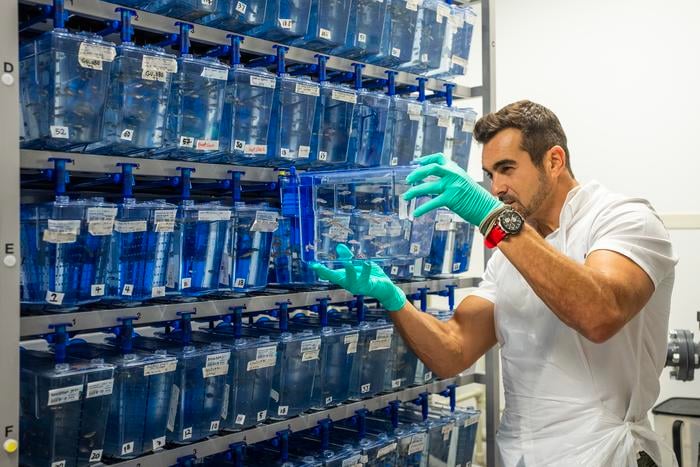
Giacomotto, a researcher at Griffith University’s Institute for Biomedicine and Glycomics in Australia, had been developing something unusual: a rapid diagnostic test using zebrafish, those tiny striped fish popular in home aquariums. The idea was simple, almost cheeky. If a genetic variant causes SMA in humans, inject that variant into zebrafish embryos lacking their own motor neuron gene and see what happens. If the fish develop normally, the variant is probably harmless. If they die, it’s likely pathogenic.
The test sounds straightforward, but its implications are profound. Newborn screening programmes worldwide are identifying more babies with potential SMA, and with that comes an explosion of uncertain variants, genetic mutations that computational tools flag as “likely pathogenic” but which nobody’s actually seen in a patient before. These variants of uncertain significance, or VUS, create medical purgatory for families and clinicians alike.
For the two babies in question, genetic sequencing revealed they each carried one of two different four-base-pair deletions in the SMN1 gene (designated 861VUS and 855VUS by researchers). Intriguingly, despite being different mutations, both were predicted to produce the exact same truncated protein. Computational prediction programmes ranked both as likely pathogenic. One infant carried a single backup SMN2 gene; the other had none at all, which suggested (if these variants were indeed harmful) a severe disease course.
Giacomotto’s team got to work. They created zebrafish embryos completely lacking functional SMN protein, then injected synthetic mRNA carrying each baby’s specific mutation. The fish would either rescue themselves or they wouldn’t; there’s not much middle ground when you’re talking about motor neurons. Within just six days, the results were clear. Zebrafish injected with either variant swam normally, developed proper body shape, and survived, just like fish injected with healthy human SMN1 gene, and completely unlike fish injected with known pathogenic variants, which exhibited progressive paralysis and died.
The experiments were replicated three times to be certain. By the time 18 working days had elapsed, Giacomotto could tell clinicians what they needed to know. Both variants appeared functional.
The clinical team decided not to initiate treatment but to monitor the infants closely. At six months, both babies remained symptom-free. At 12 months, they’d hit all expected motor milestones. One infant took his first independent steps at 14 months. The therapeutic costs of more than US$2 million per child (potentially over US$4 million a decade for some treatments) were avoided. So was the physical and psychological stress of unnecessary intervention.
“This research provides the clearest demonstration to date that zebrafish can play a decisive role in clinical variant interpretation,” says Giacomotto, “particularly in newborns flagged through expanding genomic screening programmes.”
The implications extend well beyond SMA, though. The three approved treatments for the condition (nusinersen, risdiplam, and onasemnogene abeparvovec) have transformed what was until recently the most common inherited cause of infant mortality worldwide into something manageable, even survivable. But this success story has inadvertently created a new problem: as genetic screening expands (and roughly 95% of SMA cases involve straightforward deletions easily caught by screening), the variants of uncertain significance are multiplying.
“With genomic sequencing rising worldwide, clinicians are encountering more and more uncertain variants,” Giacomotto explains. Current methods for resolving VUS pathogenicity are slow, too slow for the narrow window when SMA treatments work best. Cell cultures have limitations; computational predictions are educated guesses; longitudinal patient follow-up takes months or years.
Zebrafish, by contrast, develop motor function within days. Their motor neuron circuitry is remarkably conserved with mammals, making them sensitive indicators of SMN protein function. And because the fish are small, cheap, and produce hundreds of offspring, researchers can test multiple variants simultaneously with proper statistical power. Giacomotto’s team found that as few as three fish per group were sufficient to discriminate harmful from benign variants with 90% confidence.
The approach isn’t without caveats. The current zebrafish assay is designed for urgent decision-making around severe, early-onset SMA, the type where babies need treatment in their first months of life or face irreversible damage. For milder forms that appear later in childhood, the zebrafish results would need corroboration from other models. And because the test uses injected mRNA rather than the gene itself, it can’t detect problems with splicing or gene expression, only whether the resulting protein works.
Still, for the specific problem it addresses (resolving VUS for severe SMA when time is desperately short), the zebrafish offers something previously unavailable: rapid functional testing that aligns with disease timelines rather than research timelines. In essence, the fish experience six months of motor neuron development in less than a week.
It’s a peculiar sort of medical technology. No fancy imaging, no high-throughput sequencing, no artificial intelligence. Just fish in tanks, carefully observed, their survival or death providing the most unambiguous readout biology can offer. “This tiny fish offers a fast and affordable way to help resolve these cases,” Giacomotto notes, “and reduce distress for families.”
The two infants whose mutations were tested are now toddlers, developing normally. Their parents were spared the agonising decision between multi-million-dollar treatment and potentially catastrophic waiting. The healthcare systems in Australia and Germany avoided extraordinary costs. And two specific four-base-pair deletions have been effectively reclassified from “likely pathogenic” to “functional,” meaning future babies carrying these exact variants won’t face the same uncertainty.
As whole-genome sequencing becomes routine for newborns (some countries are already moving in that direction), the variants of uncertain significance will only multiply. Every new mutation someone discovers might be the first domino in a cascade of medical interventions, or it might be completely benign. Telling the difference quickly will matter more and more.
Giacomotto’s zebrafish are already swimming towards that future, one mutation at a time.
Study link: https://link.springer.com/article/10.1038/s44321-025-00355-8
Discover more from Wild Science
Subscribe to get the latest posts sent to your email.