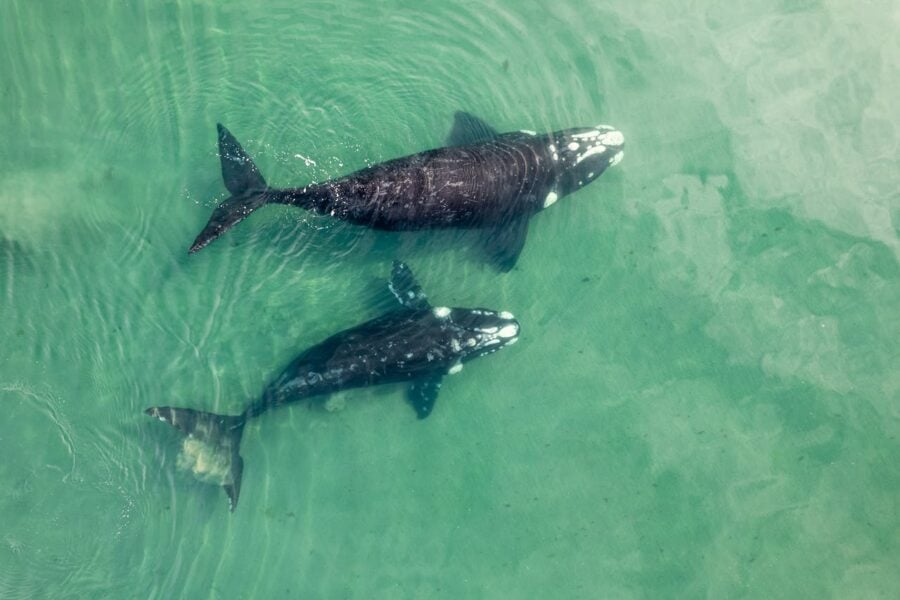
Off Canada’s coast, in the cold waters of the Gulf of St. Lawrence, something extraordinary is quietly happening. Three species of baleen whales—creatures so massive they seem to belong to another era—are changing what they eat. They’re doing it together, shifting their feeding patterns as the ocean warms. But this isn’t the violent competition you might expect. Bigger whales aren’t pushing smaller ones out. Instead, these whales are making room for each other.
The Proof Is Written in Their Skin
For 28 years, scientists have been collecting evidence in an unexpected place: whale skin.
Starting in 1992, researchers went out in small boats armed with crossbows and hollow darts. They collected tiny skin samples from more than 1,100 fin, humpback, and minke whales. These samples—barely the size of a pencil eraser—told a story. The story was written in the chemical makeup of the whales’ bodies.
Here’s how it worked: Every animal eats plants or other animals. Those foods leave traces in their bodies. Scientists measured different forms of carbon and nitrogen in the whale skin. These traces acted like molecular fingerprints. They showed what each whale had eaten over months of migration and feeding.
The researchers studied three different time periods:
- 1992-2000: The ocean was cool and food was abundant
- 2000-2010: Waters started warming and food sources shifted
- 2010s: The ocean was warmer and prey populations had changed
The World They Knew Was Disappearing
In the 1990s, life was good for fin whales. They ate krill—tiny shrimp-like creatures packed with fat and energy. A fin whale would open its mouth to near-vertical angles and gulp thousands of these animals in a single mouthful. Then it would push water out through the baleen plates in its jaw. The krill stayed behind.
Food was reliable. The whales knew where to go and what they’d find.
But the ocean was changing.
Water temperatures crept upward. In the 1990s, the water was cooler than normal. By the 2010s, it was warmer than normal. As the ocean warmed, something shifted. The krill started disappearing.
Charlotte Tessier-Larivière watched this change happen. She’s a researcher at the Maurice Lamontagne Institute in Quebec. For years, she studied the chemical fingerprints in whale skin. She watched the patterns change slowly, year by year. There were no dramatic moments. Just steady, gradual shifts in what the whales’ bodies told her they’d been eating.
How They Adapted
By the 2000s, fin whales had changed. They started eating fish instead of krill: capelin, herring, mackerel. By the 2010s, they shifted again to sand lance and northern krill. A creature that had always eaten tiny plankton was being forced into becoming a fish-eater.
Humpback whales did something different. They barely changed at all. They stuck with just a few fish species throughout the entire study. But this loyalty came at a cost. Their hunting grounds expanded. They had to work harder, venture further, and search longer to find enough food. Imagine the struggle: remembering a time of plenty, then facing the reality of scarcity.
Minke whales took the middle path. They were opportunists. They ate small fish, but also ate krill when they found it. They switched based on what was available.
The Unexpected Discovery: They Didn’t Fight
Here’s what surprised researchers: the whales didn’t compete violently. They didn’t push each other out. Ecology textbooks teach us that when resources get tight, the strongest species wins and others lose or disappear.
But these whales did something different. They made space for each other.
In the early 2000s, minke whales shared about two-thirds of their hunting grounds with the other two species. By the 2010s, that overlap had shrunk to less than half. All three species were slowly stepping back from the same table to make room.
Fin and humpback whales, which barely overlapped before, kept their distance. “This ecosystem seems productive enough to support all three species,” Tessier-Larivière explained. “It offers alternative prey spread across different spaces and times. These conditions let all three whales coexist instead of one pushing the others out.”
These whales have a superpower: they can roam hundreds of kilometers searching for food. With this mobility, they developed different strategies:
- One species hunted deeper where smaller animals couldn’t survive the pressure
- Another hunted earlier in the season when competition was lower
- A third specialized on slightly different fish species within the same family
Each whale was finding its own feeding window and place. Instead of fighting over the same meal, they spread out. Like musicians discovering their concert hall was shrinking—rather than battle for the main stage, they moved to different rooms and played different instruments.
“As prey became scarce, the whales responded by spreading out,” Tessier-Larivière noted. “They increased their resource partitioning. They found ways to coexist.”
But Adaptation Has Limits
The whales have proven they’re flexible. They’ve shown they can adjust what they eat and where they hunt. But there’s something troubling beneath this success.
The ocean is changing faster than the whales can adapt.
Krill numbers keep dropping across the North Atlantic. Herring and mackerel populations have crashed from overfishing and warming waters. Even capelin—the fish that could sustain thousands of whales—is becoming unpredictable. It appears in smaller groups, in different places, at different times.
The whales are adapting to a world that’s moving away from them. The question now is simple but urgent: Is there enough food? Will there be enough capelin, sand lance, and alternative prey if warming continues? If changes speed up?
Tessier-Larivière and her team spent 28 years collecting tiny skin samples from wild whales in harsh ocean conditions. They did this work because monitoring matters. Watching matters. Understanding what’s changing matters.
“Environmental change in the Gulf of St. Lawrence is already affecting these whales,” Tessier-Larivière wrote. “We must keep monitoring what they eat. This information should guide fishing management and the creation of marine protected areas.”
The whales have adjusted to 28 years of ocean warming through flexibility and adaptation. But adaptation is always reactive. It happens after conditions change, not before. In a warming ocean, change is accelerating. It’s outrunning the whales’ ability to keep pace.
What Happens Next
For now, in the deep waters off Canada, the whales keep hunting.
They partition their resources like diners at a shrinking table. Each finds a way to feed. Each makes space for the others. It’s not the abundance of the 1990s, when krill swarms stretched for kilometers. It’s the new world—and they’re adapting to it, one meal at a time.
Whether that will be enough is a question the whales are living through right now. It’s a question the ocean itself is trying to answer.
Study link: https://www.frontiersin.org/journals/marine-science/articles/10.3389/fmars.2025.1679523/full
Discover more from Wild Science
Subscribe to get the latest posts sent to your email.