
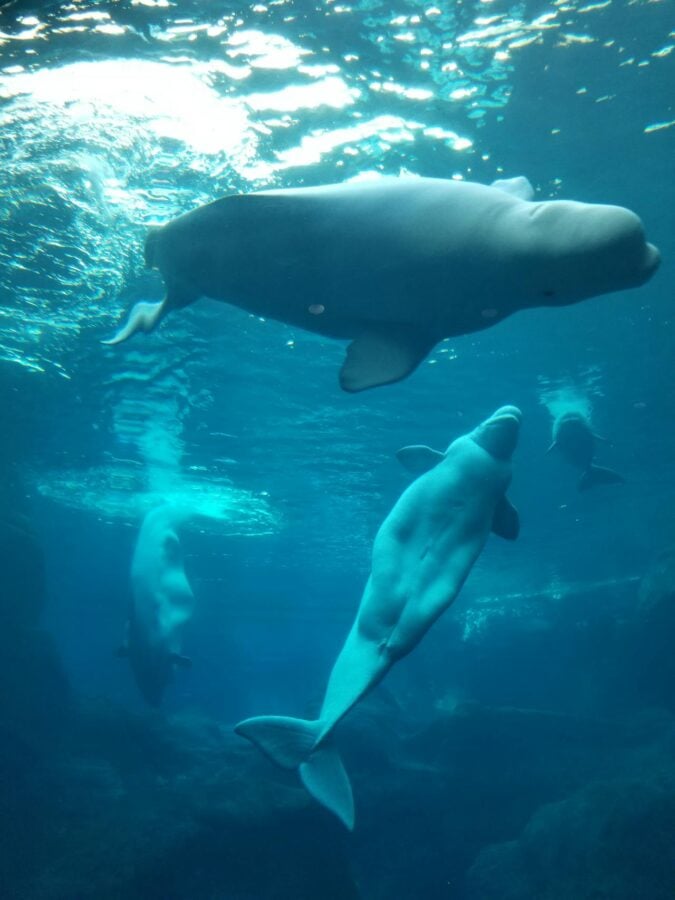
The ice in Bristol Bay closes down hard by November, locking away the whales for months in the icebound waters beneath it. When researchers finally arrive in spring with their small boats and biopsies, they’re after something most people never think about: who’s sleeping with whom, and what it means for survival in one of Earth’s harshest places.
For over a decade, Greg O’Corry-Crowe and his team at Florida Atlantic University have been collecting tiny skin samples from belugas in Bristol Bay, Alaska. They’re building a genetic catalogue of one of the Arctic’s most elusive whale populations. The results, announced this month, overturn a century of assumptions about how these creatures arrange their love lives, and they reveal something unexpected: nature’s solution to a problem conservation biologists have long feared would doom small populations to extinction.
The old story about beluga mating was straightforward. Males are massive, up to 25 per cent larger than females. They bear the scars of combat. They spend little time with calves. From these facts, scientists drew an obvious conclusion: belugas must be fiercely polygynous, meaning a handful of dominant males would father most of the calves while lesser males got nothing. This is what the evolutionary textbooks predict. It’s what the massive size difference suggests. It’s what you’d expect from an Arctic whale.
“What makes this study so thrilling is that it upends our long-standing assumptions about this Arctic species,” O’Corry-Crowe says. And he doesn’t mince words about why. “Because males are much larger than females and appear to spend little time associating with mothers and calves, scientists believed belugas were likely to be highly polygynous, where males spend a lot of time competing for mates and only a few dominant males fathering most of the calves. Our findings tell a very different story.”
The whales, it turns out, aren’t following the script. After genetically profiling 623 individuals over thirteen years, the researchers discovered that Bristol Bay’s belugas engage in something called polygynandry: a mating system where both males and females have multiple partners, but not in the way you might expect. The males aren’t fighting each other savagely for breeding supremacy. The females aren’t loyal to powerful partners. Instead, the population has stumbled on a strategy that, from a genetic standpoint, looks almost deliberately engineered to prevent extinction.
Start with the males. Yes, they’re polygynous, about 94 per cent of the calves fathered by any individual male turn out to be half-siblings to each other, meaning each father is indeed breeding with multiple females. But here’s the catch: no individual male is fathering very many calves at all. The researchers expected to find a few super-breeders dominating reproduction. Instead, they found males spreading their reproductive efforts thinly across years, with most fathering only two or three calves at a time. It’s not the winner-takes-all system evolution theory predicts.
O’Corry-Crowe thinks he knows why. “Belugas can live perhaps 100 years or more,” he notes. That longevity changes everything. Rather than competing intensely in a single season, males appear to play a different game entirely. “Rather than competing intensely in a single season, males appear to play the long game, spreading their reproductive efforts over many years. It appears to be a ‘take your time, there’s plenty of fish in the sea’ strategy.”
The three-dimensional underwater environment likely helps. Unlike terrestrial animals, a male whale can’t corral females in one place and guard them from rivals. The ice comes and goes. The whales migrate and disperse. Chasing down multiple females season after season in an aquatic landscape where you can’t see your opponent becomes a different proposition. Scrambling to find receptive females as they appear might work better than fighting for exclusive access. The males, in other words, might simply lack the physical opportunity to achieve the extreme polygyny that evolution theory suggests they should want.
But the females are the real revelation. About 83 per cent of calves born to any given mother turn out to be half-siblings, meaning they share a mother but have different fathers. This is polyandry, and it’s not passive. Female belugas are actively choosing different males across breeding seasons. Not always, some do have full siblings to their calves, born years apart to the same father. But the pattern is clear: females switch partners.
Why would females abandon a proven mate and try someone new? The answer sits at the heart of evolutionary game theory, and it’s surprisingly strategic. A female beluga carries a calf internally for fourteen months. Once born, she nurses it for two years. That’s an enormous investment in a single reproductive attempt. In a world with questionable males and unpredictable conditions, spreading that risk across multiple partners becomes insurance. “Rather than sticking with a single partner, they frequently switch mates from one breeding season to the next,” the study notes. This behaviour may serve as a form of risk management, allowing females to avoid pairing with low-quality males and increasing the likelihood of producing healthy, genetically diverse offspring.
“It’s a striking reminder that female choice can be just as influential in shaping reproductive success as the often-highlighted battles of male-male competition,” O’Corry-Crowe says. “Such strategies highlight the subtle, yet powerful ways in which females exert control over the next generation, shaping the evolutionary trajectory of the species.”
This matters, though not in the way female empowerment narratives usually frame it. In a small, isolated population like Bristol Bay’s two thousand whales, unchecked male dominance creates a problem. If only a few successful males father most calves, the effective population size (the number of individuals actually contributing to the gene pool) becomes catastrophically small. You get genetic bottlenecks. Rare alleles disappear. Inbreeding depression creeps in. The population becomes fragile.
Here’s where the mating system gets its real significance. All that promiscuity, all that mate switching, all that refusal of extreme polygyny creates something delightfully messy from a genetic perspective: loose-chain pedigrees. Offspring become connected through half-sibling chains rather than full-sibling clusters. You get many more half-siblings and far fewer full-siblings scattered across the population. For conservation, that’s golden.
“Understanding these dynamics matters for conservation,” O’Corry-Crowe explains. “If only a few males father most calves, the effective population size becomes much smaller than the number of whales actually present. This loss of genetic diversity increases the risk of inbreeding and reduces the population’s ability to adapt to environmental change.”
The researchers calculated that Bristol Bay’s effective population size is only about 118 individuals, less than 6 per cent of the actual population of two thousand. That should spell trouble. A population that small faces serious risk of genetic erosion, especially over generations. Yet when they looked at the actual genetics, they found something startling: low levels of inbreeding and high genetic diversity comparable to much larger whale populations. The mating system appears to be acting as a buffer against the worst effects of small population size.
Older females told a secondary story. While young and old females were equally likely to breed, older mothers had significantly more surviving calves than younger ones. This suggests experience matters, not just in reproduction, but in keeping offspring alive through the harsh Arctic environment. It’s a reminder that genes aren’t the only thing that matters in survival.
The study emerged from close collaboration with Indigenous communities in Bristol Bay, particularly the Alaska Beluga Whale Committee and the Bristol Bay Native Association. Their knowledge of the whales, combined with genetic science, produced something neither discipline could achieve alone: insight into how a small population maintains itself in a changing world.
“We cannot afford to be complacent,” O’Corry-Crowe cautions. “Small populations still face the dangers of genetic erosion. But we can be optimistic that beluga whale mating strategies provide evidence of nature’s resilience and offers hope for those working to save and recover small populations of any species.”
The finding matters beyond belugas. Across the Arctic, other whale populations face similar isolation and human pressures. Some endangered populations, like the Cook Inlet belugas, have effective population sizes below 400. If reproduction can be shaped by behaviour and mating preferences rather than purely by size and dominance, there’s hope. The question becomes not whether small populations inevitably collapse, but whether they might carry hidden stabilising strategies, waiting to be discovered.
What the Bristol Bay belugas demonstrate is that evolution works in subtler ways than we sometimes credit. Males don’t need to be ruthless competitors to be successful. Females don’t need to be passive. An entire population can persist at smaller sizes than theory suggests necessary, if the right behaviours align. The whales, across thirteen years of ice and ocean, have written their own story, one that challenges what we thought we knew about how life persists in extreme places.
For now, their long game continues. Under Arctic ice where researchers can barely follow, far from cameras and science, the belugas drift and mate and choose partners. They shift and adapt and play out strategies built across thousands of years. And in doing so, they offer a quiet lesson about resilience: sometimes the most robust solutions are the ones that refuse to follow the rules.
Study link: https://www.frontiersin.org/journals/marine-science/articles/10.3389/fmars.2025.1707758/full
Discover more from Wild Science
Subscribe to get the latest posts sent to your email.