

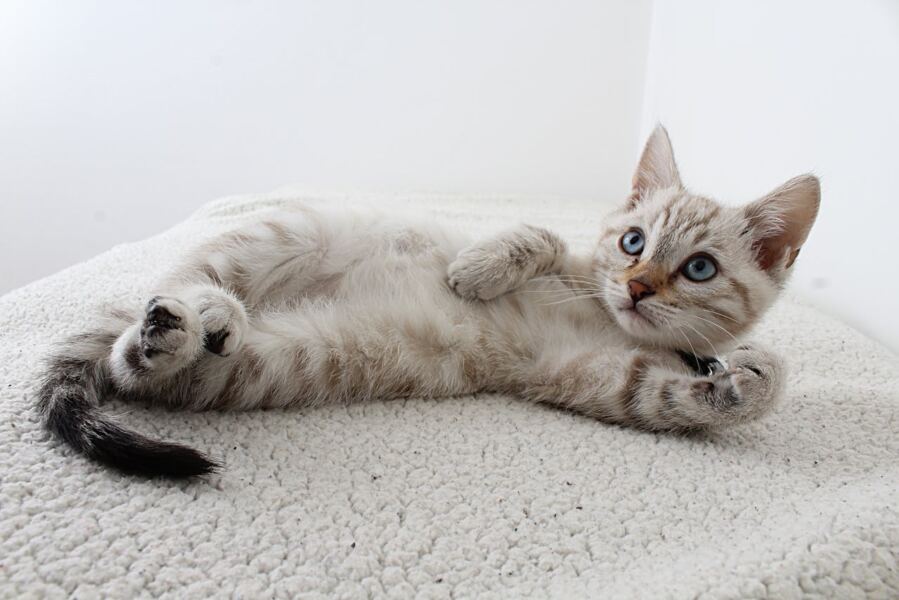
The tissue samples came from many places — diagnostic labs in Germany, pathology departments in New Zealand, veterinary hospitals across the UK — but some of the most personal contributions came from the researchers themselves. A few of the scientists involved in this study donated samples from their own pets. One photo accompanying the research shows Lanni, a tabby belonging to Cornell pathologist Latasha Ludwig, who co-authored the paper. There’s something quietly affecting about that detail: the scientists who spent years mapping cat cancer genetics thought enough of the work to make it personal.
The study, published this week in Science, is the largest genetic survey of feline tumours ever conducted. Researchers from the Wellcome Sanger Institute and institutions across Europe, North America and New Zealand sequenced tumour and normal tissue from 493 cats with 13 different cancer types, looking specifically at the feline versions of roughly 1000 human cancer genes. What they found, in short, is that cats get cancer for a lot of the same reasons we do.
That might sound like a modest observation. It isn’t.
For decades, the go-to animal for cancer research has been the mouse. Mice are easy to breed, cheap to house, and their genomes are well-mapped. But there’s a problem: mice live in laboratory conditions, not in houses. They don’t sunbathe on windowsills, breathe the same indoor air as their owners, eat processed food, or develop the same age-related diseases. Cats, by contrast, do all of these things. “Among the attractive aspects of studying feline cancers to learn more about human cancers is that cats are exposed to similar environmental conditions as humans,” says Bruce Kornreich, director of the Cornell Feline Health Center. “They also suffer from many of the same diseases as humans, supporting the notion that these two species share at least some basic mechanisms of disease.”
The new study, led by Louise van der Weyden at the Wellcome Sanger Institute, makes this case with unusual thoroughness. The most frequently mutated gene across all 493 cat tumours was TP53, altered in 33% of cases — almost exactly the figure seen in human pan-cancer datasets, where it runs to 34%. The most common copy number changes in feline tumours were gain of MYC and loss of PTEN or FAS, each seen in roughly 20% of tumours; human studies report similar frequencies. These aren’t superficial parallels. They suggest the two species are running largely the same cancer-causing machinery.
Perhaps the most striking findings involved mammary carcinoma. Breast cancer in cats is notoriously aggressive — far more so than in dogs — and had remained poorly understood at the genetic level. The new study identified seven driver genes in feline mammary tumours, with FBXW7 the most prevalent, mutated in 53 to 72% of cases. In human breast cancer, FBXW7 mutations are associated with worse prognosis, so the parallel is clinically meaningful. When the researchers grew cat mammary tumour cells in three-dimensional lab cultures and treated them with chemotherapy drugs, tumours carrying the FBXW7 mutation proved significantly more sensitive to vincristine and vinorelbine than those without it. That’s an early result, and it’ll need replication in larger cohorts, but it hints at something useful: a genetic marker that might predict which cats — and perhaps which people — respond to particular treatments.
“We are now moving toward a stage where we can treat the specific mutation, not just the species or necessarily a specific tumor type,” Ludwig says. “We can utilize the information that we find in people and translate that to cats, and also from cats to humans. We are no longer looking at these as separate problems, but as a shared biological challenge.”
This idea — that human and veterinary medicine should share data and knowledge rather than develop in parallel — goes by the name “One Medicine” or “One Health.” It’s been a slogan in some quarters for years; what’s been lacking is the kind of detailed, large-scale genetic evidence to actually make it work. Dogs have been studied more thoroughly than cats in this context, which is partly why canine cancer genomics is already informing clinical practice. Cats, the world’s second most popular companion animal, have lagged behind. “The genetics of domestic cat tumours are no longer a ‘black box,'” van der Weyden said. “We can now begin to take the next steps forward towards precision feline oncology.”
Not all the findings mapped neatly onto human cancer biology, which is itself informative. RAS mutations — found in perhaps a quarter of all human cancers — appear to be rare in cats. The reasons for that discrepancy aren’t clear yet; working out why cats dodge this particular genetic pitfall could, in theory, suggest new angles of attack in humans. Similarly, the study identified a UV-radiation mutational signature in 52% of feline squamous cell carcinomas — an echo of sun-related skin cancers in people. “We were able to show that a lot of these skin cancers were associated with UV-induced radiation, which is similar to what we see in different types of skin cancer in humans as well,” Ludwig noted. “So that speaks to our shared environment from that perspective.”
Fourteen putative cancer-predisposing germline variants were identified across the 493 cats, including several in CHEK2 and BRIP1 — genes well-known to influence cancer risk in humans. Twenty cats in the study carried at least one such variant; their average age at diagnosis was similar to cats without one, which suggests these aren’t simple deterministic mutations. The same is broadly true in people.
The team also made the dataset freely available, which matters more than it might seem. Cancer genomics has historically been siloed by species and by institution; a shared, searchable resource lets researchers spot patterns that would otherwise stay invisible. Of the 493 tumours, 14% carried mutations that are considered “actionable” in human oncology — meaning drugs already exist, or are in clinical trials, that specifically target them. That’s perhaps the most direct argument for why this work matters beyond veterinary medicine.
For now, the immediate beneficiaries are cats. Drugs approved for human PIK3CA-mutant breast cancers could plausibly work in the feline equivalents; trials testing combinations of lunresertib and camonsertib in FBXW7-mutant human cancers (currently under way in the MYTHIC study) might eventually have feline applications too. The tyrosine kinase inhibitor toceranib, licensed for use in dogs, has already shown activity in cats with KIT-mutant mast cell tumours — a proof of concept that targeted drugs can cross species lines.
Whether all this eventually translates into new human treatments depends on future research, much of which this study has now made possible. But it does suggest that the cat, long regarded as a rather inscrutable research subject (quite apart from its temperamental qualities), turns out to be sharing something far more intimate with us than we realised. The same genes breaking down, in the same ways, for some of the same reasons. “This confirms that the domestic cat is not just a beloved pet, but a vital partner in the fight against cancer,” Ludwig says. Lanni, presumably, would have no particular feelings about that — but the rest of us probably should.
Study link: https://www.science.org/doi/10.1126/science.ady6651