Skip to content
ScienceBlog.com
  • Featured Blogs
    • EU Horizon Blog
    • ESA Tracker
    • Experimental Frontiers
    • Josh Mitteldorf’s Aging Matters
    • Dr. Lu Zhang’s Gondwanaland
    • NeuroEdge
    • NIAAA
    • SciChi
    • The Poetry of Science
    • Wild Science
  • Topics
    • Brain & Behavior
    • Earth, Energy & Environment
    • Health
    • Life & Non-humans
    • Physics & Mathematics
    • Social Sciences
    • Space
    • Technology
  • Our Substack
  • Follow Us!
    • Bluesky
    • Threads
    • FaceBook
    • Google News
    • Twitter/X
  • Contribute/Contact

University of Texas

Stood up woman having a bad time alone in the restaurant

Nighttime Coffee May Make You More Impulsive

close up of the hands of an aging man

Aging Cells Fight Cancer But May Help It Spread

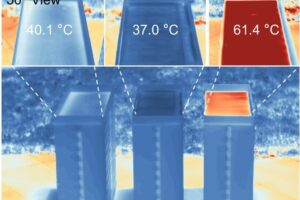
The middle model building uses the researchers' new cooling materials, showing a lower temperature after being left in the sun.

AI Creates Materials That Could Cut Your Cooling Costs

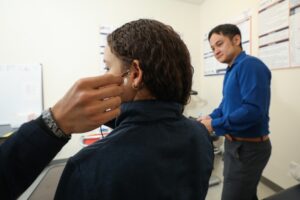
Kosaku Aoyagi, PT, Ph.D. (right), assistant professor of physical therapy and movement sciences at The University of Texas at El Paso, is leading research into a new approach to relieving knee pain. In collaboration with Harvard Medical School and Boston University, his team conducted a pilot trial testing a novel method for treating osteoarthritis-related knee pain by stimulating the vagus nerve via the ear. The results appear in Osteoarthritis and Cartilage Open.

Ear Stimulation Shows Promise for Knee Pain Relief

FAST & ACCURATE: Predicted motions of hundreds of particles inside a fusion reactor show that a new computational method (orange, red) closely matches the results of traditional Newtonian calculations (blue, green)—but with a speed boost of 10x. (Image credit: University of Texas at Austin)

Major Fusion Energy Hurdle Cleared

Bus stop

Bus Shelters Turn Deadly Ovens During Heatwaves

Aging man smiling on a park bench

Immune Resilience Grants 15-Year Survival Advantage in Aging

A generated image showing a human gut with various types of bacteria, accompanied by a personalized treatment plan featuring antibiotics, probiotics, and prebiotics

Gut Bacteria Imbalance After Stroke May Worsen Brain Inflammation

Drug found to more than double survival time for glioblastoma patients

A sorbent created using biomass that can pull drinkable water out of thin air.

Kitchen Scraps and Seashells Pull Drinking Water from Thin Air

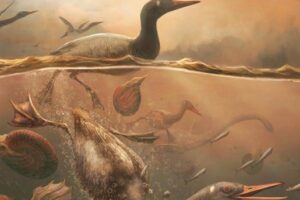
An artist’s interpretation of Vegavis iaai diving for fish in the shallow ocean off the coast of the Antarctic peninsula, with ammonites and plesiosaurs for company.

Ancient Antarctic Bird Had a Spear for a Beak, Revealing Lost World of Avian Diversity

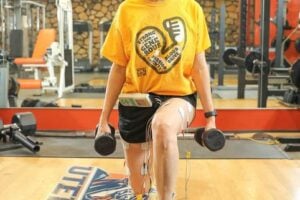
Zahra Fatahimeiabadi, a graduate student in the lab of Sudip Bajpeyi, Ph.D., a professor in the Department of Kinesiology at The University of Texas at El Paso (not pictured), demonstrates a resistance workout while using neuromuscular electrical stimulation (NMES). Bajpeyi leads a team of researchers whose new meta-analysis study, published this month in the European Journal of Applied Physiology, found that combining NMES with resistance training leads to greater muscle mass and strength compared to resistance training alone.

Adding Electrical Stimulation to Workouts Boosts Muscle Gains, Study Shows

The team analyzed genetic material from microbes in a one-of-a-kind archive of water samples collected over 20 years from Lake Mendota in Wisconsin.

Lake Bacteria Reveal a Stunning Seasonal Evolution Loop That Defies Expectations

illustration of mice and DNA

Drug Restores Social Communication in Fragile X Newborns

Older posts
Page1 Page2 … Page6 Next →
Substack subscription form sign up

Comments

  • Marco Messina on More Than a Third of Americans Have Lost Relationships Over Politics
  • Anon on Why Fructose Behaves Less Like a Calorie and More Like a Hormone
  • Mark Mellinger on Living Plastic Can Self-Destruct on Command
  • Marie Feret on The Silent Frequency That Makes Old Buildings Feel Haunted
  • Dax on The Silent Frequency That Makes Old Buildings Feel Haunted
© 2026 ScienceBlog.com | Follow our RSS / XML feed