
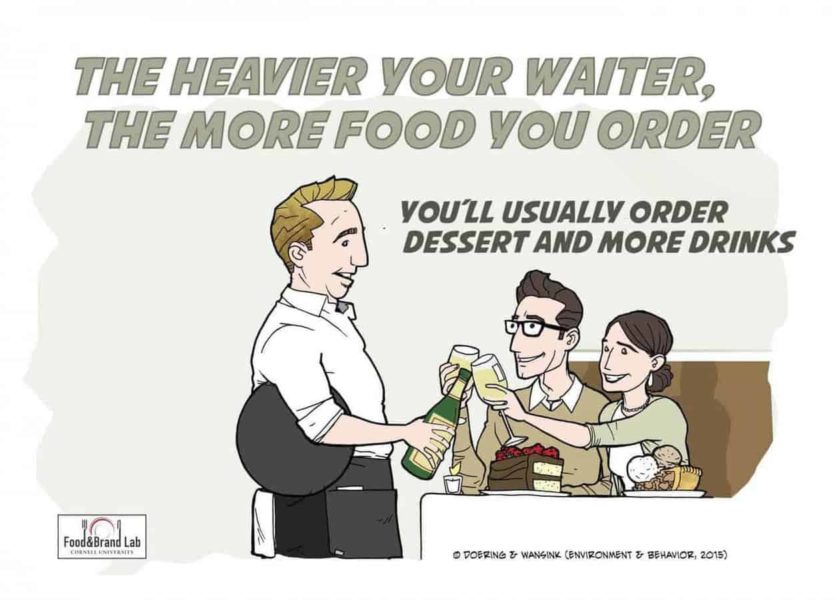
Whether you order a dessert or a drink might depend on your waiter. It’s not what they say; it’s how much they weigh.
A new Cornell Food and Brand Lab study of 497 diners in 60 restaurants shows that diners who ordered their dinner from heavier wait staff were four times more likely to order dessert, and ordered 17% more alcohol.
“No one goes to a restaurant to start a diet. As a result, we are tremendously susceptible to cues that give us a license to order and eat what we want,” says Tim Doering, researcher at the Cornell Food and Brand Lab and lead author of the study. “A fun, happy, heavy waiter, might lead a diner to say ‘What the heck’ and to cut loose a little.”
The study, which is published in the current issue of the journal Environment and Behavior observed 497 diners ordering in dinner in casual American restaurants – like Applebee’s and TGI-Friday’s. It then compared these orders to the Body Max Index (height and weight ratio) of the person who waited on them and the size of diner. Interestingly, Doering notes, “A heavy waiter or waitress seems to have an even bigger influence on the skinniest diners.”
Along with the size of your waiter, the lighting, music, and even where you sit has been shown to unknowingly bias what you order. Although you can’t change your waiter or the music in a restaurant, you can follow a personal ordering rule-of-thumb: “Deciding that you’ll have either an appetizer or a dessert – but not both – before you get to the restaurant could be one of your best diet defenses,” suggests coauthor Brian Wansink, Ph.D., Director of the Cornell Food and Brand Lab and author of Slim by Design.
ScienceBlog.com has no paywalls, no sponsored content, and no agenda beyond getting the science right. Every story here is written to inform, not to impress an advertiser or push a point of view.
Good science journalism takes time — reading the papers, checking the claims, finding researchers who can put findings in context. We do that work because we think it matters.
If you find this site useful, consider supporting it with a donation. Even a few dollars a month helps keep the coverage independent and free for everyone.