
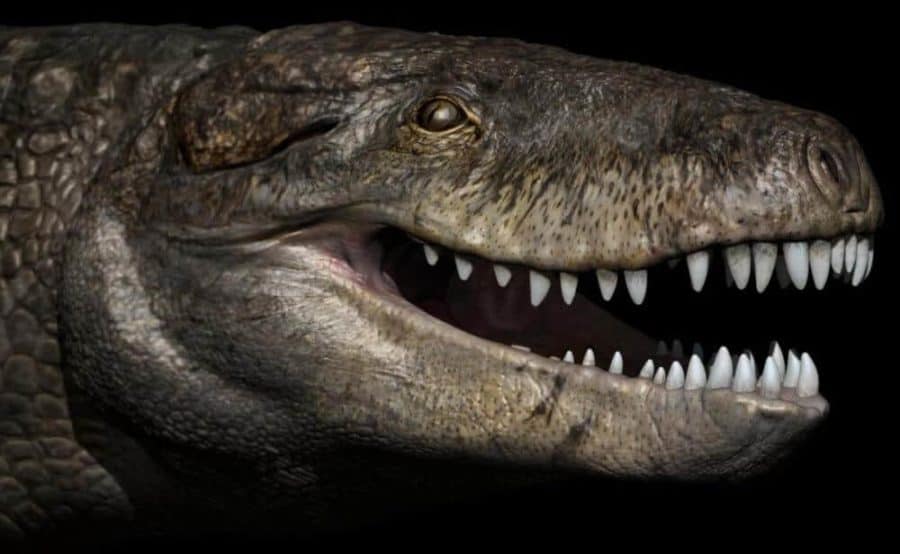
A new study co-led by a University of Iowa researcher throws into question the notion that today’s crocodiles and alligators have a simple evolutionary past.
Previous research pointed to crocodiles and alligators evolving from a land-based ancestor some 200 million years ago and then moving to fresh water, becoming the semi-aquatic predators they are today.
But a new analysis, published online Jan. 24 in the journal Scientific Reports, offers a different theory. Modern crocodiles and alligators came from a variety of surroundings beginning in the early Jurassic Period, and various species occupied a host of ecosystems over time, including land, estuarine, freshwater, and marine.
“Crocodiles are not living fossils,” says Christopher Brochu, professor in the UI’s Department of Earth and Environmental Sciences. “Transitions between land, sea, and freshwater were more frequent than we thought, and the transitions were not always land to freshwater or freshwater to marine.”
Brochu and colleagues from Stony Brook University in Stony Brook, New York, pieced together crocodile and alligator ancestry by analyzing a large family tree showing the evolutionary history of living and extinct crocodylomorphs (modern crocodiles, alligators, and their extinct relatives). The team was then able to predict the ancestral habitat for several divergence points on the evolutionary tree.
This suggests a complex evolutionary history not only of habitat, but of form. Those living at sea had paddles instead of limbs, and those on land often had hoof-like claws and long legs. These did not all evolve from ancestors that looked like modern crocodiles, as has long been assumed.
The paper is titled, “Evolutionary structure and timing of major habitat shifts in Crocodylomorpha.” Study co-authors are Eric Wilberg and Alan Turner, from Stony Brook University.
The U.S. National Science Foundation funded the research, through grants to each author.
ScienceBlog.com has no paywalls, no sponsored content, and no agenda beyond getting the science right. Every story here is written to inform, not to impress an advertiser or push a point of view.
Good science journalism takes time — reading the papers, checking the claims, finding researchers who can put findings in context. We do that work because we think it matters.
If you find this site useful, consider supporting it with a donation. Even a few dollars a month helps keep the coverage independent and free for everyone.