
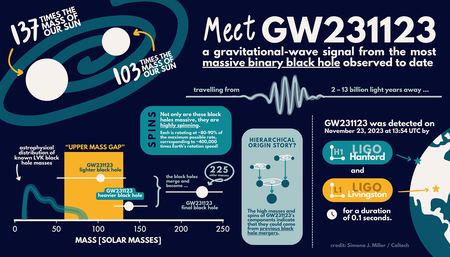
Two colossal black holes, each weighing more than 100 times our Sun’s mass, spiraled into each other across the cosmos and merged in a violent collision that created the most massive black hole ever detected through gravitational waves.
The cataclysmic event, designated GW231123, produced ripples in space-time that reached Earth on November 23, 2023, carrying the signature of a final black hole weighing approximately 225 solar masses.
The detection by the LIGO-Virgo-KAGRA collaboration pushes the boundaries of what scientists thought possible for black hole formation and challenges current models of stellar evolution. It marks a significant milestone for gravitational wave astronomy, which has revolutionized our understanding of the universe since LIGO’s first detection in 2015.
When Giants Collide
The merger involved black holes of approximately 100 and 140 solar masses—far larger than anything produced by conventional stellar collapse. When massive stars die, they typically create black holes no heavier than about 65 solar masses, making this detection a puzzle for astrophysicists.
Mark Hannam of Cardiff University, a member of the collaboration, emphasized the significance: “This is the most massive black hole binary we’ve observed through gravitational waves, and it presents a real challenge to our understanding of black hole formation.” The extreme masses suggest these black holes likely formed through earlier mergers of smaller black holes, rather than direct stellar collapse.
What makes this detection even more remarkable is the rapid spinning of both black holes, rotating near the theoretical limit allowed by Einstein’s general relativity. This extreme rotation complicated the analysis, requiring sophisticated models to extract meaningful data from the gravitational wave signal.
Technical Challenges and Scientific Rewards
The detection pushed LIGO’s instrumentation to its limits. The observatory’s twin detectors in Louisiana and Washington, along with partners Virgo in Italy and KAGRA in Japan, had to measure distortions in space-time smaller than 1/10,000th the width of a proton.
Key aspects of this historic detection include:
- Record mass: 225 solar masses, surpassing the previous record of 140 solar masses from 2021
- Extreme rotation: Both black holes spinning near the maximum rate allowed by physics
- Formation mystery: Masses too large for standard stellar evolution models
- Complex analysis: Required advanced theoretical models to interpret the signal
Charlie Hoy from the University of Portsmouth highlighted the analytical challenges: “The black holes appear to be spinning very rapidly—near the limit allowed by Einstein’s theory of general relativity. That makes the signal difficult to model and interpret.”
Implications for Black Hole Evolution
This detection provides crucial insights into how the most massive black holes in the universe form and evolve. The standard picture of stellar evolution cannot explain black holes this massive, pointing toward a more complex formation history involving multiple generations of mergers.
The observation suggests these “intermediate-mass” black holes might serve as building blocks for the supermassive black holes found at galaxy centers. Understanding this process could reveal how the universe’s largest structures assembled over cosmic time.
Dave Reitze, LIGO’s executive director at Caltech, noted the broader significance: “This observation once again demonstrates how gravitational waves are uniquely revealing the fundamental and exotic nature of black holes throughout the universe.”
Looking Forward
The fourth observing run, which began in May 2023, has already detected over 200 black hole mergers, with more discoveries expected as researchers analyze additional data. Each detection refines our understanding of black hole populations and formation mechanisms.
Gregorio Carullo from the University of Birmingham emphasized the ongoing work ahead: “It will take years for the community to fully unravel this intricate signal pattern and all its implications. Despite the most likely explanation remaining a black hole merger, more complex scenarios could be the key to deciphering its unexpected features.”
Sophie Bini, a Caltech postdoctoral researcher, captured the excitement of pushing scientific boundaries: “This event pushes our instrumentation and data-analysis capabilities to the edge of what’s currently possible. It’s a powerful example of how much we can learn from gravitational-wave astronomy—and how much more there is to uncover.”
The detection will be presented at the International Conference on General Relativity and Gravitation in Glasgow, where researchers will share their latest findings with the global physics community. As LIGO continues its observations, each new detection brings us closer to understanding the most extreme phenomena in our universe.
ScienceBlog.com has no paywalls, no sponsored content, and no agenda beyond getting the science right. Every story here is written to inform, not to impress an advertiser or push a point of view.
Good science journalism takes time — reading the papers, checking the claims, finding researchers who can put findings in context. We do that work because we think it matters.
If you find this site useful, consider supporting it with a donation. Even a few dollars a month helps keep the coverage independent and free for everyone.
Consider the empirical data (of two blackholes interacting) in light of Pearlman SPIRAL (hyper-dense proto galactic formation..) Cosmology ‘Black-Hole illusion Resolution’ where one could predict the appearance of ‘Black Holes’ by galactic centers and that they represent long PAST, not ongoing, hyper-density.
Just like (as both competing cosmology models SPIRAL vs SCM-LCDM agree) the hyper-dense start of the entire universe represents long past, not ongoing, hyper density.
If SPIRAL, all beyond SPIRAL Light Year radius i being ‘look-back’ to the transition from the hyper-dense start to gravitational bound equilibrium, by 4/365.25(SPIRAL LY radius i) a fraction into history. i years before present. The entire universe approximates the visible universe with a radius of 1B LY rounded.
The much closer distance we see them from, means they were a lot smaller (consider moon 1/400th the distance, and apparent size, of the sun), so they had a lot slower velocity per rotation (one needs a speed 400? times faster to do one lap of the sun, in the same time it takes to do one lap of the moon.
Black-holes are on average far more than a million times closer, so smaller. The more distant the greater the overestimate by consensus. Based on the vastly higher probability science, basic physics and math. As well over half (about 8? times)the volume of the approximate sphere that is the visible universe is beyond the radius midpoint. Assume no extreme imbalance of the distribution of Blackholes over large distances. If SPIRAL light departure distance should pan out at 6k LY rounded, vs SCM-LCDM over 12B LY.
12B radius midpoint is 6BLY. 6B/6k=1M.
Reference and consider on ResearchGate.
Including SPIRAL on the cosmic distance ladder, ‘Pearlman vs Hubble’, ‘MVP’ ‘GRIP’ on galactic rotation, ‘GRaB’ on past interaction of now distant stellar objects, hypothesis and ‘Einstein’s Doubt’.