
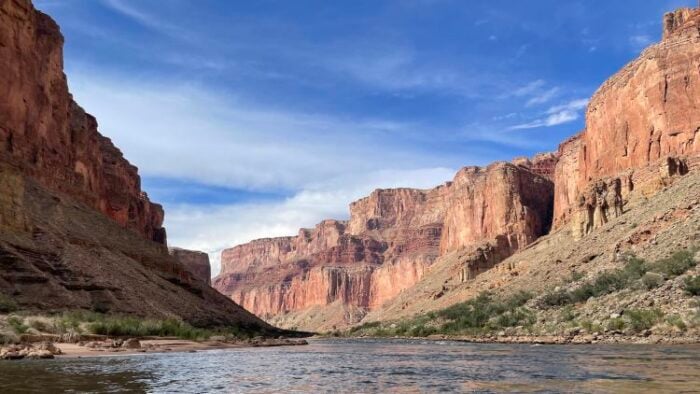
The Grand Canyon, best known for its staggering rock walls and mile-deep vistas, has just revealed a subtler wonder: an explosion of ancient life.
Scientists have discovered a trove of exquisitely preserved soft-bodied fossils dating back more than half a billion years, capturing early animal life in striking detail. These fossils, from a “Goldilocks zone” of just-right environmental conditions, show an arms race of feeding innovations and ecological experiments during the Cambrian explosion—a time when life was evolving fast and furiously.
Delicate Fossils From a Resource-Rich Past
Led by Giovanni Mussini at the University of Cambridge, a team of researchers unearthed thousands of microscopic fossils from the Bright Angel Shale in Grand Canyon National Park. Unlike most Cambrian fossils, which are typically limited to hard-shelled trilobites and brachiopods, this new cache includes soft-bodied crustaceans, molluscs, and a particularly bizarre worm with teeth reminiscent of a Star Wars creature.
“These rare fossils give us a fuller picture of what life was like during the Cambrian period,” said Mussini. “By combining these fossils with traces of their burrowing, walking, and feeding—which are found all over the Grand Canyon—we’re able to piece together an entire ancient ecosystem.”
The Fossil Find and What It Reveals
The fossils date from roughly 507 to 502 million years ago and were found in shale formations laid down when the Grand Canyon region sat near the equator, submerged under a shallow, oxygen-rich sea. This environment, rich in nutrients and low in disturbance, allowed early animals to experiment with complex forms and behaviors.
Key discoveries from the site include:
- Crustaceans with molar-like teeth and conveyor-belt mouthparts for filtering plankton
- Slug-like molluscs with scraping radulae similar to those of modern snails
- An unusual priapulid worm—named Kraytdraco spectatus—with hundreds of branching teeth used to sweep food into its expandable mouth
- Fragments of plankton and microbial mats, likely the food source for many of these creatures
“These were cutting-edge ‘technologies’ for their time,” said Mussini. “Animals were investing in complex feeding systems to outcompete each other.”
A Goldilocks Zone for Evolutionary Escalation
What sets this Grand Canyon site apart isn’t just the quality of the fossils—it’s the context. Most soft-bodied Cambrian fossils have been found in low-oxygen, marginal environments. But here, animals were living in a well-oxygenated, productive setting that allowed for intense competition and innovation.
“In a more resource-starved environment, animals can’t afford to make that sort of physiological investment,” Mussini explained. “It’s got certain parallels with economics: invest and take risks in times of abundance; save and be conservative in times of scarcity.”
The team argues that this nutrient-rich setting drove what evolutionary theorists call escalation: a process where the competitive pressure between organisms leads to increasingly sophisticated adaptations. The complex anatomy of these ancient crustaceans and molluscs, along with the strange but intricate priapulid worm, exemplify this kind of arms race.
Implications for Evolutionary Theory
The discovery supports the idea that modern ecosystems didn’t just suddenly appear—they were assembled step by step in places like this. The Grand Canyon’s Cambrian fauna includes many functionally “modern” features that suggest early versions of today’s animals were already taking shape in favorable environments.
“We’re seeing the early blueprints for things like filtering limbs, grinding molars, and radular scraping mechanisms that still exist in marine animals today,” said Mussini.
The site also shows signs of abundant infaunal activity—worm-like animals burrowing, feeding, and reshaping the sea floor—adding another layer of ecological complexity.
A View Into a Lost World
More than just a glimpse into early life, this find offers a window into how ecosystems can thrive when conditions align. The Grand Canyon’s fossil-rich Bright Angel Shale joins the ranks of the Burgess Shale in Canada and the Maotianshan Shales of China, but with a key difference: it represents a Cambrian community living in the kind of stable, resource-abundant environment that allowed evolution to take bold steps forward.
“There’s a lot we can learn from tiny animals burrowing in the sea floor 500 million years ago,” Mussini noted.
And now, thanks to some careful dissolving of rocks and long river treks through one of the most iconic landscapes on Earth, we know a little more about how our animal ancestors first carved out their niche in an ancient sea.
Journal Reference
Giovanni Mussini et al. “Evolutionary escalation in an exceptionally preserved Cambrian biota from the Grand Canyon (Arizona, USA).” Science Advances (2025). DOI: 10.1126/sciadv.adv6383
ScienceBlog.com has no paywalls, no sponsored content, and no agenda beyond getting the science right. Every story here is written to inform, not to impress an advertiser or push a point of view.
Good science journalism takes time — reading the papers, checking the claims, finding researchers who can put findings in context. We do that work because we think it matters.
If you find this site useful, consider supporting it with a donation. Even a few dollars a month helps keep the coverage independent and free for everyone.