
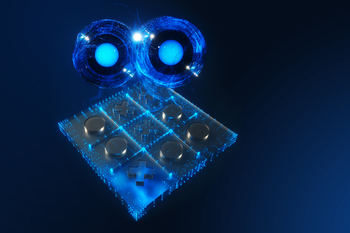
In a lab at Lawrence Livermore National Laboratory, researchers have trained tiny droplets of salt water to recognize handwritten digits and play tic-tac-toe. Their secret? Harnessing the brain-like properties of ion flow in fluid, not electricity in wires.
These droplet-based devices mimic how neurons process information, using lipid-coated water spheres suspended in oil. Unlike conventional silicon chips, they compute with molecules, not electrons, and they remember the past. This strange new platform, described in Science Advances, hints at a future where computing could be soft, wet, and remarkably energy-efficient.
Droplets That Remember
The platform consists of two saltwater droplets, each lined with lipids and placed in oil. When the droplets touch, they form a lipid bilayer—similar to a cell membrane. Electrodes apply voltages to the droplets, and researchers measure the resulting ion currents. But this is not a passive system. The droplets react differently depending on what voltages they experienced earlier. That means they have memory.
“Think about what you had for breakfast,” said LLNL scientist Aleksandr Noy, senior author on the study. “It’s not a lot of energy, but you are able to do pretty sophisticated computing and information processing tasks.”
By delivering sequences of voltage pulses, the team trained the droplets to associate inputs with specific outputs—just like Pavlov’s dogs learning to salivate at the sound of a bell. In their version, a low-voltage pulse came to trigger a high current response after repeated pairings with a high-voltage pulse.
Learning to Play
Next, the team collaborated with researchers at Google and the University of Southern California to try something bolder. Could the droplets not only remember, but also learn? Using a technique called reservoir computing, they input digit images and mapped the resulting currents to correct numerical labels. The system achieved 86.2% accuracy recognizing handwritten numbers from the MNIST dataset—rivaling results from solid-state neuromorphic devices.
The droplets also faced off against a conventional computer in tic-tac-toe. Game states were encoded as voltage strings. After training, the droplets learned to play to a draw, consistently matching the ideal opponent.
“It’s pretty fascinating how such a simple object can perform these functions,” said Zhongwu Li, LLNL postdoc and first author.
Biological Inspiration, Ion by Ion
Instead of simulating neurons with silicon, the team built their system around ionic transport—how the brain actually works. The droplets exhibit behaviors seen in real synapses:
- Paired-pulse facilitation and depression
- Spike-rate–dependent plasticity (learning with frequency)
- Short-term associative memory
- Hebbian learning (“neurons that fire together, wire together”)
With just a single droplet pair, they built a working analog computer. But the architecture is inherently scalable. Networks of droplets could one day process information in parallel, like neurons in the brain.
The Road Ahead for Dropletronics
This form of computing is not ready to replace your laptop. The devices operate at voltages higher than biological neurons, and their memory fades in seconds. But the researchers believe this soft, flexible architecture holds promise for low-power, bio-inspired computing—especially in areas where traditional chips struggle, like interfacing with living tissue.
“I don’t think any of us will be replaced by droplets any time soon,” said Noy. “But it is cool that you can teach a droplet to play a board game.”
Journal: Science Advances
Published: July 23, 2025
DOI: 10.1126/sciadv.adv6603
ScienceBlog.com has no paywalls, no sponsored content, and no agenda beyond getting the science right. Every story here is written to inform, not to impress an advertiser or push a point of view.
Good science journalism takes time — reading the papers, checking the claims, finding researchers who can put findings in context. We do that work because we think it matters.
If you find this site useful, consider supporting it with a donation. Even a few dollars a month helps keep the coverage independent and free for everyone.