

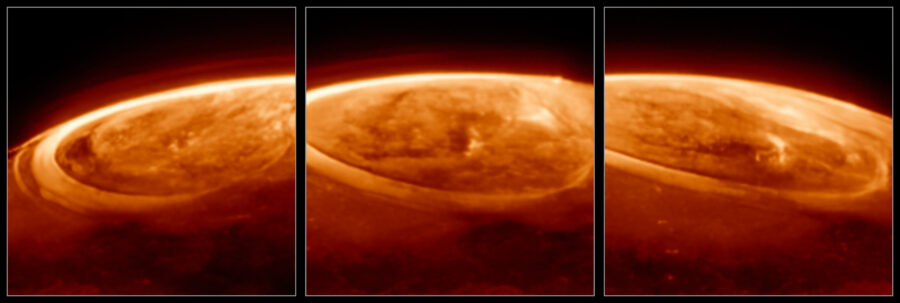
A strange new wave has been found dancing above Jupiter. Using NASA’s Juno spacecraft, University of Minnesota researchers have detected an entirely new type of plasma wave in the planet’s aurora, reshaping how scientists understand planetary magnetospheres.
The finding, published in Physical Review Letters, reveals an unusual plasma environment where the electron plasma frequency is lower than the ion cyclotron frequency. These conditions have never been observed before. This alien aurora discovery not only sheds light on Jupiter’s extreme space weather but may also help researchers better understand how Earth’s magnetic field shields us from solar radiation.
Probing Jupiter’s Polar Sky
Juno, the first spacecraft to orbit Jupiter by passing over both poles, allowed researchers to sample the planet’s northern auroral regions at unprecedented detail. Plasma, the charged gas that fills magnetized space around planets, produces auroras when electrons and ions slam into the atmosphere. On Earth, this becomes the shimmering green and blue northern lights. But Jupiter’s auroras are usually invisible to human eyes and can only be detected with ultraviolet and infrared instruments.
“The James Webb Space Telescope has given us some infrared images of the aurora, but Juno is the first spacecraft in a polar orbit around Jupiter,” said Ali Sulaiman, an assistant professor in the University of Minnesota School of Physics and Astronomy (UMN Physics).
A Plasma Wave Never Seen Before
When researchers analyzed Juno’s data, they found something surprising. At extremely low plasma densities and in Jupiter’s powerful magnetic field, wave behavior did not match what is seen near Earth. Instead, a hybrid plasma wave appeared, showing traits of both Alfvén waves and Langmuir waves. The team has named this new mode the Alfvén-Langmuir wave. Unlike the auroral “donut” pattern seen on Earth, Jupiter’s auroral dynamics allow particles to flood directly into the polar cap, enabling this unique plasma regime.
“While plasma can behave like a fluid, it is also influenced by its own magnetic fields and external fields,” said Robert Lysak, professor of physics at the University of Minnesota (APS PRL).
Implications for Earth and Beyond
Studying Jupiter’s aurora offers more than just planetary science. Plasma physics under extreme conditions can reveal how magnetic fields interact with charged particles across the solar system and beyond. Understanding how these waves grow and interact could help researchers model space weather, which affects Earth’s satellites, power grids, and astronauts. The discovery also suggests that similar plasma regimes might exist on other magnetized planets or even on certain stars.
- Juno’s polar orbit provided rare plasma data over Jupiter’s auroral regions.
- Electron densities as low as 10-3 cm-3 were detected, producing unusual wave conditions.
- The newly identified Alfvén-Langmuir wave bridges known plasma wave behaviors.
- Findings could help improve models of space weather shielding on Earth.
What Comes Next
As Juno continues its extended mission, scientists expect even more data from Jupiter’s poles. Future analysis will help confirm how these plasma waves form, how they interact with energetic particles, and whether they exist in other cosmic environments. For now, this alien aurora stands as a reminder that even in familiar physical systems like magnetized plasmas, new surprises still await discovery.
Journal: Physical Review Letters
DOI: 10.1103/fn63-qmb7